

 Edited By Jeevan D'Souza
Expert Reviewed By Soumen Chatterjee
OnlineMastersColleges.com (OMC) evaluates accredited online master’s programs using a structured methodology designed to help prospective students compare programs based on cost, academic structure, flexibility, and career outcomes.
Rather than relying on institutional reputation or marketing visibility, OMC uses consistent research criteria and verified data to evaluate programs across comparable factors. Individual ranking pages include evaluation summaries explaining how programs align with the criteria outlined in this methodology.
This page explains how programs are selected, evaluated, and ranked across OMC’s rankings and comparison guides.

Key Takeaways: OMC Methodology
Why OMC Rankings Are Trustworthy
- Rankings are based on verified education data and institutional disclosures.
- Programs are evaluated using a consistent, published methodology.
- Editorial independence is maintained — partner relationships do not influence rankings.
OMC Ranking Philosophy
The goal of OMC’s research and rankings is to help prospective graduate students evaluate programs using information that directly affects their educational and career decisions.
Many graduate program lists focus primarily on institutional reputation or marketing visibility. OMC takes a different approach by prioritizing factors that most directly affect the student experience and return on investment.
Our evaluation framework emphasizes:
- Program affordability and total cost
- Academic flexibility for working professionals
- Accreditation and institutional credibility
- Program completion timelines
- Career and learning outcomes
- Availability of student support services
By focusing on these practical factors, OMC aims to provide research tools that help students identify programs that align with their academic goals, financial situation, and professional development plans.
OMC rankings are developed independently using the evaluation framework described on this page. Advertising relationships or partner placements do not influence editorial rankings or program evaluations. No partner relationships influence program inclusion, evaluation scoring, or ranking position.
All programs are evaluated using the same core criteria regardless of institutional relationships.
How OMC Rankings Are Developed
OMC rankings follow a structured research and editorial workflow designed to ensure transparency and consistency.
The ranking process follows a structured sequence:
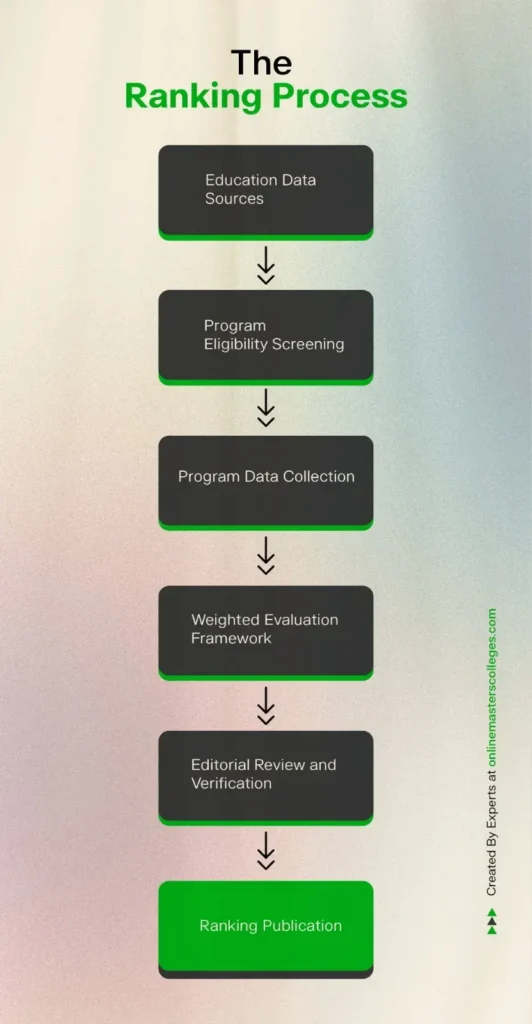
This process allows OMC to combine verified education data with editorial evaluation to produce structured program comparisons. Programs are evaluated using the same criteria regardless of institutional relationships
Institutions cannot pay for inclusion, ranking placement, or scoring advantages within OMC rankings.
Data Sources
OMC uses a combination of public education datasets and institutional disclosures to evaluate graduate programs.
Primary sources include:
Integrated Postsecondary Education Data System (IPEDS)
IPEDS is the primary federal data system for higher education statistics in the United States and provides standardized institutional data including enrollment, graduation rates, and program characteristics.
National Center for Education Statistics (NCES)
NCES provides additional datasets used to verify institutional reporting and educational outcomes.
Institutional Program Disclosures
Universities publish information about program structure, credit requirements, tuition, admissions policies, and academic format. These disclosures are used to confirm program details.
Accreditation Databases
Accreditation status is verified through agencies recognized by the U.S. Department of Education and the Council for Higher Education Accreditation (CHEA).
OMC cross-references multiple sources to improve data accuracy; however, universities may update tuition, program structure, admissions requirements, or other details over time.
Prospective students should verify current program information directly with the institution before making enrollment decisions.
Some data points may vary based on institutional reporting updates, data availability, or differences in how programs disclose information.
Program Eligibility Criteria
Not all graduate programs are included in OMC rankings. Programs must meet specific eligibility standards before they are evaluated.
Programs are generally included if they meet the following criteria:
- Offered by an institution with recognized institutional accreditation
- Available fully online or in hybrid formats, accessible to remote students
- Provide publicly available information about tuition and program structure
- Publish clear curriculum requirements and credit structures
- Maintain active enrollment availability
Programs may be excluded if sufficient program data is unavailable or if accreditation status cannot be verified.
Ranking Criteria and Weighting
OMC evaluates programs using a weighted scoring framework designed to reflect the factors most relevant to prospective graduate students.
| Ranking Factor | Weight |
|---|---|
| Tuition & Affordability | 25% |
| Program Flexibility | 15% |
| Completion Time | 15% |
| Accreditation | 15% |
| Student Outcomes | 15% |
| Faculty & Academic Quality | 10% |
| Student Support Services | 5% |
The weighting system reflects factors that prospective students frequently prioritize when comparing graduate programs, including affordability, flexibility, and completion timelines.
Tuition & Affordability
Total program cost, tuition structure, and financial accessibility are considered when evaluating program affordability.
Program Flexibility
Programs are evaluated based on delivery format, asynchronous coursework availability, and scheduling flexibility for working professionals.
Completion Time
Programs that offer accelerated formats or efficient academic structures may receive higher scores for completion efficiency.
Accreditation
Institutional accreditation status and specialized program accreditation are verified through recognized accrediting agencies.
Student Outcomes
Where available, indicators such as graduation rates and employment outcomes contribute to program evaluation.
Faculty and Academic Quality
Faculty qualifications, research activity, and academic leadership contribute to overall academic quality assessment.
Student Support Services
Programs are evaluated for availability of advising services, career support resources, and student success infrastructure.
How Rankings Are Calculated
OMC rankings are developed using a weighted evaluation model that assigns scores to programs across several evaluation categories.
Each program receives a score for individual evaluation factors such as affordability, flexibility, program structure, and academic quality. These scores are then combined using the weighting system described above to generate an overall program evaluation score.
Scores for each evaluation factor are normalized to allow comparison across programs with different structures and reporting formats. Where applicable, values are scaled into standardized ranges to ensure consistency across evaluation categories.
The combined weighted score reflects a relative comparison of programs within each ranking category rather than an absolute performance measure.
Programs are then reviewed editorially and organized within each ranking guide based on their relative evaluation results.
When programs receive similar overall scores, additional factors such as program structure, data completeness, and consistency across evaluation criteria may be considered to determine final ordering within rankings.
Because ranking pages focus on different student priorities, some guides may emphasize certain evaluation factors more heavily while still following the core methodology framework.
This evaluation approach helps ensure that rankings reflect a consistent and transparent program comparison process.
How Rankings Differ by Category
OMC publishes multiple ranking guides designed to help students evaluate programs based on different priorities.
While the core evaluation framework remains consistent, some rankings emphasize specific criteria more heavily depending on the purpose of the guide.
Editorial review is used to verify accuracy, context, and consistency, not to override the core scoring framework for commercial reasons.
| Ranking Category | Primary Evaluation Focus |
|---|---|
| Best Online Master’s Programs | Overall program quality, structure, and student-relevant evaluation factors |
| Most Affordable Online Master’s Programs | Tuition and total program cost |
| Fastest Online Master’s Programs | Program length and accelerated structures |
| 1-Year Online Master’s Programs | Completion timelines and course pacing |
| Easiest Online Master’s Programs | Admissions accessibility and flexible learning models |
| Self-Paced Online Master’s Programs | Asynchronous delivery and competency-based learning |
This approach allows OMC to align rankings with the specific factors students prioritize when researching graduate programs.
Editorial Review Process
OMC rankings are produced through a multi-step editorial and research process designed to ensure accuracy and consistency.
The process typically includes:
Data Collection
Program information is gathered from federal education databases and institutional disclosures.
Program Evaluation
Programs are analyzed using OMC’s weighted evaluation framework.
Editorial Verification
Editors review program information for accuracy, clarity, and contextual relevance.
Publication
Ranking pages and program comparison guides are published with structured evaluation summaries.
Periodic Updates
OMC periodically reviews ranking pages to ensure program information reflects the most recent available data.
If an institution believes that factual information about a program is inaccurate, it may submit a correction request through the contact information provided on the Site. Correction requests are reviewed based on verifiable evidence and evaluated by OMC’s editorial team. Updates are applied where appropriate to maintain accuracy and consistency.
Accreditation Standards
OMC prioritizes programs offered by institutions with recognized institutional accreditation.
Accreditation indicates that a university meets established standards of academic quality and institutional oversight.
Recognized accrediting bodies include those approved by:
Some graduate programs may also hold specialized accreditation depending on the academic field.
OMC verifies accreditation status when evaluating programs included in rankings.
Continuous Methodology Improvements
Higher education continues to evolve as universities introduce new program structures, learning technologies, and delivery formats.
OMC periodically reviews and updates its research methodology to ensure that evaluation criteria remain aligned with modern graduate education.
Updates may include improvements to evaluation criteria, additional data sources, or enhanced comparison frameworks designed to help prospective students make informed program decisions.
Frequently Asked Questions About OMC Rankings
How does OMC rank online master’s programs?
OnlineMastersColleges ranks programs using a weighted evaluation framework that considers factors such as tuition, program flexibility, completion timelines, accreditation, student outcomes, and academic quality. These factors are combined to create structured program comparisons within each ranking guide.
Are universities able to pay for rankings?
No. Rankings on OnlineMastersColleges are developed independently using research data and editorial evaluation criteria. Institutions cannot influence their position within rankings.
How often are rankings updated?
OMC periodically reviews ranking pages and updates program data when new information becomes available, including changes to tuition, program structure, or institutional reporting.
Conclusion
OnlineMastersColleges.com is designed to help prospective graduate students research and compare accredited online master’s programs using transparent evaluation criteria.
By combining verified education data with structured program evaluation, OMC aims to provide students with transparent comparison tools grounded in consistent research criteria.
The methodology is applied consistently across all ranking pages to ensure comparability and transparency.
Additional Transparency
For additional information about OnlineMastersColleges.com (OMC), how we develop editorial content and operate the website, readers may review the following pages:
- About OnlineMastersColleges.com (OMC): Who OMC is
- Editorial Values: How content is reviewed
- Advertising Disclosure: How OMC makes money
- Terms of Use: Legal terms and site usage
- Privacy Policy: Data collection and user information practices