
- Western Governors University's Snapshot
- Start Here
- What Western Governors University Is Known For
- Business
- Healthcare
- Nursing
- Education
- IT & Data
- Cybersecurity
- Psychology / Counseling
- How Western Governors University Compares
- Western Governors University is
- WGU's Admissions Process
- Tuition
- Frequently Asked Questions
Western Governors University’s Snapshot
17+
Online master’s programs
~$4,530
Per 6-month term
~$9–18k
Typical total cost
CBE
Competency-based learning
Key policies
Institution type
Private, nonprofit
Regional accreditation
NWCCU
Admissions model
Rolling — starts 1st of every month
GRE/GMAT required
Not required
Grading model
Pass/no-pass · No GPA
Notable Programmatic Accreditations
- ACBSP
- CCNE
- CAEP
- CAHIIM
- CACREP

- Edited By Jeevan D'Souza
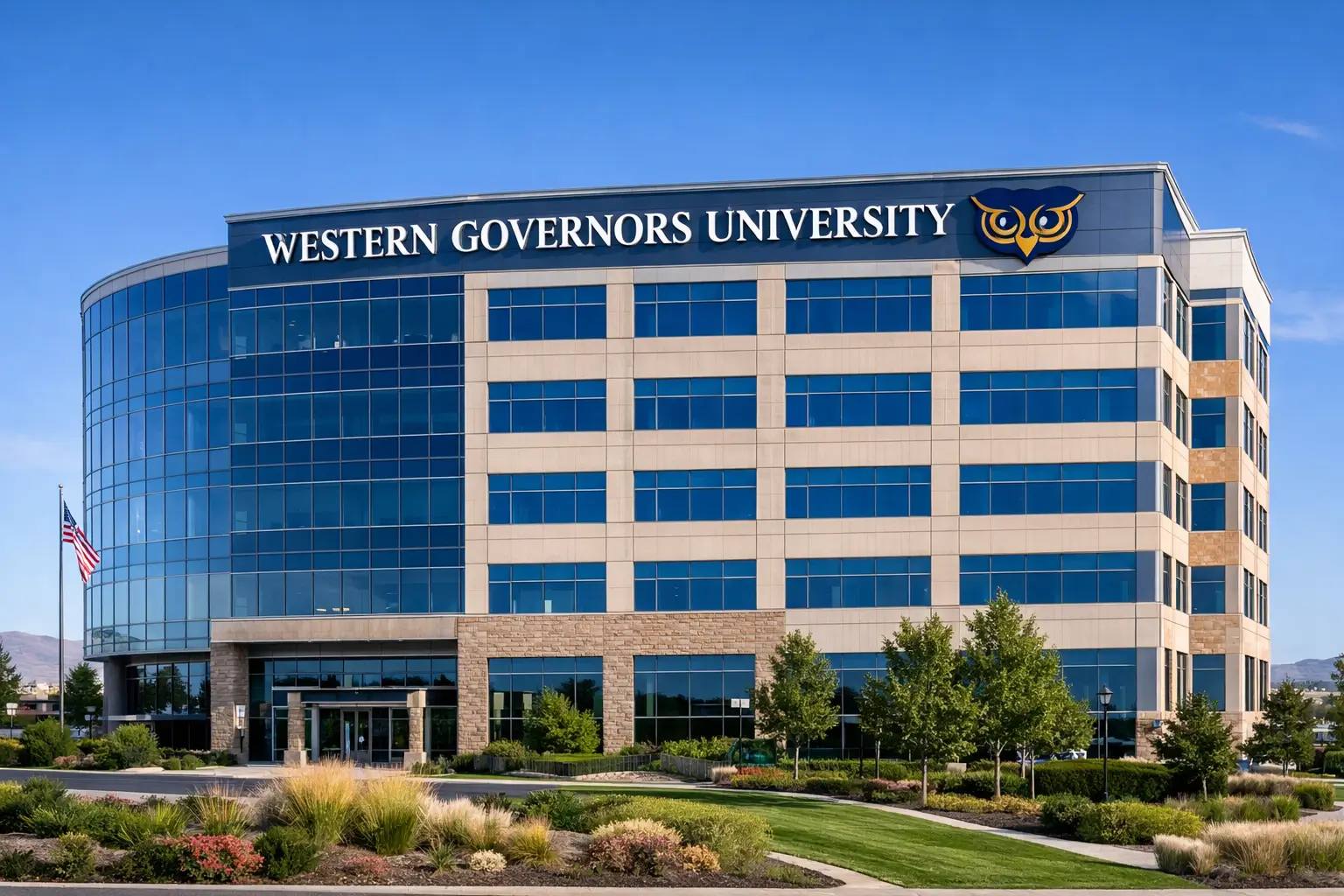
Start Here: Compare WGU by What Matters Most
- Compare learning model → Fully online competency-based education with self-paced progress inside six-month flat-rate terms
- Compare affordability → Most master’s programs cost ~$4,530 per term, with total degree cost heavily dependent on completion speed
- Compare accreditation → NWCCU regional accreditation plus ACBSP, CCNE, CAEP, CAHIIM, and CACREP programmatic credentials
- Compare student fit → Strongest for self-directed working professionals seeking flexible scheduling, acceleration, and career-focused credentials
- Compare alternatives → Southern New Hampshire University, Arizona State University, Purdue University, and University of Maryland Global Campus
Western Governors University (WGU) is a private, nonprofit university founded in 1997 by 19 U.S. governors to expand access to higher education through technology. Today it enrolls over 160,000 students, making it one of the largest universities in the country — and the largest built entirely around online, competency-based education (CBE).
WGU is regionally accredited by the Northwest Commission on Colleges and Universities (NWCCU). It holds programmatic accreditations from ACBSP (business), CCNE (nursing), CAEP (education), CAHIIM (healthcare administration), and CACREP (counseling) — credentials that matter for licensure and employer recognition in those fields.
The defining feature of WGU is its competency-based model. Instead of attending scheduled classes over a 15-week semester, students work through competency units (CUs) at their own pace within six-month terms. You demonstrate mastery through assessments — pass, and you move on, regardless of how long it took. This means a highly motivated student with relevant work experience can complete a master’s degree significantly faster than the standard timeline.
Tuition is charged at a flat rate per six-month term: approximately $4,530 for most programs and $4,795 for nursing programs. There are no per-credit charges. The faster you complete competency units, the fewer terms you pay for — which is where WGU’s cost advantage becomes most dramatic.
WGU has no physical campus in the traditional sense. All instruction, assessment, and student support happen online. Admissions are rolling, with new start dates on the first of every month, and no program requires the GRE or GMAT.
What Western Governors University Is Known For
Competency-based self-pacing that rewards experience.
WGU’s CBE model is not just a scheduling convenience — it fundamentally changes the master’s experience. Instead of sitting through lectures on material you may already know from your career, you demonstrate competency through assessments and move on. For working professionals with years of relevant experience, this can compress a two-year degree into 12–18 months. Each six-month term includes a set of competency units, but there’s no cap on how many you can complete within that term.
Flat-rate tuition that actually gets cheaper when you work harder.
Most online master’s programs charge per credit hour, meaning the total cost is fixed regardless of how quickly you finish. WGU flips this: you pay ~$4,530 per term (or ~$4,795 for nursing), and every additional CU you complete in that term is included at no extra cost. Students who accelerate can finish an entire master’s degree for under $10,000 — a figure that’s nearly unheard of at the graduate level.
Strong programmatic accreditations where they count most.
WGU’s business programs hold ACBSP accreditation, its nursing programs carry CCNE accreditation, education programs are CAEP-accredited, the MHA is CAHIIM-accredited, and the clinical mental health counseling program has CACREP accreditation. These aren’t optional credentials — they’re often prerequisites for licensure, certification, and employer recognition in regulated fields.
Built-in industry certifications in IT and cybersecurity.
WGU’s IT-related master’s programs include preparation for industry certifications like CISSP, CEH, and others as part of the curriculum. You’re not just earning a degree — you’re simultaneously preparing for credentials that hiring managers in cybersecurity and IT management specifically look for.
Consistent graduation outcomes for the online sector.
WGU reports higher-than-average graduation rates relative to other large-scale online institutions, which is notable given its open-access admissions model. The university assigns each student a dedicated program mentor who provides accountability and support throughout the degree — a structural feature designed to counteract the isolation that can undermine self-paced learning.
These five WGU master’s programs stand out based on accreditation strength, career relevance, completion speed, or value:
1. Master of Business Administration (ACBSP-accredited)
WGU’s MBA is one of the most affordable accredited MBAs available anywhere. With ACBSP accreditation and concentrations in Healthcare Management and IT Management, it targets working professionals who want a recognized business credential without the $40,000–$80,000 price tag. Self-motivated students with business experience regularly complete it in two to three terms (~$9,000–$13,500 total). For context on where it fits among accelerated options, see our guide to the easiest online MBA programs . Note that WGU’s MBA carries ACBSP rather than AACSB accreditation — a distinction that matters for certain employers and career paths.
2. Master of Science in Nursing — Family Nurse Practitioner (CCNE-accredited)
The FNP track combines WGU’s cost advantage with CCNE accreditation and preparation for board certification. It requires clinical practicum hours (the one significant in-person component), but the didactic coursework remains self-paced and competency-based. For RNs holding a BSN who want to advance to an NP role, this is one of the most cost-effective pathways available. Prospective students exploring nursing master’s options can compare WGU’s programs with others on our MSN programs hub or the BSN-to-MSN pathway page.
3. Master of Education in Educational Leadership (CAEP-accredited)
This program prepares current educators for principal licensure in many states and carries CAEP accreditation — the standard for education programs nationally. WGU’s flat-rate pricing makes it especially attractive for teachers on limited budgets who want to move into administration. The competency-based format means experienced educators can move quickly through material they’ve already mastered in practice.
4. Master of Science in Cybersecurity and Information Assurance
This program embeds preparation for in-demand certifications (CISSP, CEH, and others) directly into the curriculum. For IT professionals who need both the master’s credential and the industry certifications, WGU collapses two investments into one. The cybersecurity MBA ranking contextualizes where cybersecurity-focused programs fit in the broader landscape.
5. Master of Science in Clinical Mental Health Counseling (CACREP-accredited)
CACREP accreditation is significant — it’s the gold standard for counseling programs and a requirement for licensure in most states. WGU’s program requires practicum and internship hours (in-person), making it a hybrid experience, but the coursework remains competency-based. At WGU’s flat-rate tuition, it’s among the most affordable CACREP-accredited options. Students exploring clinical tracks may also want to review our broader psychology programs hub and clinical psychology specialization page.
WGU offers online master’s programs across six primary subject areas. All programs use the competency-based model with flat-rate tuition, rolling monthly start dates, and no GRE requirement. Programs requiring in-person components (clinical hours or practicum) are noted.
Business
WGU’s business programs carry ACBSP accreditation and cover general management, leadership, and accounting. The MBA offers concentrations in Healthcare Management and IT Management.
- Master of Business Administration (MBA) — ACBSP | ~$4,530/term | Concentrations: Healthcare Management, IT Management
- MS in Management and Leadership — ACBSP | ~$4,530/term
- MS in Accounting — ACBSP | ~$4,530/term | Includes CPA exam preparation pathway
Healthcare
The MHA is accredited by CAHIIM and targets professionals moving into healthcare administration roles. For a broader view of MHA options, see our MHA programs hub.
- Master of Healthcare Administration (MHA) — CAHIIM | ~$4,530/term
Nursing
All nursing programs carry CCNE accreditation. The Leadership/Management and Education tracks are fully online; the NP tracks require clinical practicum hours. All require an active, unencumbered RN license. Explore the full landscape on our MSN programs hub, including RN-to-MSN pathways.
- MSN — Leadership and Management — CCNE | ~$4,795/term | Fully online
- MSN — Nursing Education — CCNE | ~$4,795/term | Fully online
- MSN — Family Nurse Practitioner — CCNE | ~$4,795/term | Requires clinical hours | BSN required
- MSN — Psychiatric Mental Health Nurse Practitioner — CCNE | ~$4,795/term | Requires clinical hours | BSN required
Education
WGU’s education programs are CAEP-accredited and designed for working teachers and administrators. Several lead to licensure or endorsement, depending on your state.
- MEd in Learning and Technology — CAEP | ~$4,530/term
- MEd in Curriculum and Instruction — CAEP | ~$4,530/term
- MEd in Instructional Design — CAEP | ~$4,530/term
- MEd in Educational Leadership — CAEP | ~$4,530/term | Principal licensure preparation
- MA in English Language Learning — CAEP | ~$4,530/term
IT & Data
These programs include embedded industry certification preparation. No programmatic accreditation, but WGU’s IT programs are known for aligning curriculum to employer-valued credentials.
- MS in Data Analytics — ~$4,530/term | Includes certification prep
- MS in IT Management — ~$4,530/term
Cybersecurity
- MS in Cybersecurity and Information Assurance — ~$4,530/term | Includes CISSP, CEH certification prep
Psychology / Counseling
The clinical mental health counseling program holds CACREP accreditation, which is essential for state licensure as a professional counselor. This program requires in-person practicum and internship hours. See our psychology programs hub for the broader field.
- MS in Clinical Mental Health Counseling — CACREP | ~$4,530/term | Requires practicum and internship (in-person)
How Western Governors University Compares
WGU operates on a fundamentally different model than most online universities. Here’s how it stacks up against four commonly compared institutions across the dimensions that matter most for prospective master’s students.
WGU vs. Southern New Hampshire University (SNHU)
Southern New Hampshire University is the closest comparison in terms of scale and accessibility — SNHU enrolls over 170,000 online students. But the models diverge sharply. SNHU uses traditional 8-week terms with structured coursework and letter grades. WGU uses competency-based self-pacing with a pass/no-pass assessment. SNHU charges per credit (roughly $627/credit for graduate programs); WGU charges a flat rate per term. For students who thrive with structure and traditional grading, SNHU is likely the better fit. For self-directed learners who want to accelerate and minimize cost, WGU has a clear advantage.
WGU vs. Liberty University
Liberty University is another large-scale online provider, but it operates as a faith-based institution with traditional online course delivery. Liberty offers a broader range of master’s programs (including many in ministry and divinity), charges per credit, and follows a structured term calendar. WGU is secular, nonprofit, competency-based, and flat-rate. The student experiences are quite different: Liberty’s programs include discussion-board participation and group assignments, while WGU’s assessments are primarily individual. Choose based on whether you value a faith-integrated environment and structured coursework, or secular CBE with self-pacing.
WGU vs. University of Maryland Global Campus (UMGC)
University of Maryland Global Campus targets a similar audience — working adults and military-connected students — but uses traditional 8-week online courses with per-credit pricing. UMGC carries the University of Maryland name, which can carry more weight in certain government and defense-adjacent hiring contexts. WGU’s flat-rate tuition model is typically cheaper overall, especially for fast completers. UMGC offers more traditional transcript formats (letter grades, credit hours), which some employers and doctoral programs prefer over WGU’s pass/no-pass CU-based transcripts.
WGU vs. Arizona State University (ASU)
Arizona State University represents a fundamentally different tier of online education. ASU is a large research university (R1 classification) with traditional online master’s programs delivered through structured coursework, letter grades, and faculty-led instruction. ASU’s brand recognition, research infrastructure, and alumni network far exceed WGU’s. But ASU’s graduate programs typically cost $700–$1,100+ per credit, making a master’s degree $25,000–$50,000+. WGU’s total cost for the same credential can be under $15,000. If employer prestige, research opportunities, or traditional academic credentials matter for your field, ASU is the stronger choice. If cost-effectiveness and speed matter more, WGU wins clearly.
WGU vs. Purdue University (Online)
Like ASU, Purdue University offers online master’s programs backed by a major research university brand. Purdue’s per-credit pricing is higher than WGU’s flat-rate model, but Purdue’s programs include more traditional academic experiences (faculty interaction, cohort elements, letter-graded transcripts). For STEM-adjacent fields or careers where a research-university pedigree matters, Purdue is stronger. For career-focused professionals in business, education, nursing, or IT who prioritize affordability and flexibility, WGU is the more practical option.
Western Governors University is
Best For
WGU’s model isn’t designed for everyone — but for the right student profile, it’s one of the strongest options in online graduate education. WGU is best for:
- Self-motivated learners who work well independently. WGU’s competency-based format has no scheduled class times, no required discussion boards, and no cohort assignments. You set your own pace. This is ideal for disciplined learners who don’t need external structure to stay on track — and frustrating for those who do.
- Working professionals who want to accelerate completion. If you have years of relevant experience in your field, much of the material in a master’s program may already be familiar. WGU lets you demonstrate that competency through assessments and move on, rather than sitting through content you’ve already mastered. Students with strong backgrounds regularly finish in 12–18 months.
- Budget-conscious students who benefit from flat-rate pricing. WGU’s per-term flat rate means the faster you go, the less you pay. A student who completes their master’s in two terms pays roughly $9,060 total. That’s a fraction of what most accredited online master’s programs cost. If cost is your primary constraint, WGU is difficult to beat.
- Career changers or advancers in education, nursing, IT, and business. These are WGU’s strongest program areas, all with relevant programmatic accreditations. Teachers pursuing a principal license, nurses moving into NP roles, IT professionals wanting certifications alongside a degree, and business professionals seeking an affordable MBA — these are WGU’s core audience.
- Students who already have the knowledge and need the credential. WGU is particularly effective for people who’ve learned on the job and need the formal degree to match their actual competence. The CBE model is essentially designed for this scenario.
- Students seeking programs with no GRE requirement . Every WGU master’s program admits without GRE or GMAT scores, and admissions are rolling — you can start the first of any month.
Not a Best Fit For
WGU’s model has real limitations that prospective students should weigh honestly before enrolling.
- If you need structured cohort interaction and peer learning. WGU’s self-paced model means you’re largely working alone. There are no synchronous classes, no required group projects, and no built-in cohort. If you learn best through discussion, collaboration, and peer accountability, WGU’s format will feel isolating. Institutions like Southern New Hampshire University or Arizona State University offer more structured online experiences with cohort elements.
- If you’re targeting competitive industries where institutional prestige matters. WGU’s degree is regionally accredited and widely accepted — but in fields like management consulting, investment banking, or tenure-track academia, hiring managers may weigh a degree from a traditional research university more heavily. For these paths, a program from a Purdue, ASU, or similar institution carries more weight regardless of what you learned.
- If you tend to procrastinate without external deadlines. WGU provides mentors and sets term-level expectations, but day-to-day pacing is entirely self-directed. Students who need weekly deadlines, assignment due dates, and instructor-imposed structure often struggle in CBE environments. If you’ve historically needed external accountability to complete large projects, WGU’s model may work against you.
- If you need a traditional graded transcript. WGU uses a pass/no-pass system. You either demonstrate competency or you don’t — there are no letter grades, no GPA. Some doctoral programs, employers, and credentialing bodies want to see a traditional graded transcript. If you’re planning to apply to a PhD or EdD program, verify whether your target institution accepts competency-based transcripts.
- If you want a research-intensive or thesis-based master’s experience. WGU’s programs are applied and professional, not research-oriented. There are no thesis options, no research assistantships, and no faculty research collaboration. If your career requires a research-focused master’s as a stepping stone to doctoral work or academic research, WGU is not the right institution.
- If your employer has specific concerns about competency-based degrees. While employer acceptance of WGU degrees has grown substantially — particularly in education, healthcare, and IT — some organizations still view CBE degrees with skepticism, especially in industries with less exposure to the model. It’s worth checking whether your current or target employer has a clear position on CBE credentials before enrolling.
- If you want the traditional university experience, even online. Some students value the rhythm of a semester, the relationship with an instructor, the process of receiving feedback on written work, and the experience of being part of a class. WGU intentionally strips all of that out in favor of efficiency. That’s a feature for some students and a loss for others.
WGU’s Admissions Process
WGU’s admissions process is designed for accessibility, not selectivity. Here’s what to expect:
No GRE or GMAT required — for any master’s program. Admissions decisions are based on prior academic credentials and, where applicable, professional prerequisites.
Rolling admissions with monthly start dates. You can begin your program on the first of any month. There are no application deadlines, and you won’t have to wait for a semester to start.
Prerequisites vary by program. All master’s programs require a bachelor’s degree from a regionally accredited institution. Beyond that:
- MSN programs require an active, unencumbered RN license. The NP tracks specifically require a BSN.
- Education programs typically require a current teaching license or equivalent background.
- Business and IT programs have no specific prerequisite beyond a bachelor’s degree.
- The MS in Clinical Mental Health Counseling may require prerequisite coursework in psychology.
Transfer of prior learning. WGU evaluates prior coursework, certifications, and credentials for potential transfer credit (measured in competency units). If you’ve completed relevant graduate coursework elsewhere or hold industry certifications, some of your CU requirements may be reduced.
Application process. Applications are free and submitted online. Expect to provide transcripts and program-specific documentation where required (e.g., RN license verification for nursing programs). Most applicants receive an admissions decision within a few days to two weeks.
The overall bar for admission is low compared to selective institutions — WGU is intentionally open-access. The institution’s philosophy is that the rigor comes from the assessments, not the admissions gate. Students considering how WGU’s financial model works alongside federal aid may find our guide to student loan forgiveness programs useful for planning.
Tuition
WGU’s tuition model is its single biggest differentiator — and it requires a different way of thinking about graduate school costs.
Flat-rate per-term pricing:
- Most master’s programs: ~$4,530 per six-month term
- Nursing master’s programs: ~$4,795 per six-month term
No per-credit charges. Unlike virtually every other accredited university, WGU doesn’t charge by the credit hour or competency unit. You pay for the term, and you can complete as many CUs as you’re able to within that term. This means:
- A student who finishes in 2 terms pays ~$9,060 total.
- A student who takes 4 terms pays ~$18,120.
- A nursing student finishing in 3 terms pays ~$14,385.
For comparison, a typical online master’s program at a traditional university costs $500–$1,000+ per credit hour. A 36-credit program at $700/credit totals $25,200. Even at WGU’s slowest pace, most students pay significantly less.
What’s included in tuition: Course materials, eTextbooks, and access to learning resources are included. Many IT and cybersecurity programs include certification exam vouchers. You don’t pay separately for assessments.
Financial aid eligibility: WGU is approved for federal financial aid (Title IV), including federal student loans, Pell Grants (for eligible undergraduate students), and military/veteran benefits (GI Bill, Yellow Ribbon). WGU also offers institutional scholarships.
The acceleration incentive: WGU’s model creates a direct financial incentive to complete your degree quickly. Every additional CU you finish within a term is effectively free. This means students with relevant work experience and strong study habits can dramatically reduce their total cost, sometimes finishing a master’s degree for less than many institutions charge for a single semester.
The tradeoff: if you’re unable to maintain consistent momentum and end up stretching your program over five or six terms, the cost advantage narrows. WGU’s model rewards speed and discipline.
These OMC rankings provide additional context for evaluating WGU’s programs relative to the broader online master’s landscape:
- Online Master’s Programs with No GRE Requirement — WGU waives the GRE across all programs, making it a natural fit for this list.
- Easiest Online MBA Programs — WGU’s self-paced MBA frequently appears in discussions of accessible, accelerated MBA options.
- Part-Time Online MBA Programs — WGU’s flexible pacing makes it relevant for students balancing work and study.
- AACSB-Accredited Online MBA Programs — WGU’s MBA holds ACBSP rather than AACSB accreditation. This ranking helps students understand the distinction and whether it matters for their goals.
Visit Western Governors University’s official online programs page
Frequently Asked Questions
Yes. WGU is regionally accredited by the Northwest Commission on Colleges and Universities (NWCCU). Regional accreditation is the highest institutional accreditation standard in the U.S. and is the same type held by universities like the University of Washington and Oregon State University. This means WGU credits and degrees are broadly recognized for employment, professional licensure, and transfer to other regionally accredited institutions — though individual institutions and doctoral programs set their own acceptance policies.
Instead of attending scheduled classes and completing weekly assignments over a set number of weeks, you work through competency units (CUs) at your own pace within six-month terms. Each CU has a defined set of competencies you need to demonstrate, assessed through either objective assessments (exams) or performance assessments (papers, projects, case analyses). When you pass the assessment, you’ve earned the CU — regardless of whether it took you two days or two months. You have access to course materials, mentor support, and learning resources, but there are no lectures to attend and no mandatory participation requirements. At the master’s level, assessments tend to emphasize applied analysis, case-based reasoning, and professional application rather than rote memorization.
Broadly, yes — and increasingly so. WGU graduates work across education, healthcare, IT, and business in roles that require recognized master’s credentials. The university’s programmatic accreditations (ACBSP, CCNE, CAEP, CAHIIM, CACREP) carry specific weight in regulated industries. However, employer perception varies by field and organization. In sectors where institutional prestige is a significant hiring factor — top-tier consulting, investment banking, tenure-track academia — a WGU degree may carry less weight than one from a traditional research university. For most applied professional roles, WGU’s degree is accepted and valued, particularly when combined with relevant work experience.
Yes, and this is one of WGU’s core value propositions. There is no minimum pace — you can complete CUs as quickly as you can pass the assessments. Students with significant relevant experience regularly finish master’s programs in 12–18 months (two to three terms). Some finish even faster. The flat-rate tuition model means faster completion, which directly reduces your total cost.
A. You pay a fixed amount (~$4,530 or ~$4,795 for nursing) for each six-month term. Within that term, you can complete as many competency units as you’re able to. If you complete 20 CUs in one term, you pay the same as someone who completes 12. There are no per-credit-hour charges, no fees per assessment, and course materials are included. This model gives self-motivated students a built-in financial incentive to accelerate.
WGU uses a pass/no-pass system. You either demonstrate competency and earn the CU, or you don’t — there are no letter grades and no GPA. Your transcript shows competency units completed and their status. For most employment contexts, this is not an issue. However, some doctoral programs, graduate schools, and credentialing bodies require a traditional GPA or graded transcript. If you’re considering WGU as a stepping stone to a PhD or EdD, verify your target program’s transcript requirements before enrolling.
Yes. The MSN — Family Nurse Practitioner and MSN — Psychiatric Mental Health Nurse Practitioner programs require supervised clinical practicum hours that must be completed in person. The MS in Clinical Mental Health Counseling also requires practicum and internship hours at approved sites. All other WGU master’s programs are fully online with no in-person requirements.
Every WGU student is assigned a Program Mentor — an advisor who stays with you throughout your entire degree. Your mentor contacts you regularly (typically weekly), helps you set goals, monitors your progress, and provides accountability. For individual courses, you also have access to Course Instructors who can answer content questions and help you prepare for assessments. The mentor system is WGU’s primary structural response to the challenge of keeping self-paced students on track.