
- Key Findings From OMC's Employer Tuition Benefits Research
- Download the Full Employer Tuition Benefits Report
- Should You Check Whether Your Employer Pays for Graduate School?
- Companies That Pay for Graduate School
- Explore Employer Graduate Tuition Benefits
- Key Patterns From Employer Tuition Benefits
- Employer Tuition Benefit Distribution
- How to Use This Employer Comparison
- Employer Tuition Benefit Trends by Industry
- Frequently Asked Questions About Companies That Pay for Graduate School
- Methodology and Data Sources

- Edited By Jeevan D'Souza
- Expert Reviewed By Soumen Chatterjee
Employer-sponsored tuition assistance can significantly reduce graduate school costs, but employer programs vary widely in coverage, benefit amount, eligibility, and source transparency. OMC reviewed education benefit policies across major U.S. employers to identify companies with verified graduate tuition benefits, evaluate programs supported by credible but incomplete public evidence, and document prominent employers whose current education benefits do not appear to cover graduate study. This resource focuses specifically on graduate education and compares benefit amounts, eligibility requirements, service commitments, payment structures, and source confidence.
If you’re new to employer tuition reimbursement, start with our Employer Tuition Reimbursement for Graduate School guide, which explains how these programs work, how IRS tax rules apply, and how to estimate your potential employer benefit before using the employer comparison data below.
Key Findings From OMC’s Employer Tuition Benefits Research
OMC reviewed publicly available education benefit information across major U.S. employers and classified each employer based on the strength of evidence for graduate-level coverage. The findings below are based on OMC’s verified graduate-benefit dataset and summarize the most significant patterns identified in benefit amounts, eligibility requirements, and employer funding models.
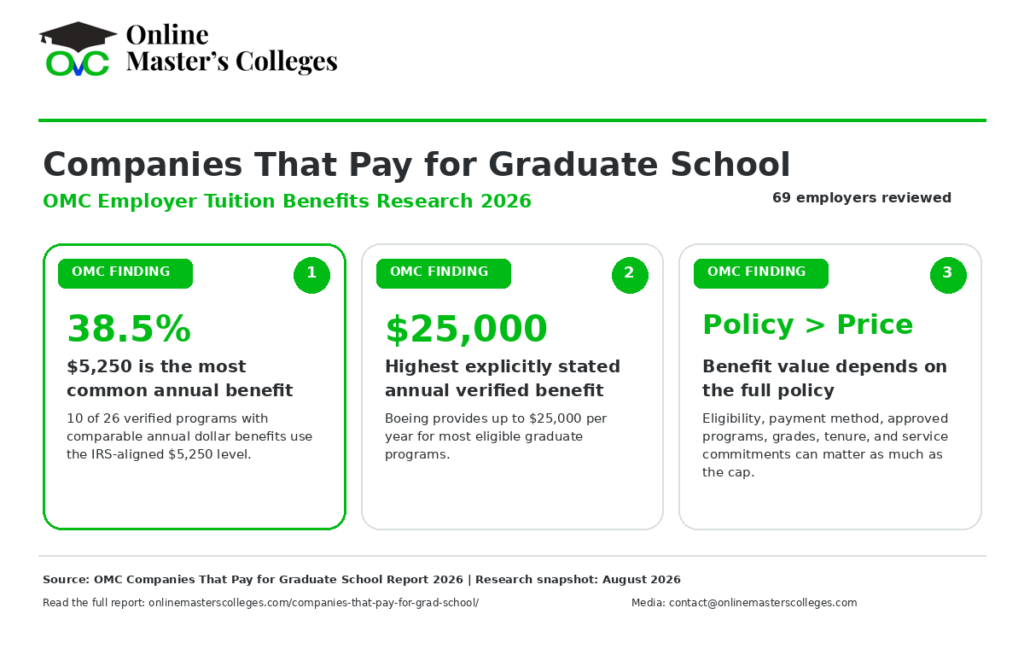
OMC Research Finding #1
38.5% of Comparable Verified Employer Benefits Are Set at $5,250 Per Year
Among the 26 verified employer programs with a comparable annual dollar benefit, 10 provide $5,250 per year, making it the single most common annual benefit amount identified in OMC’s verified dataset. The amount aligns with the current IRS Section 127 tax-free educational assistance limit, illustrating how federal tax policy continues to influence employer education benefit design.
OMC Research Finding #2
Verified Employer Graduate Benefits Reach $25,000 Per Year
Among employers with graduate tuition benefits verified through first-party sources, annual benefit levels vary considerably. Boeing provides up to $25,000 per year for most eligible graduate programs, representing the highest explicitly stated annual graduate benefit identified in OMC’s verified dataset. Other verified employers provide enhanced benefits above the common $5,250 level, demonstrating that the federal tax-free threshold does not function as a ceiling on employer education support.
OMC Research Finding #3
Employer Benefit Value Depends on More Than Reimbursement Amount
OMC’s research found that reimbursement amount alone rarely determines the overall value of an employer tuition benefit. Eligibility requirements, employment tenure, minimum grade standards, approved degree programs, payment method, and post-graduation service commitments vary considerably between employers. Employees comparing graduate tuition benefits should evaluate the complete policy rather than focusing solely on the maximum annual reimbursement.
Download the Full Employer Tuition Benefits Report
Download the complete Companies That Pay for Graduate School Report, including OMC’s review of education benefits across 69 major U.S. employers, verified graduate tuition benefit comparisons, benefit structures and eligibility requirements, source-confidence classifications, industry observations, methodology documentation, and source notes.
The downloadable report distinguishes between employers with Verified graduate benefits, employers with Corroborated graduate-benefit information, and employers where graduate coverage could not be confirmed or was found to be undergraduate-focused. This distinction allows readers to evaluate both the benefit information and the strength of the evidence supporting it.
The report includes:
- Education benefit research across 69 major employers
- Verified graduate tuition benefit comparisons
- Annual benefit amounts and benefit structures
- Eligibility requirements and key restrictions
- Source-confidence classifications
- Employer benefit observations by industry
- OMC research findings and data visualizations
- Methodology, source documentation, and research limitations
Should You Check Whether Your Employer Pays for Graduate School?
Not every employee has access to graduate tuition assistance, but many people overlook benefits they already have. Use the quick guide below to determine whether it’s worth reviewing your employer’s education policy before exploring the company comparison table.
| Your Situation | Recommendation |
|---|---|
| You work full-time at a large employer | ✅ Check your benefits immediately |
| You’re considering changing employers while planning graduate school | ✅ Compare tuition benefits before accepting an offer |
| Your employer already advertises education benefits | ✅ Verify whether graduate degrees are included |
| You only know about undergraduate tuition programs | 💡 Review the policy carefully—graduate benefits often differ |
| Your employer has no formal tuition reimbursement program | ⚠️ Consider negotiating education assistance or combining scholarships and federal aid |
| You’re self-employed or work for a very small employer | 💡 This page may still help identify employers with strong education benefits if you’re considering a career move |
Employer tuition assistance policies vary significantly. Some companies reimburse graduate tuition after each completed course, others pay institutions directly through education partners, and many impose annual reimbursement caps, minimum grade requirements, or post-graduation service commitments. The employer profiles below summarize these differences so you can quickly identify whether your organization—or a prospective employer—offers graduate education support.
Companies That Pay for Graduate School
OMC reviewed education benefit policies across 69 major U.S. employers to evaluate whether and how they support graduate education. The comparison below includes employers with verified graduate tuition benefits, employers whose graduate benefits are supported by credible but incomplete public documentation, and major employers where graduate coverage could not be confirmed or was found to be limited to undergraduate education.
Graduate tuition benefits change periodically, and employers may update reimbursement amounts, eligibility requirements, approved programs, or service commitments. Unless otherwise noted, the information below reflects employer policies reviewed and verified by OMC during August 2026.
For complete policy details, always review the employer’s official education benefits documentation before enrolling in a graduate program.
Verified Graduate Tuition Benefits
The employers below have graduate education benefits supported by official employer documentation, employer-authorized benefit materials, or other first-party sources reviewed by OMC. These employers form the primary dataset used in OMC’s quantitative analysis.
Corroborated Graduate Tuition Benefits
The employers below have graduate tuition benefits supported by credible and consistent public sources, but OMC could not locate current first-party documentation confirming all material program details. These employers are included for reference and should be independently verified with the employer before making enrollment or employment decisions.
Graduate Benefits Not Confirmed or Undergraduate Only
OMC also reviewed major employers frequently associated with tuition assistance where current graduate-level coverage could not be independently verified, available sources were conflicting, or the publicly documented education benefit was primarily limited to undergraduate programs. These employers are retained in the research for transparency but are excluded from OMC’s quantitative graduate-benefit analysis.
| Employer | Graduate Benefit | Benefit Type | Eligibility / Restrictions | Industry | Source Confidence | Official Source |
|---|---|---|---|---|---|---|
| 3M | Tuition reimbursement confirmed as an official benefit on 3M’s own careers site, but No specific dollar figure is published | Tuition reimbursement | Listed among 3M’s benefits alongside adoption assistance and flexible work arrangements on 3M’s own official careers/benefits page | Diversified Manufacturing | Not Confirmed | View Source |
| Adobe | Up to $10,000/year (Learning Fund) for tuition and books toward courses, GRADUATE PROGRAMS, and certain certifications — explicitly includes graduate, PhD, and MBA degree programs. A Separate one-time $10,000 ‘Graduate Education Reimbursement’ also exists for new hires who completed a degree within 12 months prior to their hire date | Tuition reimbursement | Confirmed via multiple official Adobe benefits pages and an official policy document. Amounts above the $5,250 IRS Section 127 exclusion are taxable. Unused benefit does not carry forward year to year | Technology | Verified | View Source |
| Amazon | Graduate degrees are not covered under the cited Career Choice program | Undergraduate-only education benefit | Undergraduate only. 90-day employment wait. Hourly (‘blue badge’) employees; being expanded to some salaried Level 4+ per 2025 reporting | E-commerce & Technology | Undergraduate Only | View Source |
| American Express | Tuition reimbursement is widely and consistently reported across many independent benefit-tracking sites at up to $7,500/year for graduate degrees, but No americanexpress.com or aexp.com page confirming this was found in this research pass | Tuition reimbursement | Financial Services | Corroborated | No primary source found | |
| Apple | Up to $5,250/year (same flat cap for grad and undergrad; program existence confirmed on Apple’s own site, exact figure corroborated by extensive, consistent secondary reporting) | Education benefit / structure varies | Education Reimbursement program via Bright Horizons EdAssist. Coursework must be job-related. Requires ~6 months tenure. Separate UMass Global direct-pay partnership available up to the same cap | Technology | Corroborated | View Supporting Source |
| Aristocrat Gaming / Aristocrat Technologies | Current official benefits materials reviewed did not list tuition reimbursement | Tuition reimbursement | Some older/unofficial sources (Glassdoor reviews, one of which appears to actually describe a different company, ‘Apple Cinemas’) mention tuition reimbursement, but this is Not corroborated by Aristocrat’s own current benefits guide | Gaming Technology | Not Confirmed | View Source |
| Bank of America | Up to $7,500/year — applies equally to graduate and undergraduate coursework (no separate, higher grad tier). MBA is not explicitly named as covered on the primary source; confirm directly with BofA before publishing as MBA-eligible | Education benefit / structure varies | Tuition Assistance Program. No lifetime maximum; resets annually | Banking & Financial Services | Verified | View Source |
| Best Buy | Up to $5,250/year for graduate-level coursework related to the employee’s current role | Education benefit / structure varies | Tuition Assistance Program (TAP). Full-time employees only, after 6 months of continuous service. Coursework must be job-related. Separate Degrees@Work (Strayer) fully-funded pathway for undergrad exists | Retail | Verified | View Source |
| Boeing | Up to $25,000/year for most graduate degree programs; No annual cap for eligible STEM graduate degrees/certificates at partner schools | Education benefit / structure varies | Learning Together Program (LTP). Eligible from hire date. Boeing pays partner school directly (no reimbursement wait). ~300 partner schools. Amounts above the $5,250 IRS Section 127 exclusion may be taxable depending on job-relatedness | Aerospace & Defense | Verified | View Source |
| Capital One | Up to $5,250/year (grad coursework requires a ‘B’ or better; same pool as undergrad) | Education benefit / structure varies | Educational Assistance Program, administered by EdAssist. Eligible on date of hire for full- and part-time associates. Prepaid model (upfront allowance), not pure reimbursement | Banking & Financial Services | Verified | View Source |
| Chevron | 75% reimbursement of tuition for job-related/career-development coursework, confirmed usable for an MBA per multiple independent employee reports. Exact annual dollar cap not found in primary sourcing (U.S. HR Policy 125 – Educational Assistance) | Tuition reimbursement | Active-employee program is U.S. HR Policy 125. A Separate, better-documented program (SESP Educational Assistance) exists only for departing/laid-off employees receiving severance: 75% reimbursement up to $5,000 total for post-Chevron job transition coursework | Energy / Oil & Gas | Corroborated | View Supporting Source |
| Chipotle | Up to $5,250/year for master’s degrees in the Guild catalog (select programs may be fully funded under Tier 1) | Fully funded / partner program | Cultivate Education Program, administered via Guild. Available to full- and part-time crew after ~120 days at 15+ hrs/week | Restaurants & Food Service | Verified | View Source |
| Cisco Systems | $10,000/year for graduate coursework per numerous consistent, independent employee reports spanning many years (2015-2026); requires a ‘B’ or higher average grade | Education benefit / structure varies | No cisco.com primary source with these figures was found, but the $7,500/$10,000 split is repeated consistently and specifically across many independent employee reviews over a decade, which is a meaningfully stronger signal than a single aggregator listing. Benefit is reportedly funded out of each business unit’s budget, so approval can vary by team | Networking & Technology | Corroborated | No primary source found |
| Comcast NBCUniversal | Up to $8,000/year for graduate programs (associate/bachelor’s/master’s/doctorate all eligible per company-authorized partner-school pages) | Education benefit / structure varies | Education Assistance Program, administered by EdAssist. Full-time employees eligible from day one. Comcast does not publish full policy details externally — dollar figures corroborated via Comcast’s own authorized partner-school pages (Champlain College, UAGC), not stated directly on jobs.comcast.com | Media & Telecommunications | Corroborated | Supporting Source 1 · Supporting Source 2 |
| CVS Health | Up to $3,000/year for job-related degree programs (undergraduate or graduate); $1,500/year for non-degree programs. $0 out-of-pocket available at direct-pay partner schools (Capella, Strayer, CTU, University of Phoenix) | Direct pay / partner program | Tuition Assistance Program, effective 9/1/2024, administered via Bright Horizons EdAssist. Full-time colleagues eligible first of the month after hire date; part-time after 90 days. Separate PharmD Tuition Assistance Program offers up to $20,000/year for pharmacy interns specifically — a much larger, narrower benefit | Healthcare | Verified | View Source |
| Deloitte | 100% tuition reimbursement — but only for a small, competitively-selected cohort of consultants attending top-ranked MBA programs. Not an open-access benefit for the general employee population | Selective sponsorship / fully funded | Requires 2+ years of tenure and a competitive nomination/application before enrolling; participants must return to Deloitte for 2 years post-graduation or repay; participants leave Deloitte to attend school full-time and return as Senior Consultants | Professional Services / Consulting | Verified | View Source |
| Discover Financial Services | Confirmed to cover graduate degrees via the company’s own ‘Education Assistance Program’ (explicitly named alongside Associate’s and Bachelor’s degrees in Discover’s own press release), separate from the fully-funded undergraduate-only ‘Discover College Commitment.’ Exact annual dollar cap not found in primary sourcing | Tuition assistance | Discover also runs a distinctive ON-SITE MBA PROGRAM in partnership with Lake Forest Graduate School of Management for select employees, and a Leadership Education Advancement Program (LEAP) combining a bachelor’s degree with leadership development — both notable differentiators | Banking & Financial Services | Verified | View Source |
| Disney (Disney Aspire) | New graduate enrollment closed Sept. 5, 2024; employees already enrolled may continue under updated capped terms | Grandfathered graduate benefit | Grandfathered / closed to new graduate enrollment. Disney Aspire, administered via Guild since 2018. This is a RECENT (late 2024) and significant downgrade from the program’s original 100%-coverage, unlimited-master’s design — a major currency risk if cited using older, pre-2024 sources | Media & Entertainment | Not Open to New Graduate Enrollment | Source 1 · Source 2 |
| EY (USA) | Existence of multiple education benefit tracks is well documented, but no ey.com primary source with a specific dollar figure for standard tuition reimbursement was found | Tuition reimbursement | EY offers a notable, distinctive program: ‘EY Tech MBA by Hult’ — a free, fully-sponsored corporate MBA described as universally accessible to EY’s global workforce (unlike competitor programs that select a small cohort). Separate business-unit-funded MBA sponsorship and standard Section 127 tuition reimbursement also reportedly exist | Professional Services / Accounting | Corroborated | No primary source found |
| FedEx | Up to $5,250/year, no lifetime maximum. Primary source does not explicitly exclude graduate coursework (unlike Amazon/Walmart); partner-school pages (Rasmussen, RMU) show graduate and even doctoral programs being used with the benefit | Education benefit / structure varies | Available first day of employment for some populations, 90 days for others (varies by operating company: FedEx Ground vs. Express). Reimbursement model | Transportation & Logistics | Corroborated | View Supporting Source |
| Fidelity Investments | Up to $5,250/year for master’s degrees within the Guild catalog. Doctoral degrees Not covered | Education benefit / structure varies | Administered through Guild Education. No requirement to stay at Fidelity after completing a degree | Financial Services | Verified | View Source |
| Ford Motor Company (UAW-represented ETAP) | Up to $8,000/year total (GED through PhD); up to $4,000 of that can go to work-related Personal Development Assistance coursework instead | Education benefit / structure varies | Education Development & Training Program (EDTP) / Employee Tuition Assistance Program (ETAP), a UNION-NEGOTIATED benefit for UAW-represented HOURLY employees only. Not Ford’s general salaried-employee benefit. Voucher/prepayment system via ONTAAS, not standard reimbursement. Separate Guild Education partnership (up to $6,000/yr) exists for other Ford employee populations | Automotive & Manufacturing | Verified | View Source |
| General Motors (GM) | Up to $8,000/year for graduate/postgraduate degree programs (Salaried Tuition Assistance Program, STAP). Confirmed used for a master’s degree per an official GM employee story | Tuition assistance | GM University / STAP. No time/service commitment required after use, per GM’s own careers site | Automotive & Manufacturing | Verified | View Source |
| Google / Alphabet | Graduate tuition benefit amount and current eligibility could not be verified from public first-party sources | Education benefit / structure varies | Google states informally (via secondary reporting) that MBA-track reimbursement exists with manager approval, but funding limits and eligibility are described as ‘not publicly disclosed.’ | Technology | Not Confirmed | No primary source found |
| HCA Healthcare | Up to $5,250/year in tax-free reimbursement for eligible higher education expenses, confirmed on HCA’s own official careers benefits page. Confirmed usable for an MBA via an official HealthTrust (an HCA-affiliated organization) employee story | Tuition reimbursement | Administered via Bright Horizons EdAssist. HCA also owns Galen College of Nursing, offering a separate zero-out-of-pocket RN-to-BSN pathway for HCA employees combining a Galen tuition grant with the standard $5,250 benefit, a notable differentiator for nursing-track employees specifically (less relevant to OMC’s general grad-degree audience) | Healthcare | Verified | View Source |
| HCLTech (USA) | Not a traditional dollar-cap reimbursement. Full-time US employees receive a 14% TUITION DISCOUNT (not reimbursement) on graduate degree programs at Purdue Global, a named academic partner | Partner tuition discount | Announced via HCLTech’s own press release (Purdue Global partnership). A separate, more generous track exists for HCLTech’s Apprenticeship Program participants (non-degreed high school graduates), who receive 100% tuition-paid UNDERGRADUATE degrees at Purdue Global via the Advantage Tuition Gran but that track is undergraduate/apprentice-only, not open to general full-time employees pursuing a master’s | IT Services & Consulting | Verified | View Source |
| IBM | IBM historically offered tuition reimbursement, but current graduate benefit terms were not confirmed in this research pass | Tuition reimbursement | IBM’s own corporate history page documents the program’s 1958 origin and describes it as covering ‘degrees of any kind.’ A separate, formal IBM PhD Fellowship program (external, for current PhD students, not IBM employees) offers $40,000/year in the US | Technology & IT Services | Not Confirmed | View Source |
| IGT (International Game Technology) | Tuition reimbursement is publicly listed as a benefit, but graduate eligibility and the dollar amount were not confirmed | Tuition reimbursement | Confirmed via numerous official IGT job postings (jobs.igt.com) across many roles and locations (Reno, Las Vegas, etc.), plus IGT’s own 2018 sustainability report referencing the U.S. program. Amount not disclosed in any public IGT document found | Gaming Technology | Not Confirmed | View Source |
| Intel | Up to $50,000 PER DEGREE PROGRAM (no stated annual limit) for graduate-level BUSINESS programs specifically. Other eligible programs: up to 100% of tuition, gated on a ‘successful or better’ job-performance rating | Education benefit / structure varies | Tuition Assistance Program (TAP), administered by GP Worldwide | Semiconductors & Technology | Corroborated | View Supporting Source |
| Johnson & Johnson | A distinct employee graduate tuition reimbursement program could not be confirmed from the official benefits materials reviewed | Tuition reimbursement | Healthcare / Pharmaceuticals & Medical Devices | Not Confirmed | View Source | |
| JPMorgan Chase | Up to $7,500/year for master’s degrees, certificates, and certifications in the Guild catalog (same cap for approved non-catalog programs) | Education benefit / structure varies | Administered via Guild. Includes a distinctive Dalton CFP(R)/Mark Meldrum CFA(R) finance-certification pathway | Banking & Financial Services | Verified | View Source |
| Kaiser Permanente | Up to $3,000/year (National Tuition Reimbursement) for completing courses toward a degree or certificate — explicitly confirmed usable for BOTH bachelor’s and master’s degrees via multiple named-employee stories on Kaiser’s own official channels (one employee earned both a bachelor’s and MBA online using the benefit) | Tuition reimbursement | Available to employees working 20+ hrs/week. For union-represented staff, additional benefits exist through Labor Management Partnership trusts (e.g., Ben Hudnall Memorial Trust, SEIU UHW-West Education Fund) that can layer on top of the $3,000 national benefit — coordination varies and should be confirmed with the specific trust | Healthcare | Verified | Source 1 · Source 2 |
| KPMG (USA) | Graduate reimbursement figures are reported by secondary sources but were not confirmed by a current KPMG first-party source | Education benefit / structure varies | Professional Services / Accounting | Not Confirmed | No primary source found | |
| Light & Wonder | 80% reimbursement of tuition/registration/books/lab/test fees, up to $5,250/year, lifetime cap of $15,750. Explicitly covers ‘undergraduate or graduate degree program.’ | Tuition reimbursement | Official Tuition Reimbursement Policy, effective April 2025. Full-time (30+ hrs/week) employees only, with 6 months continuous service and no discipline in prior 6 months. Requires a ‘B’ or better grade. Must stay employed 1 year after reimbursement or repay a pro-rated amount. Does Not apply to union-represented employees unless separately negotiated | Gaming Technology | Verified | View Source |
| Lockheed Martin | Up to $10,000/year for graduate coursework (including doctoral programs), administered through Bright Horizons EdAssist. No direct lockheedmartin.com page with this figure was found, but it is extremely consistently corroborated across many independent sources, and Lockheed Martin’s EdAssist partnership is independently confirmed by partner-school pages (e.g., Worcester Polytechnic Institute’s own corporate partnership page) | Education benefit / structure varies | Requires job-related coursework, minimum grades (commonly C+ for undergrad, B+ for grad), and roughly a 1-year post-completion service expectation per secondary reports. Partner schools with added discounts include WPI, Stevens Institute of Technology, and Rowan University | Aerospace & Defense | Corroborated | View Supporting Source |
| Lowe’s | Up to $2,500/year for master’s degrees explicitly listed in the Guild catalog | Education benefit / structure varies | Administered via Guild since 2022. One year of employment required for the $2,500 reimbursement track (debt-free catalog may have different eligibility). Separate Track to the Trades pre-apprenticeship program (100% funded) for skilled trades, not degree-relevant to OMC | Retail / Home Improvement | Verified | View Source |
| Marriott International | Tuition Reimbursement confirmed on Marriott’s own official 2025 benefits guide as an associate benefit, but Marriott does Not publicly disclose a specific dollar cap — amounts and rules reportedly vary by property, role, and geography. Independent reports range from $1,500/yr to $5,250/yr | Tuition reimbursement | Separate Marriott Scholars Program exists (undergraduate-only, up to $9,000/yr for 4 years) and a Student Debt Repayment Program (SDRP) | Hospitality | Not Confirmed | View Source |
| McDonald’s ”Franchise employees | Up to $2,500/year; primary source explicitly lists ‘graduate or post-graduate school’ as an approved school type | Education benefit / structure varies | Tuition Assistance track of Archways to Opportunity. Requires ~90 cumulative days with the same franchise owner/operator. Not limited to McDonald’s-branded partner schools — any accredited institution qualifies | Restaurants & Food Service | Verified | View Source |
| McDonald’s McOpCo employees | Up to $5,250/year (based on documented case of two McOpCo employees who received $5,250/yr and later pursued an MBA); same ‘graduate or post-graduate school’ eligibility as the franchise tier | Education benefit / structure varies | McDonald’s-owned-and-operated (McOpCo) restaurant employees receive a higher tier than franchise employees under the same Archways to Opportunity program | Restaurants & Food Service | Corroborated | View Supporting Source |
| Meta (Facebook) | A current graduate tuition reimbursement program could not be confirmed; public sources conflict | Tuition reimbursement | Technology | Not Confirmed | View Source | |
| Microsoft | Up to $10,000/year for graduate coursework, OR $10,000/year for a combination of undergrad+grad (Corporate employees). Retail employees: $5,250/year for either level | Education benefit / structure varies | Tuition Assistance Program, administered by EdAssist. Must be job-related; manager approval required each term; must be active employee at time of reimbursement | Technology | Verified | View Source |
| Nike, Inc | Up to $5,250/year for full-time Retail Associates specifically, confirmed via numerous current official careers.nike.com job postings. Corporate-employee tier not found in this research pass — may differ | Education benefit / structure varies | Separate ‘Lane Four’ program (partnership with University of Memphis) exists specifically for U.S. distribution center and Air MI employees, with direct tuition billing to Nike (no out-of-pocket cost) and 24/7 tutoring — notable, but distinct from the general Retail Associate tuition benefit | Consumer Products / Apparel | Corroborated | View Supporting Source |
| Northwestern Mutual | Tuition assistance (‘Educational reimbursement’) confirmed on Northwestern Mutual’s own careers site as an official benefit, but WITHOUT a stated dollar amount. Multiple independent Glassdoor employee reviews consistently cite a $5,250/year cap; one third-party site (not Northwestern Mutual’s own) additionally cites a $52,500 career lifetime maximum — this lifetime figure is less certain and single-sourced | Tuition reimbursement | Listed as ‘Educational reimbursement’ among Northwestern Mutual’s official benefits | Insurance & Financial Services | Corroborated | View Supporting Source |
| Oracle | Up to $5,250/year; requires a ‘B-‘ or better grade; must be approved by manager as job-related | Education benefit / structure varies | Reimbursement model (pay upfront, submit for reimbursement). Regular full-time employees only | Technology | Verified | View Source |
| PepsiCo | Up to $8,000/year for graduate degrees (traditional reimbursement track) | Tuition reimbursement | MyEducation program, administered via Guild since 2022. Covers Frito-Lay, PepsiCo Beverages, and Quaker business units. Reimbursement model: pay upfront, submit documentation after grade posts | Food & Beverage | Verified | View Source |
| Pfizer | Confirmed to cover graduate degrees, explicitly including MBA and MPH programs, per Pfizer’s own official program documentation. Exact annual dollar cap Not publicly disclosed by Pfizer; one recent (unverified) employee review cites a ‘$10K tuition benefit.’ | Education benefit / structure varies | Education Assistance Program, administered via Bright Horizons EdAssist. University discount partnerships exist separately (Brandeis University: 20% reduction on online Graduate Professional Studies programs including an M.S. in Bioinformatics; Stevens Institute of Technology: discount for part-time study; Worcester Polytechnic Institute: 10% discount) | Pharmaceuticals | Verified | View Source |
| Progressive Corporation | Tuition assistance is confirmed, but graduate eligibility and the current reimbursement amount were not clearly disclosed | Tuition reimbursement | Insurance | Not Confirmed | View Source | |
| Publix Super Markets | Reimburses tuition for a graduate program, BUT only for corporate/non-retail roles where a graduate degree meets ‘a corporate need or satisfies a required or preferred qualification’ for the employee’s career path. Publix’s own page states retail positions currently do Not qualify. Exact dollar cap not extracted from the primary page; secondary sources cite a $16,900 lifetime limit for graduate study (unverified exact figure) | Tuition reimbursement | Tuition Reimbursement program. 90 days of service, average 10 hrs/week required. Graduate participants must sign a repayment agreement committing to work for Publix during participation and 2 years after final reimbursement | Grocery Retail | Verified | View Source |
| PwC (USA) | CONFLICTING. One employee (Fishbowl) reports tuition reimbursement ‘capped at $10K/year for Advisory/Consulting staff’ and a competitive MBA sponsorship program; a separate Glassdoor review states PwC does ‘not reimburse for getting a degree (i.e. graduate school).’ No pwc.com page confirming either was found | Tuition reimbursement | A distinct, confirmed program exists: the ‘While You Work – CPA Acceleration Program’ with Northeastern University, where PwC pays directly for an online master’s degree toward the 150-credit CPA requirement — this is a real, specific offering, separate from any general tuition reimbursement claim | Professional Services / Accounting | Corroborated | No primary source found |
| Qualcomm | Up to $10,125/year for graduate and postgraduate degree-related courses (100% reimbursed for A/B grades, 50% for C grades). Undergraduate/certificate/associate: up to $5,250/year under the same grading scale | Tuition reimbursement | Confirmed to exist via Qualcomm’s own 2024 Corporate Responsibility Report (‘tuition reimbursement and more’). The specific dollar figures are not shown in that document but are extremely consistently corroborated across many independent secondary sources using near-identical language, suggesting they trace back to Qualcomm’s own internal benefits page | Semiconductors & Technology | Corroborated | View Supporting Source |
| Salesforce | Up to $5,250/year, 100% reimbursement of fees, tuition, and books for pre-approved, job-related courses at an accredited academic institution. Does not explicitly exclude graduate coursework | Tuition reimbursement | Education Reimbursement Program, confirmed on Salesforce’s own official benefits site. Complements Salesforce’s separate free Trailhead certification platform | Technology | Corroborated | View Supporting Source |
| Sandisk | Graduate tuition reimbursement could not be confirmed from the official benefits materials reviewed | Tuition reimbursement | Data Storage & Technology | Not Confirmed | View Source | |
| Siemens (USA) | Tuition reimbursement confirmed to exist as an official benefit via numerous current Siemens job postings, but No specific dollar figure is published by Siemens itself. Multiple independent employee reports (including at Siemens Healthineers) consistently cite the standard $5,250/year IRS-exclusion cap, but this is not Siemens’ own stated figure | Tuition reimbursement | Referenced across many current jobs.siemens.com postings as ‘Tuition Reimbursement program.’ Benefits also documented via a separate portal, benefitsquickstart.com/siemens | Industrial Technology & Manufacturing | Corroborated | View Supporting Source |
| Southwest Airlines | GENUINELY CONFLICTING. An unofficial mirror site (not southwest.com) claims $5,000/yr for full-time employees, but Southwest’s own JobzMall FAQ page states explicitly in one place ‘No, Southwest Airlines does not offer tuition reimbursement,’ and a Glassdoor employee review independently confirms ‘No tuition reimbursement.’ Other secondary sources (Built In, a separate JobzMall FAQ) claim the opposite | Tuition reimbursement | A University of Dallas partner-school page confirms Southwest Airlines employees ARE eligible for a 20% tuition discount scholarship on MBA/MS programs — this specific partnership discount is real and separate from any general reimbursement claim | Airlines / Transportation | Corroborated | No primary source found |
| Starbucks | The cited Starbucks College Achievement Plan is limited to a first-time bachelor’s degree | Undergraduate-only education benefit | Undergraduate only. Day-one eligibility (240 hours over 3 consecutive months). No lifetime service commitment after graduation. Sole university partner is ASU — no school choice | Restaurants & Food Service | Undergraduate Only | View Source |
| State Farm | Up to $10,000/year for graduate coursework and $7,500/year for undergraduate coursework — confirmed via State Farm’s own official newsroom articles and 2022 Impact Report, explicitly described as ‘industry-leading’ relative to the standard $5,250 IRS cap. Multiple named employees confirmed using it for a master’s degree (including one in HR Management, one in Organizational Leadership) | Education benefit / structure varies | Direct billing available for select institutions (no out-of-pocket cost). Partnership with Rio Salado College for an approved associate degree available to any employee regardless of location | Insurance | Verified | Source 1 · Source 2 |
| Super Micro Computer (Supermicro) | Graduate tuition reimbursement could not be confirmed from the official benefits materials reviewed | Tuition reimbursement | Computer Hardware & Technology | Not Confirmed | View Source | |
| T-Mobile | Up to $5,250/year (full-time); explicitly covers ‘undergraduate or graduate level degree’ per company policy documentation. Separate fully-funded track exists at select online partner universities (Capella, University of Phoenix, UAGC), including MBAs at $0 out-of-pocket | Fully funded / partner program | Tuition Assistance Program, available after 90 days. Manager approval required; coursework must relate to current or another T-Mobile position | Telecommunications | Verified | View Source |
| Target | Up to $10,000/year for master’s degrees in the Guild catalog | Education benefit / structure varies | Dream to Be program, administered via Guild. Available day one, full- or part-time. ~500 programs across 40+ schools. Amounts above $5,250 IRS exclusion are taxable income | Retail | Verified | Source 1 · Source 2 |
| Tata Consultancy Services (TCS) USA | Graduate tuition reimbursement could not be confirmed; available public sources conflict | Tuition reimbursement | IT Services & Consulting | Not Confirmed | No primary source found | |
| The Cigna Group | An education development benefit is confirmed, but graduate-degree eligibility and dollar limits were not publicly specified | Education benefit / structure varies | Multiple named-employee stories on Cigna’s own official careers site describe using the program to complete a bachelor’s degree (one after a 30-year gap) — grad-level usage not explicitly confirmed in sourcing found | Healthcare & Health Insurance | Not Confirmed | View Source |
| The Home Depot | Master’s/doctoral coursework IS eligible. Reimbursed at 50% of tuition/fees up to same tiered caps as undergrad: $5,000/yr (salaried), $3,000/yr (FT hourly), $1,500/yr (PT hourly) | Tuition reimbursement | Available day one of employment. Reimbursement model. ANY accredited institution qualifies (not catalog-restricted) | Retail / Home Improvement | Verified | View Source |
| UnitedHealth Group | Up to $5,250/year for approved coursework in an accredited program (the federal Section 127 maximum). Grad-eligible; grade requirement commonly C+ (undergrad) / B+ (grad) per secondary reports | Education benefit / structure varies | Confirmed in UHG’s own official U.S. benefits brochure. Job-related coursework requirement applies per employee reports | Healthcare & Health Insurance | Verified | View Source |
| UPS | Up to $5,250/year, $25,000 LIFETIME maximum — usable for a master’s degree per multiple secondary sources, though the program targets part-time/non-management roles | Education benefit / structure varies | Earn & Learn Program, administered by third party Edcor. Available only at SELECT UPS locations, mostly part-time non-management positions (e.g., package handlers) | Transportation & Logistics | Corroborated | View Supporting Source |
| USAA | Confirmed via USAA’s own official employee-spotlight pages at $5,000 per SEMESTER (~$10,000/year) through the ‘EdAssist’ program, explicitly usable for a bachelor’s, and separately confirmed for an MBA in another official USAA employee story. Requires an A or B grade | Education benefit / structure varies | USAA’s own careers site explicitly lists ‘opportunities to earn advanced degrees’ among its benefits language | Insurance & Financial Services | Verified | Source 1 Source 2 |
| Verizon | Up to $8,000/year for employees working 30+ hrs/week | Education benefit / structure varies | VZTAP (Verizon Tuition Assistance Program). Eligible from day one at 20+ hrs/week, no tenure requirement | Telecommunications | Verified | View Source |
| Visa Inc | Graduate tuition reimbursement could not be confirmed from Visa’s public benefits materials | Tuition reimbursement | Payments & Financial Technology | Not Confirmed | View Source | |
| Walmart | Graduate degrees are not currently included in the cited Live Better U program | Undergraduate-only education benefit | Undergraduate only. Live Better U (LBU), administered via Guild. Day-one eligibility. Employees who already hold a bachelor’s degree are Not eligible | Retail | Undergraduate Only | View Source |
| Wells Fargo | Up to $5,250/year (current figure per Wells Fargo’s own careers site; some older secondary sources cite a now-outdated $5,000 figure). Employee testimonial on Wells Fargo’s own Built In profile confirms usage toward a master’s degree | Education benefit / structure varies | Tuition Reimbursement Program. Reimbursement model; must remain employed through course completion. Separate scholarship program exists for dependent children ($1,000-$3,000/yr) | Banking & Financial Services | Verified | View Source |
Employers are presented alphabetically for reference purposes only. OMC does not rank companies based on the generosity of their graduate tuition benefits.
New to employer tuition reimbursement? Learn how reimbursement, direct pay, IRS rules, and service commitments work in our complete Employer Tuition Reimbursement Guide.
How to Read the Employer Comparison Table
Employer tuition benefits vary in more ways than reimbursement amount alone. Some employers reimburse tuition after successful course completion, while others pay institutions directly through corporate education partnerships. Eligibility requirements—including employment tenure, minimum grades, approved degree programs, reimbursement limits, and post-graduation service commitments—often have a greater impact on the value of the benefit than the dollar amount itself.
Before comparing employers, pay particular attention to:
- Annual reimbursement limit
- Graduate degree eligibility
- Minimum employment tenure
- Grade requirements
- Service commitment or repayment (clawback) provisions
- Program approval requirements
These factors determine how much of your graduate education your employer may actually fund.
Understanding Common Employer Benefit Types
| Benefit Type | What It Means |
|---|---|
| Tuition Reimbursement | Employee pays first, employer reimburses after successful completion |
| Tuition Assistance | Employer contributes during enrollment |
| Direct Pay | Employer pays the university directly |
| Partner University Program | Employer funds education through specific university partnerships |
| Fully Funded Program | Employer covers most or all approved graduate tuition subject to policy requirements |
Most Employer Graduate Tuition Benefits Cluster Around the IRS $5,250 Tax-Free Limit
OMC’s verified dataset shows a clear concentration at $5,250 per year. Among the 26 verified employer programs with a comparable annual dollar benefit, 10 — or 38.5% — provide $5,250 annually, making it the single most common benefit amount identified in the analysis. The figure aligns with the current IRS Section 127 educational assistance threshold, which generally allows employers to provide up to $5,250 per employee, per year in tax-free educational assistance.
Because of this federal tax treatment, many organizations structure their tuition reimbursement programs around the same annual threshold. Employers such as Apple, Capital One, Chipotle, Fidelity Investments, HCA Healthcare, Nike, Oracle, Salesforce, T-Mobile, UPS, Wells Fargo, and several others use reimbursement limits at or near this amount, although eligibility requirements and program conditions differ substantially.
The finding also highlights an important distinction for prospective graduate students. While $5,250 represents the most common employer benefit, it is not the maximum benefit available. Several employers in OMC’s research offer graduate tuition assistance well above the IRS threshold through reimbursement, direct-pay, or partner-university models.
OMC Finding: The IRS tax-free threshold appears to influence employer tuition reimbursement design more than any other single reimbursement amount observed across the dataset.
Explore Employer Graduate Tuition Benefits
The employer table above provides the complete dataset, but graduate tuition policies can be difficult to compare when reimbursement amounts, payment structures, and eligibility requirements vary from company to company. Use the Employer Graduate Tuition Benefit Explorer to compare education benefits across the employers reviewed by OMC. Filter employers by benefit amount, benefit structure, industry, eligibility requirements, and source confidence to identify programs that may fit your graduate education plans.
Employers classified as Verified have graduate-level benefits supported by first-party documentation. Corroborated and unverified records remain available in the explorer for research and transparency, but they should not be interpreted as equivalent to verified graduate tuition benefits.
What You Can Compare
Use the explorer to compare employers across factors including:
- Annual graduate tuition benefit
- Tuition reimbursement, direct-pay, or partner-school structure
- Graduate degree eligibility
- Employment tenure requirements
- Minimum grade requirements
- Program or job-relevance restrictions
- Service commitment or clawback provisions
- Official employer policy source
How to Use the Explorer
Start with the factors most likely to affect your decision. If minimizing graduate school costs is your priority, filter by benefit amount or fully funded education options. If you’re concerned about career flexibility, pay particular attention to service commitments and repayment requirements. Employees who do not want to finance tuition upfront may want to prioritize employers offering direct-pay or partner-university programs rather than traditional reimbursement.
The explorer summarizes publicly documented employer policies reviewed by OMC in August 2026. Employer education benefits can change, so confirm current eligibility and program terms through the employer’s official benefits documentation before making enrollment or employment decisions.
OMC Employer Graduate Tuition Explorer
Search or filter all 69 employers from OMC's 2026 research — including Verified programs, Corroborated programs, and employers whose benefits don't cover graduate degrees. Always verify current policy directly with the employer before enrolling.
For the strongest comparison, select Verified employers. Employer policies can change, and employees should confirm current eligibility and benefit terms directly with their employer before enrolling.
Key Patterns From Employer Tuition Benefits
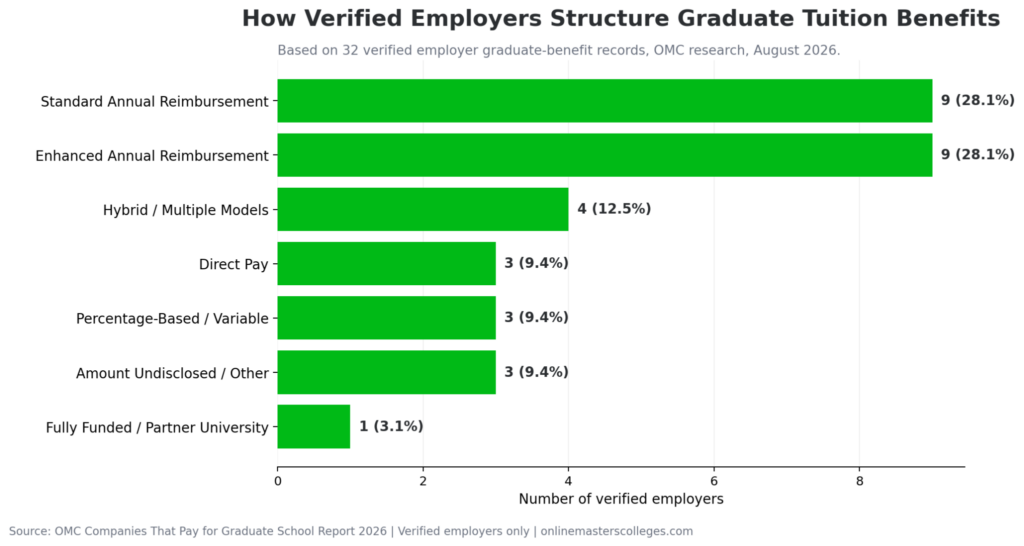
OMC’s review of 69 major employers identified substantial differences in both the dollar value and structure of employer education benefits. Among employers with graduate benefits verified through first-party sources, programs range from traditional annual reimbursement to enhanced graduate-specific benefits, direct-pay arrangements, and fully funded pathways through selected university partners.
Several Employers Offer Graduate Benefits Well Above $5,250
Several employers in OMC’s verified dataset provide annual graduate tuition benefits substantially above the $5,250 level. Boeing offers up to $25,000 per year for most eligible graduate programs, representing the highest explicitly stated annual graduate benefit identified among the verified employers reviewed by OMC.
Other verified employer programs provide enhanced annual benefits above the $5,250 threshold, demonstrating that some organizations invest considerably more in graduate education when advanced degrees support specialized skills, workforce development, or leadership pipelines.
Graduate Tuition Benefits Often Come With Eligibility Restrictions
The amount advertised by an employer does not necessarily equal the amount every employee can receive. OMC’s research found that graduate tuition programs frequently include restrictions involving employment status, tenure, academic performance, job relevance, approved institutions, or specific employee populations.
Best Buy, for example, requires graduate coursework to relate to the employee’s current role and generally limits the benefit to eligible full-time employees after six months of service. Capital One requires a B or better for graduate coursework. T-Mobile requires manager approval and limits eligible education to programs connected to current or potential roles within the company. Ford’s $8,000 benefit in this dataset applies specifically to UAW-represented hourly employees rather than the entire Ford workforce.
These conditions make it important to evaluate the complete employer policy rather than comparing reimbursement amounts alone.
Benefit Structure Matters Almost as Much as the Dollar Amount
Employer tuition benefits are not all delivered in the same way. Traditional reimbursement programs require employees to pay tuition first and receive repayment after completing coursework, while direct-pay and partner-university arrangements can reduce or eliminate the need to finance tuition upfront.
Boeing, for example, pays eligible partner institutions directly through its Learning Together Program. State Farm offers direct billing at select institutions, while T-Mobile provides fully funded pathways at selected university partners in addition to its standard tuition assistance benefit. CVS Health similarly offers zero-out-of-pocket options through approved direct-pay schools.
For employees choosing between employers or graduate programs, payment structure can be especially important because a generous reimbursement benefit may still require thousands of dollars in temporary out-of-pocket spending.
Some Employers Use Fully Funded or Partner-School Models Instead of Traditional Reimbursement
Several employers have moved beyond standard tuition reimbursement by offering fully funded or heavily subsidized education through selected university networks. These arrangements can provide greater value than a flat annual reimbursement limit, but they typically restrict employees to approved schools, programs, or degree pathways.
T-Mobile offers selected graduate programs, including some MBA pathways, at no out-of-pocket tuition through approved university partners. Chipotle provides access to fully funded programs within portions of its Guild Education catalog while offering up to $5,250 annually for other eligible master’s programs. CVS Health also provides direct-pay pathways at selected universities, while Boeing maintains a network of approximately 300 partner schools through its Learning Together Program.
For students willing to choose from an employer’s approved university network, these models can substantially reduce or even eliminate tuition costs.
The Highest Benefit Is Not Always the Best Benefit
The strongest graduate tuition benefit is not necessarily the policy with the largest advertised dollar amount. Employees should compare the reimbursement limit with program eligibility, payment timing, grade requirements, approved-school restrictions, and any post-employment repayment obligations.
A $5,250 direct-pay benefit with broad program eligibility may be more useful to some employees than a $10,000 reimbursement program that requires substantial upfront tuition payments or limits eligible fields. Similarly, a fully funded partner-school program may provide the lowest out-of-pocket cost even if the employee has fewer universities to choose from.
OMC recommends evaluating employer tuition benefits as a complete funding package rather than ranking companies solely by the maximum reimbursement amount.
Employer Tuition Benefit Distribution
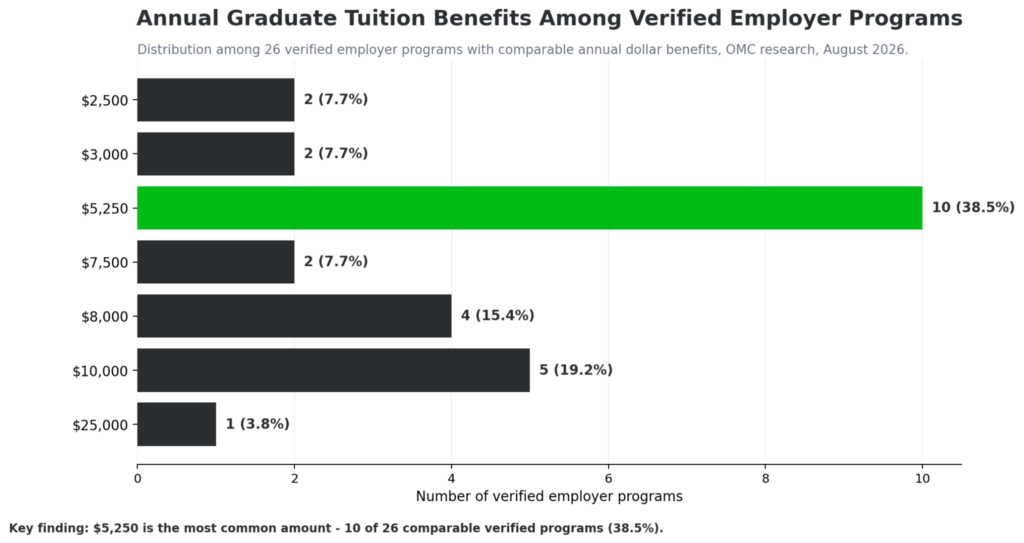
Annual graduate tuition benefits vary considerably among verified employer programs, but OMC’s analysis shows that benefit amounts cluster around several common funding levels rather than being evenly distributed. The chart below examines the 26 verified employer programs with a comparable annual dollar benefit to show how graduate tuition assistance is distributed across the dataset.
What the Distribution Reveals
The distribution shows a clear concentration at $5,250 per year, with 10 of the 26 comparable verified employer programs (38.5%) providing this amount. Other employers provide enhanced annual benefits above the $5,250 threshold, while a smaller number offer substantially higher benefit levels.
The pattern suggests that employer graduate tuition assistance is structured around a limited number of common funding approaches rather than a continuous range of reimbursement amounts. This makes benefit structure, eligibility requirements, and payment method important considerations alongside the advertised dollar value.
OMC Finding
Employer tuition reimbursement is not a one-size-fits-all benefit. OMC’s analysis suggests that employers generally adopt one of three approaches:
- Standard reimbursement aligned with the IRS tax-free threshold.
- Enhanced reimbursement for workforce development and leadership pipelines.
- Direct-pay or partner-university models designed to maximize employee participation while reducing upfront education costs.
Understanding which model an employer follows often provides more practical insight than comparing reimbursement amounts alone.
How to Use This Employer Comparison
Before comparing benefit amounts, check the employer’s source-confidence classification. A Verified designation means OMC identified first-party documentation supporting graduate-level education benefits. Corroborated indicates that credible public evidence supports graduate coverage but current first-party documentation confirming all material terms was not identified. Unverified / Graduate Coverage Not Confirmed means the available evidence was insufficient, conflicting, outdated, or indicated primarily undergraduate coverage.
Treat Verified records as the strongest basis for employer comparisons. Corroborated records can help identify programs worth investigating, but employees should confirm current terms directly with the employer before relying on the benefit. Unverified records should not be interpreted as evidence that the employer currently pays for graduate school.
Choosing an employer based on graduate tuition assistance involves more than comparing reimbursement amounts. The companies in this dataset vary widely in eligibility requirements, payment methods, approved programs, and long-term obligations. Use the recommendations below to evaluate employer education benefits in the context of your own graduate school plans.
Start With Your Current Employer
Before assuming you need to change employers, review your current company’s education benefits policy. Many employees qualify for graduate tuition reimbursement without realizing the benefit exists. If your employer appears in OMC’s comparison table, review the official policy and confirm your eligibility with Human Resources before applying to graduate school.
Compare Total Benefit Over Your Entire Degree
Annual reimbursement limits tell only part of the story. A two-year master’s program funded at $5,250 per year provides a different total employer contribution than a three- or four-year part-time program. Estimate the total employer support you could receive across your planned enrollment timeline rather than focusing on a single year’s benefit.
Review Service Commitments Before Accepting Reimbursement
Many employers require employees to remain with the organization for a specified period after completing their graduate degree. Leaving early may trigger partial or full repayment of previously reimbursed tuition. Before accepting employer funding, understand any service commitment, repayment obligations, and career flexibility you may be giving up.
Verify Graduate Program Eligibility Before Enrolling
Not every accredited master’s degree automatically qualifies for employer reimbursement. Some employers require that graduate coursework relate directly to your current position or an approved career pathway within the company. Others maintain approved institution lists or partner universities. Always obtain written approval before enrolling.
Combine Employer Benefits With Other Funding Sources
Employer tuition reimbursement often works best as one component of a broader graduate funding strategy. Scholarships, graduate grants, employer reimbursement, and federal financial aid can frequently be combined to reduce borrowing while keeping out-of-pocket costs manageable. Understanding how these funding sources work together can significantly reduce the overall cost of earning a master’s degree.
Continue Planning Your Graduate Funding Strategy
Employer tuition reimbursement is only one way to reduce graduate school costs. Depending on your circumstances, the following OMC resources can help you compare funding options and estimate your total education costs.
- Employer Tuition Reimbursement for Graduate School — Learn how reimbursement works, IRS tax rules, eligibility requirements, and repayment obligations.
- Graduate School Scholarships — Find scholarships that can supplement employer education benefits.
- Grants for Graduate School — Explore grant opportunities that do not require repayment.
- FAFSA for Graduate School — Understand how federal financial aid works alongside employer reimbursement.
- Most Affordable Online Master’s Programs — Compare lower-cost graduate programs that maximize employer tuition benefits.
- Graduate School ROI Calculator / ROI Report — Estimate long-term return on your graduate education investment.
- Best Online Master’s Programs — Compare accredited graduate programs across disciplines.
Employer Tuition Benefit Trends by Industry
Graduate tuition benefits vary across industries as well as individual employers. OMC’s verified dataset includes employers across healthcare, technology, financial services, manufacturing, aerospace, retail, telecommunications, and other sectors. The examples below illustrate how verified employers in several major industries structure graduate education benefits; they should not be interpreted as an industry ranking or as evidence that every employer within an industry offers comparable benefits.
Verified healthcare employers in OMC’s dataset use graduate tuition assistance to support workforce development across clinical, administrative, technical, and leadership roles. HCA Healthcare, CVS Health, Kaiser Permanente, and UnitedHealth Group are among the healthcare employers reviewed with verified graduate education benefits. These programs illustrate how employer-funded graduate education can support advancement within a sector that relies heavily on specialized credentials and professional development.
Verified technology employers in OMC’s dataset use graduate tuition assistance to support advanced education and professional development. Microsoft, Adobe, Oracle, Salesforce, Intel, and Cisco are among the technology employers reviewed with graduate education benefits. Program requirements vary by employer, with some policies requiring coursework or degree programs to relate to an employee’s current role, potential future role, or broader business needs.
Verified employers across banking, insurance, and financial services use graduate tuition assistance as part of broader employee education and professional development programs. JPMorgan Chase, Bank of America, Wells Fargo, Capital One, Fidelity Investments, and State Farm are among the employers represented in OMC’s verified dataset. Benefit amounts, eligibility requirements, and payment structures vary considerably across these organizations, reinforcing the importance of comparing the complete policy rather than the industry alone.
Manufacturing and aerospace employers in OMC’s verified dataset demonstrate that graduate education benefits can extend substantially above the common $5,250 annual level. Boeing’s Learning Together Program provides up to $25,000 annually for most eligible graduate programs, representing the highest explicitly stated annual graduate benefit identified in OMC’s verified dataset. Other verified employers in these sectors use tuition assistance to support continued employee education and professional development.
Verified retail and consumer employers in OMC’s dataset use several approaches to graduate education assistance, including traditional tuition reimbursement, direct-pay arrangements, and approved university partnerships. These different models demonstrate why employees should compare not only the advertised benefit amount but also how tuition is paid, which programs qualify, and what eligibility requirements apply.
Across the industries represented in OMC’s verified dataset, employers use a range of graduate tuition benefit structures and funding levels. The research does not establish that one industry consistently provides better graduate education benefits than another; instead, it shows substantial variation between individual employers, even within the same sector.
Frequently Asked Questions About Companies That Pay for Graduate School
Among employers with graduate tuition benefits verified through first-party sources, Boeing provides the highest explicitly stated annual graduate benefit identified in OMC’s research, offering up to $25,000 per year for most eligible graduate programs. Other verified employers provide enhanced benefits above the common $5,250 annual level, while some use direct-pay or fully funded partner-university models that cannot be compared solely by annual reimbursement amount. Employees should compare eligibility requirements, payment structure, approved programs, and service commitments alongside the advertised benefit.
The $5,250 annual amount aligns with the federal tax-free educational assistance limit under IRS Section 127. Among the 26 verified employer programs in OMC’s dataset with a comparable annual dollar benefit, 10 — or 38.5% — provide $5,250 per year, making it the single most common annual benefit amount identified in the analysis. Employers can provide more than $5,250, although amounts above the federal exclusion may receive different tax treatment depending on the benefit structure and employee circumstances.
No. Many employers restrict graduate tuition benefits to programs that are relevant to the employee’s current role, an approved future role, or the organization’s workforce needs. Some companies also maintain approved university lists or partner-school networks. Employees should obtain written confirmation that a specific graduate program qualifies before enrolling.
With tuition reimbursement, the employee generally pays tuition first and receives repayment from the employer after meeting policy requirements. With direct pay, the employer pays the university directly, reducing the employee’s upfront cash-flow burden. Some companies also use partner-university or fully funded education models in which approved programs are covered through a corporate education network.
Some do, and some do not. Service commitments and repayment, or clawback, provisions vary by employer. A company may require an employee to remain for a specified period after receiving tuition assistance or completing the degree, with partial or full repayment required if the employee leaves early. OMC recommends reviewing these conditions alongside the reimbursement amount because they can materially affect career flexibility.
In many cases, yes. Employer tuition assistance can often be combined with graduate scholarships, grants, and federal financial aid, subject to employer and university rules and the overall cost of attendance. Combining multiple funding sources can significantly reduce out-of-pocket graduate school costs.
Employer education benefits can change at any time as companies revise reimbursement limits, eligibility requirements, approved programs, university partnerships, or service commitments. OMC reviewed the employer policies in this report during August 2026 and plans to refresh the dataset periodically. Employees should always confirm current terms through the employer’s official benefits documentation or Human Resources department.
Most employer educational assistance up to the current IRS Section 127 annual limit is generally tax-free under federal law, although benefits above that amount or certain program structures may have different tax treatment. Employees should review their employer’s policy and consult a tax professional regarding their individual circumstance
Based on OMC’s August 2026 review of publicly available employer policies, Amazon, Starbucks, and Walmart do not currently offer graduate degree coverage through their primary education benefit programs. Amazon Career Choice and Starbucks College Achievement Plan focus on undergraduate education, while Walmart’s Live Better U program does not currently include master’s degrees.
These employers are included in OMC’s research because they operate some of the country’s most prominent employee education programs and are frequently associated with employer-funded college benefits. Their inclusion also illustrates an important distinction: an employer offering tuition or education assistance does not necessarily mean master’s or other graduate degrees are eligible.
Employer policies can change, so employees should confirm current graduate eligibility through the employer’s official benefits documentation before making enrollment decisions.
Methodology and Data Sources
OMC compiled this research by reviewing publicly available employer education benefit policies, human resources documentation, tuition assistance program pages, and official employee benefit resources published by each company. The objective was to identify employers that currently provide graduate tuition reimbursement, tuition assistance, direct-pay education programs, or other employer-funded graduate education benefits.
Unless otherwise noted, employer policies included in this report were reviewed and verified during August 2026 using publicly accessible information available at the time of research.
How Companies Were Selected
OMC reviewed major U.S. employers that are commonly associated with tuition assistance, education benefits, or employer-funded degree programs. Employers were then classified based on the strength of available evidence for graduate-level coverage. Companies with verified graduate benefits form the primary analysis dataset, while employers with corroborated but incomplete evidence and employers with unconfirmed or undergraduate-only coverage are retained separately for transparency and reference.
Employers were included regardless of reimbursement amount. OMC did not rank or exclude companies based on the generosity of their education benefits.
Only employers classified as Verified are included in OMC’s quantitative findings, charts, and aggregate comparisons unless otherwise stated.
Source Confidence and Inclusion Rules
OMC classifies each employer record based on the quality and consistency of the available evidence supporting graduate-level education benefits.
Verified — Graduate benefit details are supported by an official employer source, official policy document, employer-authorized benefits administrator, or other first-party documentation.
Corroborated — Graduate benefit details are supported by multiple credible and consistent public sources, but OMC could not identify a current first-party source confirming all material program terms.
Unverified / Graduate Coverage Not Confirmed — Available sources are conflicting, incomplete, outdated, or indicate that the employer’s publicly documented education benefit is limited primarily to undergraduate study.
Only employers classified as Verified are included in OMC’s quantitative findings, charts, and aggregate comparisons unless otherwise stated. Corroborated and unverified records remain visible for transparency and reference but are excluded from statistical analysis.
What We Compared
For each employer, OMC reviewed available information relating to:
- Annual graduate tuition reimbursement or assistance amount
- Graduate degree eligibility
- Employment tenure requirements
- Minimum grade requirements
- Service commitment or repayment (clawback) provisions
- Payment structure (reimbursement, direct pay, or partner-university model)
- Official employer documentation supporting the benefit
- Date policy was verified
Where employers published multiple education benefit options, OMC summarized the graduate tuition benefit most broadly applicable to eligible employees while noting important limitations where appropriate.
Verification and Updates
Employer tuition assistance programs change periodically as organizations revise reimbursement limits, eligibility requirements, approved universities, and education policies. OMC reviews this dataset periodically and intends to update the report annually to reflect material changes identified through official employer sources.
Readers should always confirm the current policy with their employer’s Human Resources department or review the official employer education benefits documentation before making graduate enrollment decisions.
Limitations
This report summarizes publicly available employer information and is intended for educational and research purposes. Some employers provide additional education benefits that are available only through internal employee portals, collective bargaining agreements, geographic locations, business units, or negotiated employment arrangements that are not publicly documented.
Where employer policies differ by employee classification or are subject to change, the official employer policy always takes precedence over this summary.