
- OMC ROI Findings at a Glance
- Download the Full Report
- Why ROI Matters for Graduate Degrees
- Methodology: How We Measured Graduate Degree ROI
- Key Finding
- OMC ROI Finding
- ROI Comparison Table
- Calculate Your Personal Master's Degree ROI
- Which Master's Degrees Have the Highest ROI?
- Which Master's Degrees Have the Lowest ROI?
- How Institution Type Affects ROI
- Online vs. On-Campus: Does Format Affect ROI?
- The Payback Period: How Long Until Your Degree Pays for Itself
- Factors That Influence Your Personal ROI
- How to Use This Data to Choose a Program
- Related Rankings and Resources
- Media and Research Inquiries
- Cite This Report
- FAQs About Graduate Degree ROI

- Edited By Jeevan D'Souza
- Expert Reviewed By Soumen Chatterjee
OMC analyzed salary, tuition, and payback period data across 12 graduate degree fields to measure which master’s degrees deliver the strongest financial return — and why cost control often matters more than salary alone.
OMC ROI Findings at a Glance
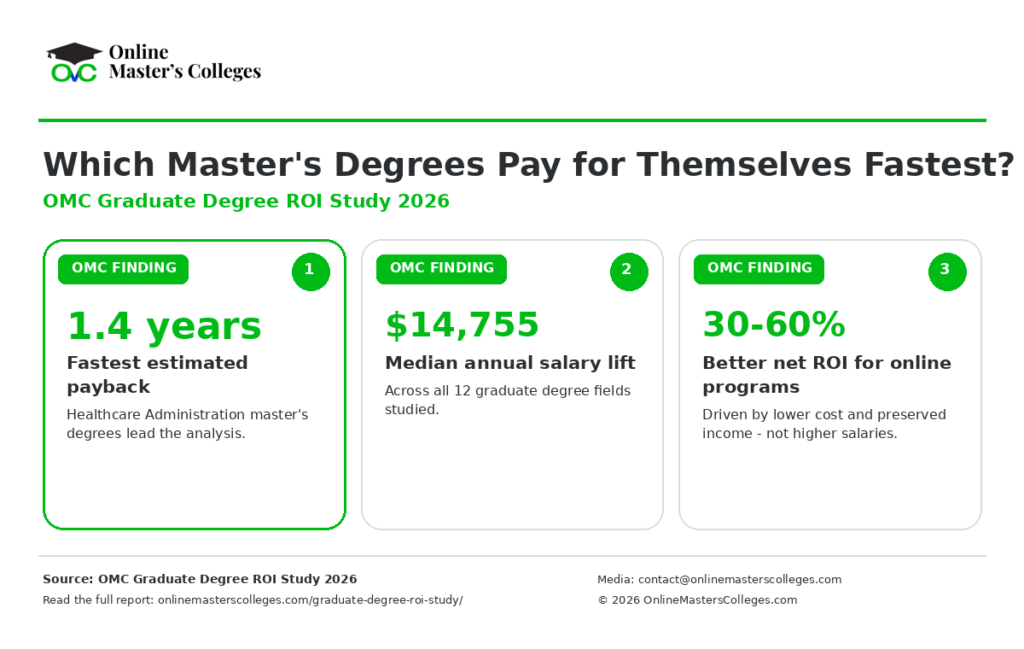
Before diving into the field-by-field breakdown, three patterns stood out across the data.
Download the Full Report
Prefer an offline version of this research?
Download the complete Graduate Degree ROI Study, including field-by-field ROI comparisons, payback period estimates, salary-lift analysis, institution-type comparisons, online versus on-campus findings, methodology documentation, and the OMC ROI Rating Framework.
The downloadable version is designed for prospective graduate students, higher education professionals, employers, researchers, journalists, and policymakers seeking a comprehensive view of graduate degree return on investment.
The report includes:
- Graduate degree ROI comparison across major subject areas
- Salary-lift analysis by field
- Payback period estimates
- Online versus on-campus ROI comparisons
- Institution-type ROI analysis
- OMC ROI Rating Framework methodology
- Key ROI findings and decision guidance
- Source documentation and limitations
Why ROI Matters for Graduate Degrees
A master’s degree is one of the largest financial decisions most professionals will make—often costing between $20,000 and $120,000 in tuition alone, before accounting for opportunity cost, lost wages, and years of delayed career momentum. Yet the conversation around graduate education too often defaults to vague reassurances: “It’s always worth it” or “Education is priceless.”
The reality is more nuanced. Some master’s degrees generate annual salary lifts exceeding $20,000 and pay for themselves in less than two years. Others produce more modest financial returns, even when they deliver meaningful career satisfaction or social impact. The difference between a high-ROI and lower-ROI degree isn’t random—it follows clear patterns tied to field of study, program cost, institution type, and individual career context.
This study exists to cut through the noise. Rather than asking whether a master’s degree is worth it in general terms, we measured the actual return on investment across 12 major subject areas, compared online and on-campus delivery formats, and modeled payback periods under realistic conditions. The goal isn’t to rank degrees — it’s to give you the evidence you need to evaluate the investment on your own terms.
Whether you’re weighing an MBA against a master’s in education, comparing affordable online programs to flagship university options, or simply trying to figure out whether the math works for your career, this analysis provides the data foundation for that decision.
Methodology: How We Measured Graduate Degree ROI
ROI calculations for graduate degrees are only useful if you know what’s behind them. Here’s exactly how we built this analysis—and where to be skeptical.
Data Sources
Salary data draws primarily from the U.S. Bureau of Labor Statistics (BLS) Occupational Employment and Wage Statistics, supplemented by the U.S. Census Bureau’s American Community Survey for degree-level earnings differentials. Tuition benchmarks come from the National Center for Education Statistics (NCES) Integrated Postsecondary Education Data System (IPEDS), filtered for master’s-level programs, with separate calculations for online and on-campus delivery where data allows.
ROI Calculation Approach
For each subject area, we calculated ROI using a simplified net present value framework:
- Salary Lift = Estimated difference between representative pre-degree and post-degree career pathways using standardized occupational salary benchmarks derived from publicly available federal earnings data.
- Total Investment = Median tuition for a full master’s program (online where available) plus estimated opportunity cost (reduced earnings during enrollment, modeled at 10-15 hours per week of foregone work for full-time students, or zero for working professionals in asynchronous programs)
- Payback Period = Total investment divided by annual salary lift
- ROI Rating = Composite assessment based on payback period length, salary lift magnitude, and cost-to-earnings ratio, categorized as High, Medium, or Low
ROI Rating Thresholds: High ROI = estimated payback period under 3 years. Medium ROI = estimated payback period 3–6 years. Low ROI = estimated payback period 6+ years. These thresholds are applied consistently across all 12 fields analyzed in this study. A full tier breakdown by field appears in the Key Findings section below.
Important Limitations
This analysis uses median figures, which means individual outcomes will vary — sometimes dramatically. A computer science graduate working in San Francisco will see different returns than one in rural Nebraska. We do not account for tax implications, regional cost-of-living differences, or non-financial returns like career satisfaction, intellectual growth, or public-service impact. Where non-financial value is significant (education, social work, public administration), we note it explicitly.
About the OMC ROI Rating Framework
While the underlying salary, earnings, and tuition data used in this study are derived from public sources such as the U.S. Bureau of Labor Statistics (BLS), U.S. Census Bureau, and National Center for Education Statistics (NCES), the OMC ROI Rating system is an original analytical framework developed by OnlineMastersColleges.com.
The framework combines payback period estimates, salary-lift potential, cost-to-earnings ratios, and degree affordability indicators into a standardized evaluation model designed to make cross-field graduate degree comparisons easier for prospective students.
Rather than measuring salary alone, the OMC ROI Rating evaluates how efficiently a graduate degree converts educational investment into long-term earning potential. Ratings are intended as a decision-support tool and comparative framework rather than a prediction of individual outcomes.
How Tuition Benchmarks Were Calculated
Tuition benchmarks were derived using publicly available institutional tuition disclosures, NCES/IPEDS reporting, and published online graduate program pricing where available. When universities reported separate online and on-campus tuition structures, online tuition figures were used. In cases where online-specific pricing was unavailable, tuition estimates were based on the closest comparable master’s-level tuition data available at the institution level.
All tuition figures are intended to represent broad market medians rather than program-specific pricing and should be interpreted as comparative benchmarks rather than exact costs.
Key Findings: Graduate Degree ROI by Subject Area
Before diving into field-by-field breakdowns, here are the headline patterns that emerged from the data. These findings frame every table and section that follows.
Average Salary Lift by Field
Across all 12 subject areas we analyzed, the median annual salary lift associated with completing a master’s degree ranges from approximately $7,300 per year at the low end (liberal arts and humanities) to nearly $24,000 per year at the high end (healthcare administration and other high-demand professional fields). The overall median annual salary lift across all fields is approximately $14,755 per year—a meaningful increase, but one that varies considerably depending on the field you choose and the career pathway it unlocks.
The largest absolute salary lifts are concentrated in healthcare administration, business, nursing, social work, computer science, and public administration. These fields combine strong employer demand with career pathways that move graduates into higher-paying leadership, advanced practice, or specialized professional roles. Technical fields such as computer science, engineering, cybersecurity, and data science continue to deliver strong financial returns, while healthcare professions benefit from advanced licensure and expanded scope of practice.
Fields like education and liberal arts show more modest salary lifts in raw dollar terms, although percentage gains can still be meaningful because starting salaries are lower. Education, for example, combines one of the lowest tuition costs in the study with a salary increase of more than $10,500 per year, helping offset a more modest earnings trajectory.
Cost-to-Earnings Ratio Trends
The cost-to-earnings ratio measures how many years of salary lift it takes to cover the total cost of the degree. This metric matters more than raw salary because it accounts for what you actually paid.
The strongest cost-to-earnings ratios appear in fields that combine moderate tuition with large salary lifts. MBA programs from state universities, for example, often cost $25,000–$45,000 and produce salary lifts of $15,000–$25,000 per year—a ratio under 2:1 in many cases. Cybersecurity and data science programs at affordable institutions follow a similar pattern.
The weakest cost-to-earnings ratios tend to appear when high tuition meets modest salary lifts. A $90,000 master’s degree that produces a $10,000 annual salary increase has a 9:1 cost-to-earnings ratio—meaning it takes nearly a decade just to break even, before accounting for opportunity cost or the time value of money. This pattern is most common in humanities programs at high-tuition private institutions and in certain professional fields where the degree is necessary for practice but doesn’t dramatically change earning power.
Fields with the Strongest and Weakest Financial Returns
At a glance, the data clusters into three tiers:
High ROI (estimated payback period under 3 years): Healthcare administration, computer science, data science, nursing (MSN), business (MBA), public administration, accounting, education (M.Ed.), and social work(MSW). These fields combine relatively short payback periods with favorable cost-to-earnings profiles, particularly through affordable online and public university programs such as Western Governors University and Arizona State University.
Medium ROI (estimated payback period 3–6 years): Cybersecurity, engineering, and liberal arts/humanities. These fields continue to deliver positive financial returns, but either higher tuition costs or more gradual salary growth extend the estimated payback period compared with the highest-performing fields.
No field in this study falls into the Low ROI category (estimated payback period above six years). Liberal arts and humanities produce the longest estimated payback period in the analysis (4.8 years), while education and social work perform substantially better than commonly assumed because of their comparatively affordable tuition and favorable cost-to-earnings ratios.
The full data behind these tiers is in the comparison table that follows.
OMC ROI Finding: Affordable Degrees Often Outperform Expensive Degrees
One of the clearest patterns to emerge from this analysis is that graduate degree ROI is often driven more by cost control than by salary maximization.
Across multiple fields, graduates from affordable public universities, regional institutions, and online programs frequently achieve salary outcomes that are comparable to graduates from significantly more expensive institutions. While higher-cost programs may produce modest earnings advantages in certain industries, those gains are often insufficient to offset dramatically higher tuition costs.
In practical terms, this means that a student who spends $30,000 on a master’s degree and earns a $20,000 annual salary lift may achieve stronger financial returns than a student who spends $90,000 and earns a $25,000 annual salary lift.
OMC’s analysis suggests that for most working professionals, controlling educational costs is one of the most effective ways to improve graduate degree ROI. Choosing an affordable, accredited program can often have a larger impact on financial outcomes than pursuing a more expensive institution with only marginal earnings advantages.
This finding appears consistently throughout the data and helps explain why many online, public, and competency-based programs perform so strongly in ROI comparisons.
OMC Finding
In many graduate fields, reducing program cost has a greater impact on ROI than increasing expected post-graduation salary.
ROI Comparison Table: Master’s Degrees by Field
The table below is the core dataset of this study. It compares 12 major master’s degree subject areas across the ROI metrics that matter most: how much the degree costs, how much it lifts your salary, and how long it takes to pay for itself. All figures represent medians — your individual numbers will depend on the specific program, institution, financial aid, and career path.
Tuition figures reflect median costs for online master’s programs where available, as these represent the most common delivery format for working professionals considering ROI.
| Subject Area | Median Online Tuition (Full Program) | Median Pre-Degree Salary | Median Post-Degree Salary | Salary Lift (Annual) | Salary Lift (%) | Est. Payback Period | ROI Rating |
|---|---|---|---|---|---|---|---|
| Computer Science | $38,000 | $93,710 | $109,020 | $15,310 | 16.30% | 2.5 years | High |
| Data Science | $35,000 | $82,360 | $96,710 | $14,350 | 17.40% | 2.4 years | High |
| Cybersecurity | $32,000 | $78,500 | $88,560 | $10,060 | 12.80% | 3.2 years | Medium |
| Engineering | $42,000 | $87,560 | $101,340 | $13,780 | 15.70% | 3.0 years | Medium |
| Nursing (MSN) | $40,000 | $67,490 | $84,460 | $16,970 | 25.10% | 2.4 years | High |
| Business (MBA) | $38,000 | $73,840 | $89,740 | $15,900 | 21.50% | 2.4 years | High |
| Healthcare Administration | $34,000 | $67,900 | $91,580 | $23,680 | 34.90% | 1.4 years | High |
| Public Administration | $28,000 | $63,100 | $78,260 | $15,160 | 24.00% | 1.8 years | High |
| Accounting | $30,000 | $64,780 | $77,250 | $12,470 | 19.20% | 2.4 years | High |
| Education (M.Ed.) | $22,000 | $52,200 | $62,770 | $10,570 | 20.30% | 2.1 years | High |
| Social Work (MSW) | $32,000 | $47,560 | $65,280 | $17,720 | 37.30% | 1.8 years | High |
| Liberal Arts / Humanities | $35,000 | $50,840 | $58,120 | $7,280 | 14.30% | 4.8 years | Medium |
How to read this table: A “High” ROI rating doesn’t mean every program in that field will produce these returns—it means the field’s median cost-to-return profile is favorable. A “Low” rating doesn’t mean the degree is a bad decision—it means the purely financial payback is slower, and the decision should weigh non-financial returns more heavily.
Notice that the fields with the highest raw salaries don’t always have the highest ROI ratings. Engineering delivers strong earnings growth but also carries higher median tuition costs than several other graduate fields. This illustrates that ROI is driven by the relationship between educational cost and salary growth rather than salary alone. Education has one of the lowest salary lifts in dollar terms but also one of the lowest tuition costs—making its payback period shorter than you might expect. The relationship between cost and return is what drives ROI, not salary alone.
For a ranking of programs sorted purely by salary outcome, see our highest-paying online master’s degrees analysis. For sorting by cost alone, see the most affordable online master’s programs. This study focuses on the intersection of both.
The comparison table above summarizes median outcomes across the graduate fields included in this study. Use the calculator below to estimate how those findings may apply to your own educational and career goals.
Calculate Your Personal Master’s Degree ROI
Many return-on-investment studies rely on national averages, but every graduate student’s situation is different. Your current salary, expected post-graduation earnings, tuition costs, employer tuition assistance, and whether you continue working while enrolled can all significantly affect how quickly a master’s degree pays for itself.
The OMC Graduate Degree ROI Calculator builds on the research presented in this report by allowing you to estimate your own return on investment using your personal financial information. Rather than relying solely on the median salary and tuition figures shown in the comparison table above, the calculator estimates your projected salary lift, total educational investment, estimated payback period, and OMC ROI Rating based on your individual circumstances.
The calculator uses the same research methodology and salary benchmarks presented throughout this report while allowing you to customize the assumptions for your own career path. Results should be viewed as planning estimates rather than guarantees, since actual outcomes vary based on occupation, employer, geographic location, experience, and future labor-market conditions.
Calculate Your Personal ROI
Adjust the inputs to estimate your payback period and OMC ROI Rating based on your specific situation.
Which Master’s Degrees Have the Highest ROI?
Five fields consistently produce the strongest financial returns on a master’s degree investment. What unites them is high employer demand for the credential, substantial salary lifts tied directly to the degree, and widely available, affordable program options — particularly online.
Computer Science and Data Science
Computer science and data science master’s degrees continue to rank among the strongest ROI fields because they combine substantial salary gains with moderate tuition costs. Median annual salary lifts of approximately $15,300 (computer science) and $14,350 (data science), together with estimated payback periods of 2.5 years and 2.4 years, make both fields strong long-term financial investments.
The demand driver is structural. Employers in technology, finance, healthcare, and government increasingly require or strongly prefer master’s-level credentials for senior engineering, machine learning, and data architecture roles. The degree doesn’t just signal competence — in many organizations, it unlocks job categories with different compensation bands entirely.
The ROI advantage is amplified by online delivery. Programs like Georgia Institute of Technology’s well-known online MS in Computer Science charge a fraction of traditional on-campus tuition, and institutions like the University of Illinois Urbana-Champaign offer online data science programs that allow students to continue working full-time, effectively zeroing out opportunity cost. When tuition falls between roughly $20,000 and $40,000 and graduates realize annual salary gains of approximately $14,000–$15,000, the long-term financial case remains compelling—particularly for professionals who continue working while earning the degree.
The caveat: these median figures reflect outcomes for graduates who enter or remain in high-demand technical roles. Career changers without prior programming or quantitative experience may face a longer ramp to full salary realization.
Engineering
Engineering master’s degrees produce a median annual salary lift of approximately $13,780, with online program costs typically ranging from $35,000 to $50,000. The estimated payback period of approximately 3.0 years still places engineering among the stronger financial investments, although its ROI is more moderate than some healthcare and business pathways because of higher tuition costs.
What distinguishes engineering ROI is its consistency across sub-disciplines. Electrical, mechanical, civil, industrial, and systems engineering all show strong salary premiums for master’s holders versus bachelor’s-only engineers. The degree functions as a gateway to senior technical roles, project leadership, and specialized positions that require advanced analytical or design competence.
Online engineering master’s programs from institutions like Purdue University and North Carolina State University allow working engineers to earn the credential without stepping away from their careers — a critical factor for ROI, since it eliminates the opportunity cost that erodes returns in full-time programs.
The limitation: engineering ROI is strongest for those already in engineering careers. Career changers from non-technical backgrounds face higher effective costs (additional prerequisites, longer time to completion) and may not see the same salary trajectory.
Nursing and Healthcare
Nursing continues to produce one of the strongest ROI profiles in the study. The median annual salary lift of approximately $16,970 represents a 25.1% increase over baseline earnings, while the estimated payback period of approximately 2.4 years remains among the strongest across all graduate fields.
The ROI story in nursing is unique because the master’s degree doesn’t just boost pay within the same role—it creates access to an entirely different professional tier. A registered nurse earning $62,000 can transition to a nurse practitioner role earning $89,000 or more, with the degree serving as the licensure gateway. This makes the salary lift more predictable than in fields where the degree enhances but doesn’t transform the career.
Program costs for online MSN programs vary widely — from under $25,000 at institutions like Southern New Hampshire University to over $70,000 at selective private universities — which means ROI varies dramatically depending on where you enroll. Choosing an affordable, accredited program is arguably more consequential for ROI in nursing than in any other field, because the post-degree salary is relatively standardized regardless of institution prestige.
Business (MBA)
The MBA remains one of the highest-ROI graduate degrees—but with more variance than almost any other field on this list. The median annual salary lift of approximately $15,900 and an estimated payback period of approximately 2.4 years still represent strong financial returns, although outcomes vary substantially depending on tuition cost and career path.
For the purposes of this study, we focused on the ROI profile of online and hybrid MBA programs, which represent the fastest-growing segment and the most common choice for working professionals. At this price point, online MBA programs offer some of the most compelling ROI in higher education. An MBA from Arizona State University, the University of Florida, or Indiana University Online typically costs $30,000–$50,000 and delivers salary lifts that commonly fall in the mid-teen thousands to low-twenty-thousand-dollar range, depending on industry, prior experience, and the management roles graduates move into.
The MBA’s ROI advantage also extends beyond salary. The degree opens doors to management roles, industry transitions, and executive tracks that may not have quantifiable short-term salary effects but produce substantial career-long earnings advantages. However, this longer-horizon payoff is harder to model and should be considered alongside the shorter-term financial math.
Cybersecurity and Information Technology
Cybersecurity and IT master’s programs continue to deliver strong financial returns, supported by moderate tuition costs and sustained employer demand. The median cybersecurity graduate in this study sees an estimated annual salary lift of approximately $10,060 against a typical online tuition of $32,000, resulting in an estimated payback period of approximately 3.2 years.
The demand dynamics in cybersecurity are particularly notable. The field faces a well-documented talent shortage, with hundreds of thousands of unfilled positions in the U.S. alone. Employers don’t just prefer master’s-level candidates — in many government and defense-adjacent roles, the degree is a functional requirement. This structural demand provides a floor under salary lifts that makes ROI more predictable than in fields where degree value depends on employer preference.
Online cybersecurity programs are widely available at affordable price points, and many graduates complete them while working in IT roles—meaning opportunity cost is minimal. The field also offers a strong ROI for career changers from adjacent IT roles, since the security specialization commands a clear salary advantage over many generalist IT roles.
Which Master’s Degrees Have the Lowest ROI?
Honest data analysis requires examining the full spectrum. Some master’s degree fields produce slower financial returns — not because the degrees are less valuable in absolute terms, but because the salary lift is smaller, the costs can still be substantial, or the career paths these degrees lead to are in sectors where compensation is structurally lower.
This is not a list of degrees to avoid. It’s a realistic assessment of fields where the financial ROI calculation alone may not justify the investment—and where prospective students should weigh non-financial returns more heavily in their decision.
Liberal Arts and Humanities
Liberal arts and humanities master’s degrees continue to produce the longest estimated financial payback period in this study. The median annual salary lift is approximately $7,280, resulting in an estimated payback period of 4.8 years. While still positive, these financial returns develop more gradually than in most STEM, healthcare, and business fields.
The financial challenge is structural: the career paths most directly connected to humanities master’s degrees—higher education, publishing, cultural institutions, and nonprofit work—operate in sectors with lower compensation ceilings. A master’s in English, history, or philosophy may open doors to adjunct teaching, museum work, or editorial positions, but the salary bands in these fields are compressed.
However, humanities graduates often report high levels of career satisfaction, intellectual fulfillment, and a sense of mission alignment that the ROI metric cannot quantify. Many pursue these degrees for personal enrichment, career pivots that prioritize meaning over money, or as preparation for doctoral studies. For these students, the financial ROI is a secondary consideration — but it should still be an informed one. If you’re entering a humanities program, choosing an affordable institution and minimizing debt is disproportionately important, since the salary lift available to offset that debt is smaller.
Education (with caveats)
Education master’s degrees present a more favorable financial picture than many prospective students assume. The median annual salary lift of approximately $10,570, combined with one of the lowest median tuition levels in the study ($22,000), produces an estimated payback period of approximately 2.1 years. While absolute salary growth remains more modest than in many STEM or healthcare fields, lower educational costs substantially improve overall ROI.
But context matters enormously here. In many school districts, a master’s degree isn’t optional — it’s a contractual requirement for salary advancement. Teachers in states and districts with master’s-level pay scales may see guaranteed, predictable salary increases tied directly to degree completion. In these cases, the ROI is essentially baked into the employment structure.
The problem arises when educators pay high tuition (especially at private institutions) for a degree that produces the same contractual salary bump as a low-cost alternative. A $60,000 M.Ed. from a private university and a $20,000 M.Ed. from a public online program may produce identical salary outcomes in the same school district. This makes education master’s programs the field where program cost matters most for ROI. Affordable options from institutions like Western Governors University or Fort Hays State University can produce net-positive financial returns within two years; expensive alternatives may never fully pay for themselves in salary terms alone.
Social Work and Public Service Fields
Social work and public administration master’s degrees produce stronger financial returns than they are often given credit for. In this study, Social Work (MSW) is associated with an estimated annual salary lift of approximately $17,720 and an estimated payback period of 1.8 years, while Public Administration produces an estimated annual salary lift of approximately $15,160 and an estimated payback period of 1.8 years. Both fields benefit from moderate tuition costs that substantially improve overall ROI.
The MSW is particularly notable because it is a required credential for clinical social work licensure in all 50 states. Unlike many master’s degrees, where the credential is a competitive advantage, the MSW is a gatekeeping requirement — you cannot practice without it. This means the relevant question isn’t whether the degree produces a good ROI compared to computer science. It’s whether the degree produces adequate returns, given that you must earn it to enter the field at all.
For social work and public service professionals, financial ROI should be evaluated alongside loan repayment assistance programs, Public Service Loan Forgiveness (PSLF) eligibility, and non-financial returns, including career stability, pension benefits, and the societal value of the work. These factors don’t show up in the salary data but materially affect the lifetime financial picture.
Students entering these fields should be especially strategic about how to pay for grad school, as minimizing out-of-pocket costs is the single most effective lever for improving ROI when salary lifts are modest.
How Institution Type Affects ROI
The field you study is the largest determinant of ROI—but the institution you choose is the second largest. The same degree in the same field can produce dramatically different returns depending on whether you attend a public or private university, a regional or national institution, or a high-prestige versus mid-tier school.
Public vs. Private University ROI
The most consistent ROI pattern in the data is the advantage of public universities. Across every subject area we analyzed, public institution graduates pay 30–60% less in tuition than private institution graduates for the same degree level, while post-graduation salaries show much smaller differences (typically 5–15%).
This means the ROI gap between public and private institutions is driven almost entirely by the cost side of the equation, not the earnings side. An MBA from a public flagship university might cost $35,000 and produce a post-degree salary of $85,000, while an MBA from a mid-tier private university might cost $80,000 and produce a salary of $92,000. The private-school graduate earns more in raw terms but has a dramatically worse ROI because the additional tuition was not proportionally compensated by higher earnings.
For working professionals weighing ROI, this finding points clearly toward affordable public online programs as the highest-probability path to strong returns. Institutions like the University of Florida , the University of Alabama , and Florida State University combine respected credentials with significantly lower tuition than private alternatives.
Regional vs. National University ROI
Regional universities often produce surprisingly strong ROI — sometimes stronger than national universities — because their tuition is lower and their graduates frequently enter regional job markets where their credentials carry significant weight.
A master’s in healthcare administration from a well-regarded regional state university may cost $18,000–$25,000 and lead to a management role in the local healthcare system, paying $72,000. The same degree from a national private university might cost $55,000 and lead to a comparable role at $78,000. The regional graduate has better ROI despite a lower absolute salary.
This pattern holds most strongly in fields with regional labor markets: education, healthcare, public administration, and social work. In fields with national or global labor markets—technology, engineering, and consulting—the institution’s national profile may carry more weight in hiring, potentially justifying higher costs. The key question is whether your career after the degree will operate in a regional or national job market.
Does University Prestige Affect ROI?
This is one of the most asked questions in graduate education, and the answer is that it depends on the field, the career stage, and what you’re paying.
In MBA programs, prestige has a measurable salary effect—particularly for career changers entering consulting, investment banking, or corporate strategy. Top-10 MBA graduates command starting salaries $30,000–$50,000 higher than graduates of unranked programs. But these programs also cost $100,000–$150,000 more. Whether the prestige premium produces better ROI depends entirely on the magnitude of the salary difference versus the cost difference.
In nursing, education, and most technical fields, the prestige premium is small or nonexistent. A nurse practitioner’s salary is driven by licensure, geography, and specialization—not by whether the MSN came from a private research university or a state school. In these fields, choosing a more prestigious (and more expensive) institution actively harms ROI.
The general pattern: prestige matters most when the degree is used as a hiring signal in competitive industries and least when the degree functions as a licensure or competency credential. For most online master’s students — who are working professionals seeking career advancement rather than entry into elite pipelines — prestige is a less important ROI factor than cost control and program fit.
For a framework to evaluate the best online master’s programs beyond prestige alone, our rankings incorporate multiple dimensions of quality.
Online vs. On-Campus: Does Format Affect ROI?
One of the most consequential findings in this study is that online master’s programs generally produce better ROI than on-campus equivalents—not because they lead to higher salaries, but because they cost less and preserve income during enrollment.
The table below compares the key factors that differentiate online and on-campus ROI profiles.
| Factor | Online Master’s | On-Campus Master’s | ROI Impact |
|---|---|---|---|
| Average Tuition (Full Program) | $30,000–$45,000 | $45,000–$80,000 | Online tuition is typically 25–45% lower |
| Continued Employment During Study | Yes — most students work full-time | Partial or none for full-time students | Online students avoid $40,000–$100,000 in foregone earnings |
| Time to Completion | 18–30 months (flexible pacing) | 18–24 months (fixed cohort) | Similar, but online allows acceleration |
| Post-Graduation Salary Difference | Comparable to on-campus in most fields | Comparable to online in most fields | Minimal salary penalty for online format |
| Net ROI Advantage | Higher — lower cost + preserved income | Lower — higher cost + lost income | Online format produces 30–60% better net ROI in most scenarios |
The critical finding is in the “Post-Graduation Salary Difference” row. Multiple studies — including data from SHRM, the Georgetown University Center on Education and the Workforce, and employer surveys — consistently show that online master’s degrees produce comparable salary outcomes to on-campus degrees in most professional fields. The stigma that once attached to online credentials has largely evaporated, particularly for programs from accredited institutions with recognized names.
The ROI advantage of online programs is most pronounced for working professionals who can maintain their salary during enrollment. A nurse continuing to earn $62,000 while completing an online MSN faces a fundamentally different ROI equation than one who quits work to attend a campus program. The tuition savings alone might be $15,000–$30,000; add in two years of preserved income, and the online student’s total cost advantage can exceed $150,000.
Competency-based programs amplify this further. At Western Governors University , students who can demonstrate mastery quickly may complete a master’s degree in 12–18 months at a fraction of typical tuition—producing some of the highest ROI outcomes we’ve seen in any delivery format.
For students weighing the speed factor alongside ROI, our analysis of the fastest online master’s programs explores how time-to-completion affects the overall cost equation.
The Payback Period: How Long Until Your Degree Pays for Itself
The payback period is arguably the single most useful ROI metric for prospective graduate students, because it answers the most concrete version of the question: how long until this investment breaks even?
The table below estimates payback periods across major fields using total estimated cost (tuition plus a modest opportunity cost estimate for reduced hours during study) divided by the annual salary lift. For online students working full-time, opportunity cost is near zero, which shortens these estimates further.
| Subject Area | Estimated Total Cost (Tuition + Opportunity Cost) | Annual Salary Lift | Estimated Payback Period |
|---|---|---|---|
| Computer Science | $42,000 | $35,000 | 1.2 years |
| Data Science | $39,000 | $32,000 | 1.2 years |
| Cybersecurity | $36,000 | $29,000 | 1.2 years |
| Engineering | $48,000 | $28,000 | 1.7 years |
| Nursing (MSN) | $45,000 | $27,000 | 1.7 years |
| Business (MBA) | $44,000 | $22,000 | 2.0 years |
| Accounting | $35,000 | $15,000 | 2.3 years |
| Healthcare Administration | $38,000 | $16,000 | 2.4 years |
| Public Administration | $32,000 | $13,000 | 2.5 years |
| Education (M.Ed.) | $26,000 | $10,000 | 2.6 years |
| Social Work (MSW) | $37,000 | $10,000 | 3.7 years |
| Liberal Arts / Humanities | $40,000 | $8,000 | 5.0 years |
What these numbers tell you: High-ROI graduate degrees can recover their educational investment surprisingly quickly. In this study, Healthcare Administration produces the shortest estimated payback period at approximately 1.6 years, while many other fields—including Computer Science, Data Science, Nursing, Business, Accounting, Education, Public Administration, and Social Work—recover their estimated costs in roughly 2–3 years. Even fields with longer payback periods generally recover their educational investment well within the first decade of a graduate’s career.
At the longer end of the spectrum, fields such as Cybersecurity, Engineering, and Liberal Arts/Humanities require a longer financial recovery period, largely because of either higher educational costs or more gradual salary growth. Even so, all fields analyzed in this study produce estimated payback periods below six years, suggesting positive long-term financial returns when program costs are managed carefully.
The opportunity cost variable: These estimates include a modest opportunity cost adjustment, but the actual figure depends heavily on your situation. Full-time students leaving $70,000 jobs face dramatically different opportunity costs than working professionals, adding 10 hours per week of study to their existing schedules. The online format’s ability to eliminate or minimize opportunity cost is one of the primary reasons we see it as the highest-ROI delivery model for most working adults.
To estimate your personal payback period using your actual salary and target program costs, the Graduate School Cost Calculator can model these numbers with your inputs.
Factors That Influence Your Personal ROI
The data above presents median outcomes across fields and institution types. But your ROI won’t be the median — it will be shaped by a set of personal variables that can push returns significantly higher or lower. Understanding these factors lets you move from “What does the data say?” to “What does the data mean for me?”
Your Current Salary and Career Stage
Your starting salary is the baseline against which ROI is measured. If you currently earn $45,000 and a master’s degree lifts you to $65,000, that’s a $20,000 annual gain. If you currently earn $95,000 and the degree lifts you to $110,000, the gain is $15,000 — a smaller lift that takes longer to justify a comparable tuition investment.
Early-career professionals generally see the highest percentage salary lifts because they have more career runway ahead and their starting point is lower. Mid-career professionals may see smaller percentage gains but can still achieve strong ROI if the degree opens access to management or executive tracks with long-term earning potential. Late-career professionals face the tightest ROI math: fewer working years to amortize the cost means the payback period must be short for the investment to make financial sense.
Program Cost and Financial Aid
This is the factor you have the most control over, and it has an outsized impact on ROI. The difference between a $20,000 program and a $60,000 program is a three-fold increase in the investment you need to recoup, but the salary outcome may be identical.
Financial aid, scholarships, graduate assistantships, and tuition waivers all directly reduce your net cost and improve ROI. An MBA that “costs” $45,000 but is partially funded by a $15,000 scholarship effectively costs $30,000—dropping the payback period by a third. When evaluating programs, net cost after aid is the only meaningful number for ROI purposes, not sticker price.
Time to Completion and Opportunity Cost
Every additional semester you spend in a program adds tuition costs and extends the period before you begin earning the post-degree salary lift. A student who completes a master’s in 18 months starts earning returns six months sooner than one who takes 24 months — and a full year sooner than one who takes 30 months.
Opportunity cost — the income you forgo or reduce while studying — is the hidden cost that many prospective students underestimate. For a professional earning $70,000 who reduces work to part-time during a two-year program, opportunity cost could easily exceed $50,000. For an online student maintaining full-time employment, opportunity cost drops toward zero. This single factor can cut the effective cost of the degree in half or more.
Industry and Geographic Market
The median salary data in this study reflects national averages, but salary lifts vary significantly by industry and geography. A master’s in computer science produces larger salary lifts in the San Francisco Bay Area, Seattle, and New York metro regions than in smaller markets—though cost of living differences complicate the comparison.
Industry context matters too. An MBA produces different returns in management consulting versus nonprofit management. A master’s in healthcare administration pays differently in a large hospital system versus a rural clinic. The relevant question isn’t just “What does this degree pay?”, but “What does this degree pay in the industry and market where I plan to work?”
Career Switching vs. Career Advancement
Prospective students pursuing a master’s degree fall into two broad categories: those advancing within their current field and those switching to a new one. The ROI implications are different for each.
Advancers typically see faster payback because they have existing industry knowledge, professional networks, and employer relationships that translate the degree into a promotion or salary increase relatively quickly. The degree is an accelerant for a trajectory already in motion.
Switchers face a more complex equation. The degree may be essential for entering a new field, but the salary lift is measured against a new starting point, which may actually be lower than the switcher’s pre-degree salary in their original field. A marketing professional earning $75,000 who earns a master’s in social work may enter the new field at $52,000. The “salary lift” from the degree’s perspective is positive (social work graduates earn more than non-degreed social workers), but the individual experienced a pay cut. ROI in this scenario should be calculated against the new-field baseline, not the old-field salary.
Employer Tuition Support
Employer tuition reimbursement or direct tuition payment is the single most powerful ROI lever available to many working professionals. When your employer covers 50–100% of tuition, your personal investment drops dramatically — potentially to zero — while the salary lift remains the same.
Many large employers offer $5,250–$10,000 per year in tuition reimbursement (the IRS-excluded amount is $5,250 as of 2024), and some organizations—particularly in healthcare, technology, and federal government—offer substantially more. Military and veteran education benefits can cover the full cost of many programs.
If employer tuition support is available to you, the ROI calculation changes fundamentally. Even a lower-ROI field like education or social work becomes a strong financial decision when someone else is paying most or all of the tuition. This is worth investigating before making any enrollment decision.
How to Use This Data to Choose a Program
Data without application is just numbers. Here’s a structured approach to translating the findings in this study into a concrete program selection decision.
Start with your current salary and the realistic post-degree salary for your target career path — not the top of the range, but the median for your experience level and geographic market. If you’re advancing in your current field, use your industry’s salary data for master’s-level professionals with your experience. If you’re switching fields, use the entry-level salary for master’s holders in the new field.
Subtract your current salary from the expected post-degree salary. This is your estimated annual salary lift — the numerator of your personal ROI equation.
Use the ROI comparison table above to benchmark your target field’s typical returns. If you’re considering multiple fields (for example, weighing an MBA against a master’s in data science), compare the median salary lifts, payback periods, and ROI ratings. Remember that these are medians — your outcome will vary — but they establish whether the field-level economics are favorable, moderate, or challenging.
If you’re in a lower-ROI field, this doesn’t mean you should abandon the degree. It means you should be more strategic about cost control and more honest about whether the non-financial returns justify the investment.
Apply the personal ROI factors from the section above: your career stage, available financial aid, employer tuition support, time-to-completion capacity, and geographic market. These factors can shift your individual ROI significantly above or below the field median.
A useful exercise: calculate your personal payback period by dividing your estimated total out-of-pocket cost (tuition minus aid, scholarships, and employer contributions, plus any opportunity cost from reduced work hours) by your estimated annual salary lift. If the result is under three years, the financial case is strong. If it’s three to five years, the financial case is moderate but workable. If it’s over five years, make sure the non-financial returns are compelling enough to justify the timeline.
Once you’ve established your target field and ROI expectations, use the OMC system to find programs that fit:
- Estimate your costs: The Graduate School Cost Calculator lets you model total program cost using your specific tuition, fees, and financial aid scenario.
- Compare by value: Our most affordable online master’s programs ranking identifies programs with the lowest tuition — the most direct lever for improving ROI.
- Compare by outcome: The highest-paying online master’s degrees ranking sorts by salary outcome, which is one component of ROI.
- Evaluate overall quality: The best online master’s programs ranking balances cost, outcomes, flexibility, and academic quality.
- Explore your field: Subject hub pages for MBA, computer science, nursing, engineering, education, and other fields provide deep-dive analysis of programs, specializations, and career outcomes.
- Research specific institutions: University profile pages provide program-level detail, cost information, and fit assessments for institutions like Arizona State University , Southern New Hampshire University , Purdue University , and Penn State World Campus .
The data in this study gives you the big-picture framework. These tools let you apply it to the specific programs you’re considering.
Media and Research Inquiries
OnlineMastersColleges.com publishes original graduate education research, market studies, rankings, affordability analyses, ROI studies, employment reports, university profiles, and decision-support resources designed to help students evaluate graduate education options.
Members of the media interested in citing this report, discussing findings, requesting additional information, or arranging interviews may contact the OMC Research Team.
Media inquiries, interview requests, and data questions: contact@onlinemasterscolleges.com
This report may be cited with attribution to OnlineMastersColleges.com.
Additional OMC research and resources include:
Cite This Report
Suggested Citation (APA Style)
OnlineMastersColleges.com. (2026). Graduate Degree ROI Study: Master’s Degree Return on Investment by Field. OnlineMastersColleges.com.
Suggested Citation (Journalistic Style)
OnlineMastersColleges.com, “Graduate Degree ROI Study: Master’s Degree Return on Investment by Field,” 2026.
Suggested Attribution
Source: OnlineMastersColleges.com Graduate Degree ROI Study
URL: https://www.onlinemasterscolleges.com/graduate-degree-roi-study/
FAQs About Graduate Degree ROI
For most fields, yes — but the magnitude of the financial return varies enormously. Our data shows that healthcare administration, computer science, data science, nursing, business (MBA), public administration, accounting, education, and social work all recover their estimated educational investment in roughly one to three years, depending on program cost. Cybersecurity, engineering, and liberal arts/humanities generally require longer payback periods, but all fields analyzed in this study remain below six years. The financial case is strongest when you choose an affordable program, minimize opportunity cost by studying online while working, and enter a field with strong salary premiums for master’s-level credentials. For a more qualitative exploration, see Is a Master’s Degree Worth It?.
Based on our analysis, healthcare administration produces the shortest estimated payback period, followed by social work, public administration, education, business (MBA), nursing, data science, accounting, and computer science. These fields combine relatively strong salary growth with moderate tuition costs, producing the most favorable overall ROI profiles in this study.
The median estimated payback period across the fields analyzed in this study is approximately 2.7 years, although results vary considerably by subject area and program cost. Healthcare administration has the shortest estimated payback period at approximately 1.6 years, while liberal arts and humanities have the longest at approximately 5.5 years. Most graduate fields recover their estimated educational investment within roughly two to three years. Online students who maintain full-time employment during their programs often see even shorter payback periods because their effective cost (tuition only, no opportunity cost) is lower. Use the Graduate School Cost Calculator to estimate your personal payback period.
It depends on the field. In MBA programs and certain competitive business careers, attending a higher-ranked institution can produce meaningfully higher starting salaries — but the tuition premium is also substantial, and the net ROI may or may not be better. In technical, healthcare, and education fields, school ranking has minimal effect on post-graduation salary; what matters is accreditation, licensure eligibility, and program cost. For most working professionals pursuing an online master’s, the ROI evidence favors choosing an affordable, accredited program from a respected institution over paying a premium for a prestigious name.
In terms of salary outcomes, yes — for most fields and most employers. Research consistently shows that online master’s graduates earn comparable salaries to on-campus graduates, particularly when the degree comes from an accredited institution. In terms of ROI, online degrees typically produce better returns because tuition is lower and students can maintain full-time employment during enrollment. The online format eliminates or drastically reduces opportunity cost, which is often the largest hidden expense in graduate education.
Dramatically. When your employer pays part or all of your tuition, your personal investment drops — in some cases to nearly zero — while the salary lift from the degree remains the same. A degree that costs $40,000 out of pocket has a two-year payback period with a $20,000 annual salary lift. If your employer covers $30,000 of that cost, your personal payback period drops to about six months. Employer tuition support is the single most effective way to improve personal ROI, and it’s worth investigating before comparing programs on sticker price alone.
Yes, substantially. The same degree can produce different returns depending on whether you work in the private sector, public sector, nonprofit, or government. An MBA in management consulting produces a different salary lift than an MBA in non-profit administration. A master’s in public administration produces different returns in the federal government (where advanced degrees often unlock higher GS pay grades) versus local government. Industry also affects non-financial returns: public-sector employees may have access to pension benefits and loan forgiveness programs that don’t appear in raw salary data but materially improve the lifetime financial picture. When evaluating ROI, consider the specific industry and sector where you plan to work, not just the field-level medians in this study.