
- OMC Research Findings
- Key Findings: Master's Degree Salary Data at a Glance
- Download the Full Report
- OMC Salary Value Score: Which Master's Degrees Combine Salary and Growth Best?
- Methodology and Data Sources
- Average Salary by Master's Degree Field
- Compare Master's Degree Salary Outcomes
- Master's vs. Bachelor's Degree Salary Premium by Field
- Highest-Paying Master's Degrees: Top Fields by Salary
- Salary Growth and Job Outlook by Field
- How Industry and Sector Affect Master's Degree Salaries
- How Experience Level Affects Earnings with a Master's Degree
- Is a Master's Degree Worth It? Using Salary Data to Decide
- Related Resources and Rankings
- Media and Research Inquiries
- Cite This Report
- Frequently Asked Questions About Master's Degree Salaries

- Edited By Jeevan D'Souza
- Expert Reviewed By Soumen Chatterjee
OMC’s analysis of salary data across 20 graduate degree fields identified three patterns that challenge common assumptions about master’s degree earnings.
OMC Research Findings
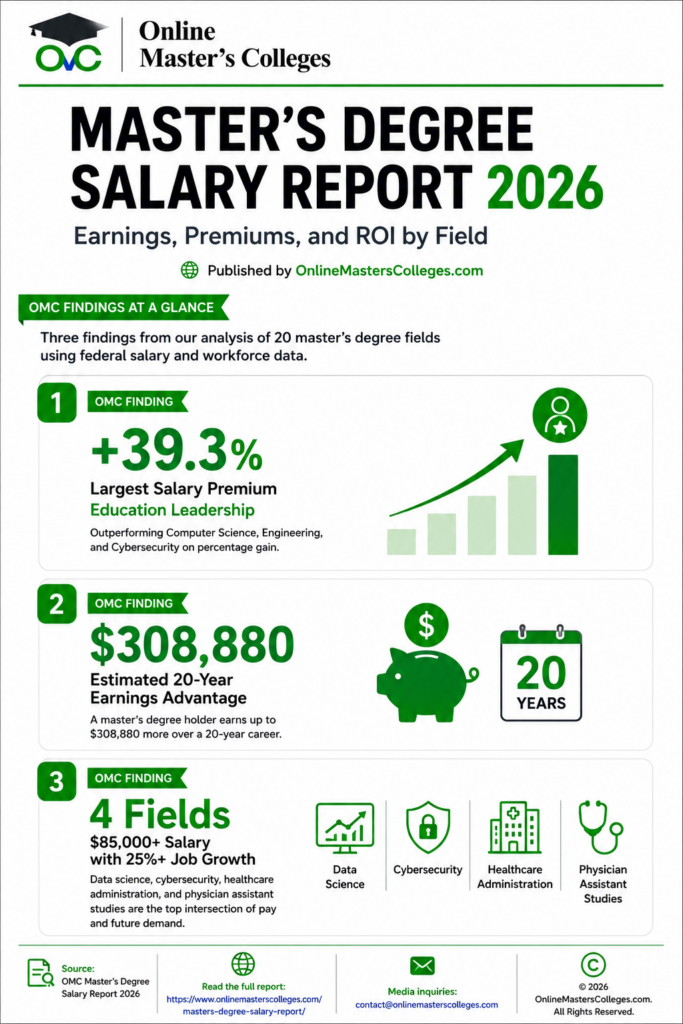
OMC Research Key Finding # 1
+39.3% Largest salary premium — Education Leadership
Education and social work outperform STEM fields on salary premium percentage because the master’s degree unlocks entirely new, higher-paying career tiers — not just an incremental raise in the same role.
OMC Research Key Finding # 2
$308,880 Estimated 20-Year Earnings Advantage
A master’s degree holder earning the current median earnings premium of approximately 19.3% accumulates an estimated $308,880 in additional earnings over a 20-year career.
OMC Research Key Finding # 3
4 fields Combine $85,000+ salary with 25%+ job growth
Data science, cybersecurity, healthcare administration, and physician assistant studies are the only fields in OMC’s analysis that clear both thresholds simultaneously — making them the strongest intersections of current pay and future demand.
Key Findings: Master’s Degree Salary Data at a Glance
Before diving into field-by-field breakdowns, here are the headline numbers that define the current master’s degree salary landscape. These findings are drawn from authoritative federal labor-market and education data, including the U.S. Bureau of Labor Statistics (BLS), the U.S. Census Bureau American Community Survey (ACS), and the National Center for Education Statistics (NCES), and are synthesized by OMC to provide a consistent comparison of master’s degree salary outcomes.
The data tells a nuanced story. A master’s degree does increase earning potential in nearly every field—but the magnitude of that increase varies enormously. In some disciplines, the salary premium justifies the investment several times over. In others, the financial case is thinner, and the degree’s value lies more in career access, credential requirements, or professional advancement than in raw salary growth. Understanding these differences is essential before committing two or more years and tens of thousands of dollars to a graduate program.
For a quick-reference answer on overall averages, see our breakdown of what the average salary with a master’s degree looks like . This report goes deeper — field by field, premium by premium, and growth projection by growth projection.
Overall Master’s Degree Earnings Premium
Workers whose highest level of education is a master’s degree earned median weekly wages of $1,840 in 2024, compared with $1,543 for workers holding a bachelor’s degree only, according to the U.S. Bureau of Labor Statistics.
The 2026 edition of this report uses the most recent finalized federal earnings data available at the time of publication.
Annualized over 52 weeks, those figures equal approximately $95,680 for master’s degree holders and $80,236 for bachelor’s degree holders. That represents an estimated annual earnings difference of $15,444, or approximately 19.3%.
Over a 20-year period, maintaining the same annual difference would equal approximately $308,880 in additional earnings before taxes, degree costs, career interruptions, raises, inflation, or investment returns are considered.
This is an aggregate comparison across occupations and fields. It does not mean every master’s degree produces a 19.3% salary increase, and it should not be interpreted as proof that the degree alone caused the earnings difference.
Key statistic: Master’s degree holders earned approximately 19.3% more than bachelor’s degree holders at the median in 2024.
Highest-Earning Fields
The highest-paying graduate fields continue to cluster in healthcare and technology. OMC’s analysis shows that nurse anesthesia, computer science/IT, engineering, finance, data science, healthcare administration, business, cybersecurity, physician assistant studies, and advanced nursing occupy the highest salary tiers among the graduate fields evaluated in this report. These fields command premium compensation because they combine advanced education with specialized expertise, technical complexity, licensure requirements, or direct organizational impact.
While individual occupations within each field may earn substantially more or less than the reported median, the field-level benchmarks provide a consistent comparison of salary outcomes across major master’s degree disciplines.
Key statistic: Healthcare, technology, engineering, and finance graduate fields dominate the highest-paying salary tiers analyzed in this report, with multiple fields exceeding $85,000 in median annual earnings.
Largest Bachelor’s-to-Master’s Salary Jumps
The fields where a master’s degree produces the largest percentage salary increase over a bachelor’s degree are not always the highest-paying in absolute terms. Healthcare administration, education leadership, social work, clinical psychology, and several healthcare-related professions consistently show some of the strongest salary premiums because a graduate degree often serves as a required credential for leadership positions, professional licensure, or advanced practice roles that are inaccessible to bachelor’s degree holders.
By contrast, fields such as computer science, engineering, and cybersecurity already offer strong earning potential at the bachelor’s level. In these disciplines, a master’s degree typically creates value through specialization, technical expertise, leadership opportunities, or access to higher-level positions rather than producing the largest percentage increase in salary.
Key statistic: The largest salary premiums generally occur in fields where a master’s degree functions as a gateway credential to new career pathways rather than simply increasing earnings within the same occupation.
Fastest-Growing High-Salary Fields
Some graduate fields stand out not only for their strong earning potential but also for exceptional long-term employment demand. OMC’s analysis shows that data science/analytics, cybersecurity, healthcare administration, physician assistant studies, nursing (NP/MSN), and computer science/IT combine above-average salaries with some of the strongest projected employment growth among the graduate fields evaluated in this report.
These fields represent the intersection of strong current compensation and sustained workforce demand. By contrast, some high-paying fields with slower projected growth may still offer outstanding career opportunities, but their long-term outlook depends more heavily on replacement hiring, specialization, or industry-specific demand than on rapid employment expansion.
Key statistic: Graduate fields in healthcare and technology continue to represent the strongest combination of salary potential and projected employment growth in OMC’s analysis.
Download the Full Report
Prefer an offline version of this research?
Download the complete Master’s Degree Salary Report, including salary comparisons across major graduate degree fields & salary premium analysis, bachelor’s-to-master’s salary premium analysis, employment growth projections, salary outlook comparisons, methodology documentation, and the OMC Salary Value Score framework.
The downloadable version is designed for prospective graduate students, higher education professionals, employers, researchers, journalists, and policymakers seeking a comprehensive view of master’s degree salary outcomes and long-term earnings potential.
The report includes:
- Salary data across 20 major master’s degree fields
- Bachelor’s-to-master’s salary premium comparisons
- Highest-paying master’s degree analysis
- Employment growth and salary outlook data
- OMC Salary Value Score methodology
- Key salary findings and decision guidance
- Source documentation and limitations
OMC Salary Value Score: Which Master’s Degrees Combine Salary and Growth Best?
While salary is important, compensation alone does not determine career value. A field paying $110,000 with minimal growth may offer a different long-term opportunity than a field paying $90,000 with rapid expansion and sustained hiring demand.
To evaluate both dimensions together, OMC developed the OMC Salary Value Score, a comparative framework that combines salary premium and projected employment growth into a single evaluation model.
The framework is designed to identify fields that deliver both strong earnings potential and favorable long-term labor market demand.
OMC Salary Value Scorecard
| Field | Salary Value Score |
|---|---|
| Nurse Practitioner / MSN | A+ |
| Healthcare Administration | A+ |
| Data Science / Analytics | A+ |
| Cybersecurity | A |
| Computer Science / IT | A |
| Physician Assistant Studies | A |
| Business (MBA) | B+ |
| Engineering | B+ |
| Public Health | B+ |
| Accounting | B |
About the OMC Salary Value Score
The OMC Salary Value Score is a comparative framework developed by OnlineMastersColleges.com to evaluate how effectively a graduate field combines earnings potential with long-term labor-market demand. The framework incorporates graduate field salary benchmarks and projected employment growth to compare major master’s degree pathways on a consistent basis.
Scores are assigned relative to other graduate fields evaluated by OMC and are intended as a comparative decision-support resource rather than a prediction of individual earnings or career outcomes.
An A+ rating indicates exceptional overall performance relative to other graduate fields analyzed by OMC, while lower grades reflect comparatively weaker performance across one or more evaluation criteria. The framework is designed to help students evaluate career opportunity more holistically than salary alone.
OMC Finding
Fields that combine strong salary premiums with double-digit job growth consistently outperform fields that rely on salary alone. Healthcare, data science, and cybersecurity emerge as the strongest overall combinations of compensation and future opportunity.
OMC Salary Finding
One of the strongest patterns in the data is that the highest-paying fields are not always the fields where a master’s degree creates the greatest financial value.
Several healthcare, counseling, and administrative disciplines generate larger percentage salary gains than many STEM fields because the master’s degree serves as a gateway credential that unlocks entirely new career pathways rather than simply improving existing earning potential.
This distinction helps explain why salary premium, salary level, and return on investment often produce different rankings.
Methodology and Data Sources
Transparency about where this data comes from — and what it can and cannot tell you — is essential for responsible interpretation. Salary figures are not uniform across sources, and understanding the methodology behind the numbers prevents misleading conclusions.
Primary Data Sources
- U.S. Bureau of Labor Statistics (BLS) Occupational Employment and Wage Statistics (OEWS)– Provides occupational wage benchmarks used throughout this report. Representative occupations were selected for each graduate field to provide consistent salary comparisons across disciplines.
- U.S. Bureau of Labor Statistics Occupational Outlook Handbook (OOH)- Provides projected employment growth, occupational outlook information, and career descriptions used in the salary outlook analysis.
- U.S. Census Bureau American Community Survey (ACS) – Provides educational attainment and earnings information used to support bachelor’s-to-master’s earnings comparisons where appropriate.
- National Center for Education Statistics (NCES) – Provides degree-completion data and academic field classifications used to organize graduate disciplines consistently throughout the report.
Salary Benchmark Methodology
Because graduate fields prepare students for multiple career pathways, OMC reports field-level salary benchmarks rather than the salary of a single occupation. Each benchmark reflects the broader labor market associated with that graduate discipline and is intended to provide a consistent basis for comparing salary outcomes across fields.
These field-level salary benchmarks should not be interpreted as the salary earned by every graduate holding a master’s degree in that field. Instead, they provide standardized reference points for comparing graduate career pathways using publicly available federal labor-market and education data.
OMC Analytical Framework
This report combines publicly available salary benchmarks, educational earnings data, and occupational outlook information with OMC’s comparative analysis. Salary premiums, comparative findings, and the OMC Salary Value Score are editorial analyses developed by OnlineMastersColleges.com using the underlying public data sources. They are intended as decision-support resources rather than predictions or guarantees of individual outcomes.
Limitations
Salary outcomes vary based on geography, industry, employer type, years of experience, specialization, and individual career path. The figures presented in this report are national benchmarks intended to support comparison across graduate fields and should not be interpreted as guaranteed earnings for any specific graduate or institution.
Average Salary by Master’s Degree Field
This table serves as the primary salary reference for this report. Rather than estimating salaries for every master’s degree holder, OMC uses graduate field salary benchmarks to illustrate the types of careers commonly associated with each graduate field. These benchmarks provide a standardized comparison across disciplines using publicly available federal wage data.
Each benchmark is paired with a typical salary range (25th–75th percentile) and representative career titles to illustrate how compensation varies within a field. While individual outcomes depend on factors such as industry, geographic location, employer, experience, and specialization, these benchmarks provide a consistent foundation for comparing graduate career pathways across major academic disciplines.
Salary benchmarks are presented in descending order by median annual earnings.
| Field / Subject Area | Median Annual Salary | Salary Range (25th–75th Percentile) | Common Job Titles |
|---|---|---|---|
| Nurse Anesthesia | $203,090 | $163,800–$229,760 | Certified Registered Nurse Anesthetist (CRNA) |
| Computer Science / IT | $109,020 | $85,500–$139,350 | Software Engineer, Data Scientist, Systems Architect |
| Engineering | $101,340 | $80,270–$127,110 | Mechanical Engineer, Civil Engineer, Electrical Engineer |
| Finance / Financial Engineering | $98,590 | $72,410–$131,480 | Financial Analyst, Quantitative Analyst, Portfolio Manager |
| Data Science / Analytics | $96,710 | $75,200–$126,830 | Data Scientist, Machine Learning Engineer, Analytics Manager |
| Healthcare Administration | $91,580 | $68,350–$119,840 | Hospital Administrator, Health Services Manager |
| Business (MBA) | $89,740 | $64,200–$122,500 | General Manager, Operations Director, Management Consultant |
| Cybersecurity / Information Security | $88,560 | $69,400–$112,700 | Information Security Analyst, CISO, Security Architect |
| Physician Assistant Studies | $86,370 | $72,900–$99,120 | Physician Assistant |
| Nursing (NP/MSN) | $84,460 | $68,790–$102,340 | Nurse Practitioner, Clinical Nurse Specialist |
| Public Administration / Policy | $78,260 | $57,200–$102,900 | City Manager, Policy Analyst, Nonprofit Director |
| Accounting | $77,250 | $60,120–$97,910 | CPA, Audit Manager, Controller |
| Psychology (Clinical/Counseling) | $73,810 | $53,600–$95,480 | Licensed Psychologist, Clinical Counselor |
| Education Leadership | $72,950 | $56,800–$94,220 | School Principal, Curriculum Director, Superintendent |
| Communications / Media | $69,420 | $49,100–$92,800 | Communications Director, PR Manager, Media Strategist |
| Social Work (MSW) | $65,280 | $46,300–$80,120 | Licensed Clinical Social Worker, Case Manager |
| Criminal Justice | $63,470 | $45,900–$83,600 | FBI Agent, Police Captain, Corrections Administrator |
| Education (Teaching/Curriculum) | $62,770 | $48,400–$77,830 | Master Teacher, Instructional Coordinator, College Lecturer |
| Public Health (MPH) | $62,360 | $46,100–$82,400 | Epidemiologist, Health Educator, Program Director |
| Liberal Arts / Humanities | $58,120 | $40,800–$76,500 | Museum Curator, Editor, Academic Advisor |
Interpreting the data: The spread between the highest- and lowest-paying fields is dramatic — more than $140,000 separates nurse anesthesia from liberal arts at the median. But within most fields, the 25th-to-75th percentile range spans $30,000–$50,000, underscoring that field choice is only part of the equation. A computer science graduate working at a large tech company will earn substantially more than one in a government IT role, even though both hold the same degree.
The clustering is also revealing. Clinical healthcare fields (nurse anesthesia, PA studies, NP) occupy distinct salary tiers driven by licensure requirements and shortage-driven demand. STEM and business fields occupy the $85,000–$110,000 range. Education, social work, and humanities cluster below $75,000 — not because they lack importance, but because compensation in these sectors is structurally lower, often funded by public budgets.
Students considering an online master’s in computer science or an online master’s in engineering will find some of the strongest raw salary numbers. But those pursuing an online master’s in education or social work should evaluate ROI differently — looking at career access, licensure eligibility, and salary premiums relative to their bachelor ‘s-level baseline rather than absolute earning levels.
Select a graduate field below to explore salary benchmarks, earnings premiums, employment outlook, and career-specific salary information.
Compare Master’s Degree Salary Outcomes
While the table above provides a comprehensive comparison of graduate field salary benchmarks, many students want to explore how earnings differ based on their intended career path, experience level, location, or employment sector.
The OMC Master’s Salary Explorer builds on the salary data presented throughout this report by allowing you to interact with the same underlying research. Select a graduate field to view national salary benchmarks, bachelor’s-to-master’s salary premiums, projected employment growth, common career pathways, and OMC Salary Value Scores. You can also estimate how salary expectations change based on career stage, state, and employment sector.
Unlike the summary tables above, the Salary Explorer allows you to evaluate a specific graduate field in greater depth while maintaining the same consistent methodology used throughout this report.
Master's Degree Salary Explorer
Explore salary benchmarks, bachelor's-to-master's premiums, growth outlook, and ROI data — filtered for your degree, location, experience, and sector.
Select a graduate field above to see salary data, premiums, and ROI.
The Salary Explorer is designed to help students evaluate individual graduate fields using the same benchmarks presented throughout this report. The following sections examine one of the most important factors behind those salary differences: how much additional earning power a master’s degree provides compared with a bachelor’s degree in the same field.
Master’s vs. Bachelor’s Degree Salary Premium by Field
Raw salary numbers tell you what a field pays. The salary premium tells you what the master’s degree itself is worth in that field — the incremental earning power you gain by investing in two additional years of education. This distinction matters enormously. A field with a $90,000 median master’s salary might look attractive, but if bachelor’s holders in the same field earn $85,000, the premium is only $5,000 — a weak financial case for a degree that may cost $40,000–$80,000 to complete.
The table below compares median earnings for bachelor’s and master’s degree holders in each field, then calculates both the dollar premium and the percentage premium. A percentage premium is often more informative than a dollar premium because it normalizes for baseline salary differences across fields.
| Field | Bachelor’s Median Salary | Master’s Median Salary | Salary Premium ($) | Salary Premium (%) |
|---|---|---|---|---|
| Education Leadership | $52,380 | $72,950 | +$20,570 | +39.3% |
| Social Work (MSW) | $47,560 | $65,280 | +$17,720 | +37.3% |
| Healthcare Administration | $67,900 | $91,580 | +$23,680 | +34.9% |
| Psychology (Clinical/Counseling) | $55,320 | $73,810 | +$18,490 | +33.4% |
| Public Health (MPH) | $48,780 | $62,360 | +$13,580 | +27.8% |
| Nursing (NP/MSN) | $67,490 | $84,460 | +$16,970 | +25.1% |
| Public Administration / Policy | $63,100 | $78,260 | +$15,160 | +24.0% |
| Criminal Justice | $51,690 | $63,470 | +$11,780 | +22.8% |
| Business (MBA) | $73,840 | $89,740 | +$15,900 | +21.5% |
| Education (Teaching/Curriculum) | $52,200 | $62,770 | +$10,570 | +20.3% |
| Accounting | $64,780 | $77,250 | +$12,470 | +19.2% |
| Communications / Media | $58,640 | $69,420 | +$10,780 | +18.4% |
| Data Science / Analytics | $82,360 | $96,710 | +$14,350 | +17.4% |
| Finance / Financial Engineering | $84,200 | $98,590 | +$14,390 | +17.1% |
| Computer Science / IT | $93,710 | $109,020 | +$15,310 | +16.3% |
| Engineering | $87,560 | $101,340 | +$13,780 | +15.7% |
| Liberal Arts / Humanities | $50,840 | $58,120 | +$7,280 | +14.3% |
| Cybersecurity / Info Security | $78,500 | $88,560 | +$10,060 | +12.8% |
What the premiums reveal:
The fields with the largest percentage premiums are not the highest-paying in absolute terms. Education leadership, social work, healthcare administration, and clinical psychology show premiums of 33–39%—the largest on this list. The reason is structural: in these fields, the master’s degree is a gatekeeping credential. You cannot become a licensed clinical social worker, a school principal, or a hospital administrator without one. The degree does not just incrementally improve your salary — it unlocks an entirely different job category with a different pay scale.
By contrast, computer science, engineering, and cybersecurity show premiums in the 13–16% range. Bachelor’s degree holders in these fields already earn strong salaries, and the master’s degree adds value primarily through specialization (machine learning, systems engineering, security architecture) rather than licensure requirements. The financial case for a master’s in these STEM fields often depends on whether you’re targeting a specific role that requires or strongly prefers graduate credentials.
The MBA sits in the middle at 21.5% — a meaningful but not dramatic premium. MBA ROI is heavily influenced by program selectivity, pre-MBA work experience, and post-MBA industry placement, making it one of the most variable degrees in terms of individual outcomes.
Students in fields like nursing see a 25% premium that becomes even more compelling when considering that NP licensure—accessible only through a master’s or doctoral program—opens clinical independence and prescriptive authority that fundamentally changes career trajectory.
Highest-Paying Master’s Degrees: Top Fields by Salary
While the comprehensive table above covers all major fields, this section isolates the top 12 highest-earning master’s degree fields and examines the drivers behind their premium compensation. A high salary is not random—it results from specific market forces, including labor shortages, technical complexity, regulatory requirements, and revenue impact of the roles these degrees qualify graduates for.
| Rank | Field | Median Salary | Key Drivers of High Pay |
|---|---|---|---|
| 1 | Nurse Anesthesia (CRNA) | $203,090 | Acute shortage, high clinical risk responsibility, licensure barrier |
| 2 | Computer Science / IT | $109,020 | Tech sector demand, scalable business impact, talent competition |
| 3 | Engineering | $101,340 | Technical specialization, infrastructure investment, PE licensure |
| 4 | Finance / Financial Engineering | $98,590 | Revenue-generating roles, quantitative complexity, Wall Street demand |
| 5 | Data Science / Analytics | $96,710 | Emerging field scarcity, AI/ML demand, cross-industry applicability |
| 6 | Healthcare Administration | $91,580 | System complexity, regulatory burden, aging population demand |
| 7 | Business (MBA) | $89,740 | Leadership pipeline, consulting/finance placement, network effects |
| 8 | Cybersecurity / Info Security | $88,560 | Threat landscape growth, regulatory compliance, critical infrastructure |
| 9 | Physician Assistant Studies | $86,370 | Clinical demand, shortage-driven hiring, scope expansion |
| 10 | Nursing (NP/MSN) | $84,460 | Primary care shortage, prescriptive authority, rural access mandates |
| 11 | Public Administration / Policy | $78,260 | Senior government roles, political/nonprofit leadership, management scope |
| 12 | Accounting | $77,250 | CPA advancement, audit/controller roles, regulatory complexity |
Why these fields pay more:
Three forces dominate this list. The first is shortage-driven demand : clinical healthcare fields like nurse anesthesia, PA studies, and nurse practitioner roles exist in a structural labor shortage that shows no sign of easing over the next decade. Employers compete aggressively for licensed providers, and compensation reflects that competition.
The second is technical complexity and business impact : fields like computer science, data science, engineering, and finance pay premium salaries because master’s-level practitioners handle problems with direct, measurable impact on organizational revenue, security, or infrastructure. A machine learning engineer who improves a recommendation algorithm by 2% can generate millions in incremental revenue—compensation scales with that leverage.
The third is credentialing and gatekeeping : healthcare administration, accounting (at the controller/partner level), and public administration all have career ceilings that require graduate education. The degree is not optional for advancement; it’s mandatory. This creates a structural salary floor for master’s holders that doesn’t exist in fields where the degree is merely preferred.
For a curated editorial ranking of the highest-paying options with program recommendations, see our highest-paying master’s degrees ranking. That page evaluates specific programs; this section presents the underlying salary data driving those rankings.
Salary Growth and Job Outlook by Field
Current salary is a snapshot. Projected job growth helps indicate whether demand for a career is expected to strengthen, remain stable, or weaken over time. Students investing in a master’s degree should evaluate both earning potential and long-term labor-market demand rather than salary alone.
The table below combines salary benchmarks associated with graduate career pathways with the latest available U.S. Bureau of Labor Statistics projected employment growth estimates. Growth outlook categories are based on how each occupation compares with the overall labor market and are intended as a comparative guide rather than a prediction of individual career outcomes.
| Field | Median Salary | Projected Job Growth (10-Year) | Growth Outlook |
|---|---|---|---|
| Data Science / Analytics | $96,710 | +35% | Strong |
| Nurse Practitioner (NP/MSN) | $84,460 | +38% | Strong |
| Cybersecurity / Info Security | $88,560 | +32% | Strong |
| Physician Assistant Studies | $86,370 | +27% | Strong |
| Healthcare Administration | $91,580 | +28% | Strong |
| Computer Science / IT | $109,020 | +23% | Strong |
| Public Health (MPH) | $62,360 | +17% | Strong |
| Psychology (Clinical/Counseling) | $73,810 | +14% | Moderate |
| Social Work (MSW) | $65,280 | +9% | Moderate |
| Business (MBA) | $89,740 | +6% | Moderate |
| Education Leadership | $72,950 | +5% | Moderate |
| Accounting | $77,250 | +4% | Moderate |
| Engineering | $101,340 | +4% | Moderate |
| Finance / Financial Engineering | $98,590 | +8% | Moderate |
| Public Administration / Policy | $78,260 | +5% | Moderate |
| Criminal Justice | $63,470 | +3% | Moderate |
| Education (Teaching/Curriculum) | $62,770 | +1% | Weak |
| Communications / Media | $69,420 | +2% | Weak |
| Nurse Anesthesia (CRNA) | $203,090 | +9% | Moderate |
| Liberal Arts / Humanities | $58,120 | -1% | Weak |
The strongest combinations:
The most compelling intersections of salary and growth are in data science, cybersecurity, healthcare administration, and physician assistant studies — four fields that combine $85,000+ median salaries with 25–28% projected growth rates that are 8–12 times the national average for all occupations. Students entering these fields can expect strong starting salaries with continued upward pressure as demand outstrips supply.
Healthcare administration is another standout: $91,580 median with 28% growth, driven by an aging population, expanding health systems, and increasing regulatory complexity. Computer science at $109,020 with 23% growth remains one of the highest-value master’s degree investments available.
Caution signals:
The teaching/curriculum track in education shows near-flat growth (+1%), which — combined with a below-median salary of $62,770 — makes the financial case challenging. Similarly, liberal arts and humanities show a slight employment decline alongside the lowest median salary on the list. This doesn’t mean these degrees are worthless, but students pursuing them should be clear-eyed about the financial trajectory and ensure their motivations extend beyond salary.
Nurse anesthesia appears in the “Moderate” growth category despite its exceptional salary. At $203,090 median, the financial case is overwhelming, regardless—even moderate growth in a field this well-compensated represents a strong career trajectory.
How Industry and Sector Affect Master’s Degree Salaries
Field-level median salaries are useful starting points, but they obscure a critical variable: the industry or sector where you actually work. The same master’s degree can yield dramatically different compensation depending on whether you land in the private sector, government, healthcare, education, or nonprofit work. Understanding this variation prevents students from making decisions based on headline salary numbers that may not reflect their likely career path.
An MBA graduate entering investment banking or management consulting can expect first-year compensation packages (salary plus bonus) of $150,000–$200,000 at top firms. The same MBA applied in nonprofit management typically yields $65,000–$85,000. That’s a 2–3x difference for the same degree credential. The MBA’s median of $89,740 is a blended average that doesn’t describe either career path accurately. Students pursuing an online MBA should research placement outcomes by industry, not just overall salary statistics.
A nurse practitioner working in a hospital emergency department or surgical specialty group can earn $95,000–$120,000, while the same NP credential applied in a community health center or school-based clinic may pay $68,000–$80,000. Geographic market amplifies this: NPs in California and New York metro areas routinely earn 30–40% more than those in rural southern states, even within the same practice setting.
Master’s in public administration holders working in federal agencies (GS-12 through GS-15 scale) earn $80,000–$130,000 with strong benefits and retirement packages. The same MPA applied in local government or small nonprofit work typically pays $50,000–$70,000. Federal placement substantially changes the ROI calculation for this degree.
BLS data allows filtering by industry sector within occupational categories. The BLS Industry-Occupation Matrix (available at bls.gov) breaks down employment and wages by NAICS industry code for each occupation. University career services offices and alumni networks are also valuable sources for industry-specific placement data. When evaluating programs, ask directly: “Where do your graduates work, and what do they earn by sector?” Programs that can answer this question with data are more trustworthy than those offering only aggregate salary statistics.
If you know your target industry, program fit matters more than program prestige in many cases. An MBA program with strong consulting and finance placement pipelines will serve a Wall Street-bound student better than a higher-ranked program focused on entrepreneurship and social enterprise — and vice versa. The same principle applies across fields. Match the program to the sector, and the salary data becomes far more predictive of your actual outcomes.
How Experience Level Affects Earnings with a Master’s Degree
The salary premium of a master’s degree is not static across a career. In most fields, the premium starts modestly, widens during mid-career, and reaches its full magnitude at senior levels. Understanding this trajectory matters because students at different career stages face different ROI calculations.
At the entry level, the master’s degree premium is often the smallest in dollar terms but most important in access terms. In fields like computer science and engineering, a new master’s graduate may earn only $5,000–$10,000 more than a bachelor’s counterpart—the premium is real but not transformative. However, certain roles (data scientist, machine learning engineer, and systems architect) are significantly more accessible with a master’s degree, meaning the credential’s value lies as much in opening doors as in immediate salary.
In clinical and licensure-dependent fields, the picture is different. An entry-level nurse practitioner with an MSN immediately earns $20,000+ more than an RN with a bachelor’s because the degree grants prescriptive authority and independent practice capability. The master’s degree salary premium in nursing is fully realized from day one.
This is where the master’s degree premium accelerates most dramatically in business, management, and leadership fields. An MBA holder who has risen to director or VP level will have substantially outpaced a bachelor’s-level peer—not just in salary but in access to equity compensation, profit sharing, and bonus structures that don’t appear in base salary data. Mid-career is also when education leadership degrees show their full value: the jump from classroom teacher to assistant principal or principal is both a credential milestone and a compensation milestone.
In technical fields, mid-career master’s holders increasingly differentiate through specialization. A software engineer with an MS in machine learning and 10 years of experience commands a premium that a generalist bachelor’s-level engineer cannot match, particularly at companies investing heavily in AI and data infrastructure.
At the executive and senior practitioner level, the master’s degree often becomes table stakes rather than a differentiator. Nearly all hospital CEOs, school superintendents, senior government officials, and corporate VPs hold graduate degrees. The premium at this level is less about what the degree adds and more about what its absence would cost—namely, disqualification from consideration for these roles.
One important exception: in fields where doctoral degrees are the terminal credential (clinical psychology, some academic and research roles), the master’s degree reaches a ceiling at mid-career, and the doctoral degree becomes the differentiating credential for senior roles.
- Pre-career students (no work experience): Focus on fields where the master’s degree provides immediate licensure or role access. STEM and clinical healthcare deliver the fastest salary returns. Consider whether employer tuition assistance might be available after a few years of work experience — starting a career and returning for the master’s may be more cost-effective in some fields.
- Early-career professionals (2–5 years of experience): You’re in the strongest position to leverage a master’s degree. You have enough experience to contextualize graduate coursework, and the degree will position you for the mid-career acceleration phase. Institutions like Western Governors University and Southern New Hampshire University offer flexible online formats designed for working professionals in this stage.
- Mid-career professionals (10+ years of experience): Evaluate carefully. If the degree unlocks a specific role (principalship, clinical licensure, senior management) with a clear salary jump, the ROI is straightforward. If it’s primarily for enrichment or modest salary improvement, calculate whether the time and financial cost justify the incremental gain at this career stage.
Is a Master’s Degree Worth It? Using Salary Data to Decide
The salary data in this report provides the financial inputs for the most important question prospective graduate students face: Is this degree worth the investment? The answer is field-specific, career-stage-specific, and cost-specific—which is why a framework is more useful than a blanket yes or no.
To assess whether a master’s degree makes financial sense in your situation, work through these five dimensions:
Include tuition, fees, books, and opportunity cost (foregone earnings while studying). For a full-time, two-year program at a private university, the total cost can exceed $100,000. For an online program at a public university or competency-based institution, it may be $15,000–$40,000. This range dramatically changes the math. Use the graduate school cost calculator to model your specific scenario, including employer tuition assistance if available.
For students focused on affordability, our most affordable online master’s programs ranking identifies programs that minimize the cost side of the equation.
Divide the total degree cost by the annual salary premium. If the degree costs $40,000 and yields a $15,000 annual premium, the payback period is approximately 2.7 years — a strong investment. If the degree costs $80,000 and yields a $7,000 annual premium, the payback period extends beyond 11 years — a much harder case to justify on financial grounds alone.
In some fields, the master’s degree is not optional. You cannot practice as a nurse practitioner, licensed clinical social worker, school psychologist, or physician assistant without one. In these fields, the ROI question is less “is the premium worth it?” and more “can I afford not to get this degree if I want this career?” The salary premium is additive to the career access value.
Salary data captures cash compensation. It does not capture career satisfaction, intellectual growth, professional network expansion, geographic mobility, or alignment with personal values. A master’s in psychology or social work may not compete with computer science on raw earnings, but if clinical practice is your calling, the financial calculation is secondary to career fulfillment.
The strongest financial case for a master’s degree exists when three conditions align: the salary premium in your field exceeds 20%, the total degree cost is manageable (under $50,000 or employer-subsidized), and the degree is required or strongly preferred for your target role. Fields that consistently demonstrate strong financial value are those where a master’s degree combines meaningful earnings growth, manageable educational costs, and access to higher-level or licensed professional roles. Healthcare, advanced nursing, healthcare administration, education leadership, and selected business and technology pathways frequently meet these criteria, though outcomes vary by program cost, occupation, and individual career path.
If you’re in a field with a sub-15% salary premium, the degree costs more than $60,000, and you already have access to your target role without a master’s, the financial case is thin. This doesn’t mean the degree is wrong — it means the decision should rest on career access, personal goals, or credential requirements rather than salary improvement. Liberal arts, communications, and some STEM fields, where bachelor’s holders already earn strong salaries, fall into this category for some students.
For a broader evaluation of master’s degree value beyond salary data, see our analysis of whether a master’s degree is worth it, which examines career satisfaction, employability, and credential value alongside financial returns.
Cite This Report
Suggested Citation (APA Style)
OnlineMastersColleges.com. (2026). Master’s Degree Salary Report 2026: Earnings by Field, Premium & ROI Data. OnlineMastersColleges.com.
Suggested Citation (Journalistic Style)
OnlineMastersColleges.com, “Master’s Degree Salary Report 2026: Earnings by Field, Premium & ROI Data,” 2026.
Suggested Attribution
Source: OnlineMastersColleges.com Master’s Degree Salary Report 2026
URL: https://www.onlinemasterscolleges.com/masters-degree-salary-report/
Frequently Asked Questions About Master’s Degree Salaries
The median annualized earnings for workers whose highest level of education is a master’s degree are approximately $95,680, based on U.S. Bureau of Labor Statistics median weekly earnings data for 2024. This represents national median earnings across all occupations and industries rather than the salary for any specific profession.
Actual earnings vary substantially by field. Graduate field salary benchmarks in this report range from approximately $58,000 in some humanities-related career pathways to more than $200,000 in advanced clinical specialties such as nurse anesthesia. For more details on national averages and field-specific benchmarks, see our full breakdown of average master’s degree salary.
The highest-paying master’s degrees are nurse anesthesia (CRNA) at $203,090 median, computer science/IT at $109,020, engineering at $101,340, finance/financial engineering at $98,590, and data science/analytics at $96,710. These fields command top salaries due to combinations of labor shortages, technical complexity, and direct business or clinical impact. Our highest-paying master’s degrees ranking provides program-specific recommendations within these fields.
Based on U.S. Bureau of Labor Statistics earnings data, workers whose highest level of education is a master’s degree earn approximately 19.3% more at the median than workers whose highest level of education is a bachelor’s degree. Annualized, this represents an estimated earnings difference of about $15,444.
The actual earnings premium varies considerably by field. Education leadership and social work show some of the largest percentage salary premiums because a master’s degree serves as a gateway to higher-level roles, while fields such as computer science, engineering, and cybersecurity show smaller percentage premiums because bachelor’s degree holders already earn comparatively high salaries. The salary premium table in this report provides detailed field-by-field comparisons.
The answer depends on three factors: the salary premium in your field, the total cost of the degree, and whether the credential unlocks roles that would otherwise be inaccessible.
OMC’s analysis shows that master’s degrees deliver the strongest financial value when they combine a meaningful salary premium with manageable tuition costs and strong labor-market demand. In fields such as nursing, healthcare administration, education leadership, data science, and business, graduates often recover their educational investment within a relatively short period through increased earnings and expanded career opportunities.
By contrast, fields with smaller salary premiums or higher educational costs may take substantially longer to produce a positive financial return. In these cases, career advancement, licensure requirements, leadership opportunities, and personal goals may be equally important considerations.
As a general rule, students should evaluate a master’s degree using salary growth, degree cost, projected job demand, and career-access benefits rather than salary alone.
For a broader analysis of graduate degree value, see our guide on whether a master’s degree is worth it. For cost-specific planning, use the graduate school cost calculator to estimate your potential return on investment.
In most fields, yes. BLS salary data does not differentiate between online and on-campus degree holders, and most employers evaluate candidates based on the degree, credential, accreditation, and institution—not the delivery format. A master’s in nursing from Arizona State University earned online carries the same credential weight as one completed on campus. The exceptions are niche fields where on-campus networking or lab access directly affects placement outcomes (e.g., some MBA programs where on-campus recruiting events drive placement into top-tier firms). For most working professionals, an accredited online master’s degree delivers equivalent salary outcomes at a lower total cost due to reduced living expenses and continued employment during study.
The master’s degree salary premium generally widens with experience. At entry level (0–5 years), the premium in many non-clinical fields is modest — $5,000–$10,000 above bachelor’s peers. At mid-career (5–15 years), the premium accelerates significantly as master’s holders access management, leadership, and specialized technical roles. At senior levels (15+ years), the degree often becomes a baseline requirement for executive positions rather than a differentiator. The exception is clinical and licensure-dependent fields (nursing, social work, and education leadership), where the full premium is realized immediately upon degree completion and licensure.
The largest percentage salary premiums belong to fields where the master’s degree is a gatekeeping credential: education leadership (+39.3%), social work (+37.3%), healthcare administration (+34.9%), and clinical/counseling psychology (+33.4%). In these fields, the degree does not just improve salary incrementally—it unlocks entirely new job categories (school principal, licensed clinical social worker, hospital administrator) with fundamentally different pay scales. By contrast, fields where bachelor’s holders already earn high salaries (computer science, engineering, and cybersecurity) show smaller percentage premiums of 13–16%, though the dollar amounts can still be meaningful.