
- Snapshot Card
- Start Here
- What Penn State World Campus Is Known For
- Business
- Education
- Engineering
- IT, Data & Cybersecurity
- Psychology
- Healthcare & Public Administration
- Criminal Justice & Homeland Security
- Geosciences & GIS
- Communication & Other Specialized Programs
- Comparison
- Penn State World Campus is
- Program Cost
Penn State World Campus’s Snapshot
40+
Online master’s programs
$862–1,082
Per credit hour
~$26–52k
Typical total cost
Since 1998
Online since
Key policies
Institution type
Public, Big Ten R1 university
Regional accreditation
MSCHE
Admissions model
Rolling (education) · Deadline-based (most programs)
GRE/GMAT required
Not required (most programs)
Out-of-state premium
None — flat rate for all
Notable Programmatic Accreditations
- AACSB
- ABET
- CAHME
- NASPAA
- NSA/DHS CAE-CD

- Edited By Jeevan D'Souza
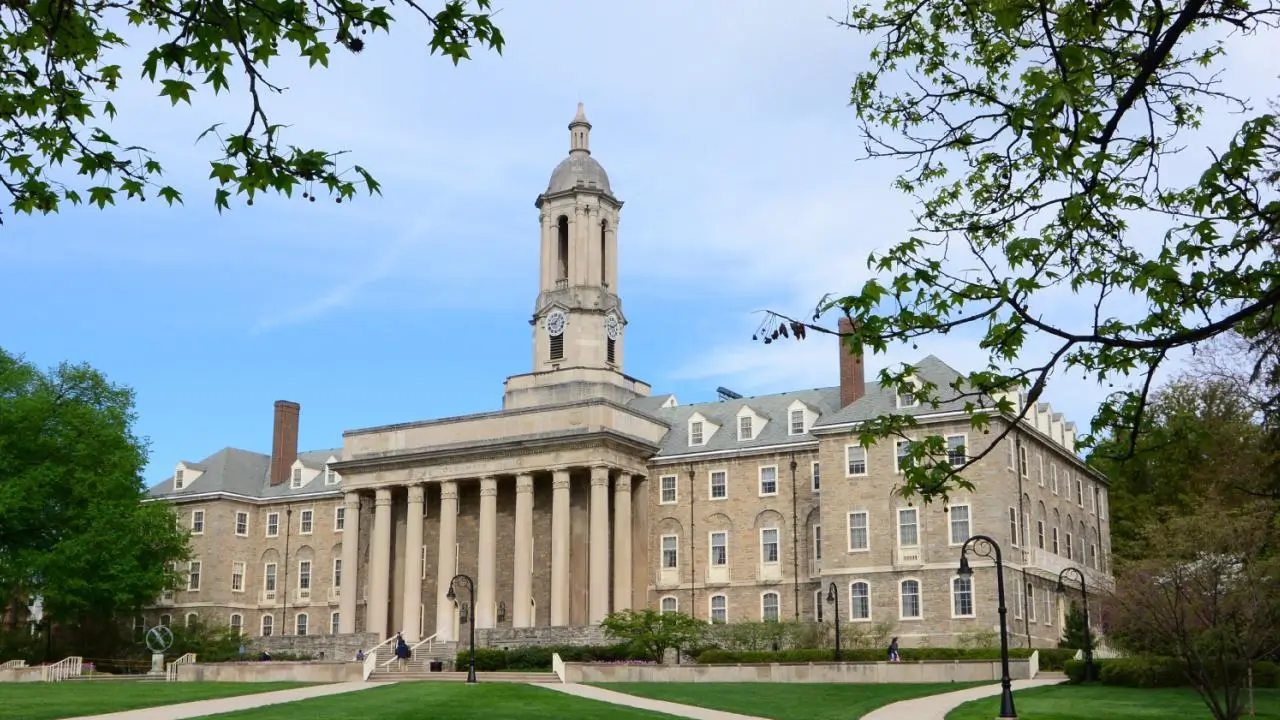
Start Here: Compare Penn State World Campus by What Matters Most
- Compare institutional strengths → Particularly strong in engineering, GIS/geosciences, supply chain, homeland security, and education
- Compare accreditation → MSCHE regional accreditation plus AACSB, ABET, CAHME, NASPAA, and NSA cybersecurity designations
- Compare prestige vs cost → Premium-priced online programs backed by a nationally recognized Big Ten R1 research university brand
- Compare flexibility → Mostly asynchronous programs with strong online infrastructure, though admissions timelines are less flexible than rolling-enrollment competitors
- Compare alternatives → Arizona State University, Purdue University, University of Florida, and University of Maryland Global Campus
Penn State World Campus is the online arm of the Pennsylvania State University, a public R1 research institution accredited by the Middle States Commission on Higher Education. World Campus launched in 1998 and now offers more than 40 online master’s degrees spanning business, engineering, education, data analytics, geosciences, public administration, healthcare, and several niche fields.
The most important thing to know upfront: a degree earned through World Campus is identical to a degree earned at University Park. Your diploma, your transcript, and your alumni status carry the full weight of the Penn State name — there is no separate designation for online students.
Penn State World Campus is not the cheapest online option, and it’s not trying to be. Its value proposition rests on catalog breadth, R1 research prestige, established online infrastructure, and employer name recognition — particularly in engineering, geosciences, supply chain, and education.
What Penn State World Campus Is Known For
Penn State World Campus has genuine, evidence-based strengths in several areas. These aren’t marketing claims — they reflect where the university’s online programs carry the most weight with employers, peers, and accrediting bodies.
1. Engineering depth and prestige.
Penn State’s College of Engineering is consistently ranked among the top 20 nationally. The online Master of Engineering programs in electrical, mechanical, systems, aerospace, and nuclear engineering draw on the same faculty and carry the same ABET-relevant context as the on-campus programs. For working engineers who need a top-tier MEng without relocating, this is one of the strongest options in the country.
2. World-class geosciences and GIS.
Penn State’s geography program is consistently ranked #1 in the United States. The online Master of Geographic Information Systems (MGIS) and Master of Professional Studies in Geodesign leverage that departmental strength in a way few competitors can match. If spatial analysis, GIS, or geodesign is your field, Penn State is the default choice.
3. Broad, AACSB-accredited business portfolio.
The online MBA carries AACSB accreditation and the Penn State Smeal College of Business brand. Beyond the MBA, the supply chain management, project management, human resources, and finance programs round out one of the widest online business catalogs at a major public university.
4. Deep education catalog.
Five distinct MEd specializations — curriculum and instruction, educational leadership, learning design and technology, special education, and higher education — offer practicing educators multiple pathways at a moderate per-credit rate ($862/credit), making the education programs among the most affordable in the Penn State World Campus portfolio.
5. Homeland security and intelligence specializations.
The Master of Professional Studies in Homeland Security offers six concentrations, including counterterrorism, cyber threat analytics, and geospatial intelligence. Penn State’s proximity to federal agencies and defense contractors in the mid-Atlantic corridor gives this program employer connections that generic criminal justice programs lack.
6. One of the oldest and most mature online operations.
With 25+ years of online delivery, Penn State World Campus has had time to refine its learning management systems, student support infrastructure, and asynchronous course design in ways that newer online entrants are still catching up to.
These five programs represent Penn State World Campus at its strongest — where institutional reputation, program design, and market demand align.
Master of Geographic Information Systems (MGIS)
Penn State’s #1-ranked geography department makes this arguably the best online GIS program in the country. 34 credits, $1,001/credit, fully online. If your career depends on spatial data, geospatial analysis, or geodesign, this is the flagship.
Master of Engineering in Electrical Engineering
A 30-credit MEng backed by a top-20 engineering college and ABET context. At $1,001/credit (~$30,030 total), it’s not cheap — but for working engineers at defense contractors, energy companies, or tech firms, the Penn State engineering brand opens doors that many cheaper alternatives don’t.
Master of Business Administration (MBA)
AACSB-accredited, 48 credits, $1,082/credit (~$51,936 total). GMAT/GRE waivers available. The cost is premium for a public university MBA, but the Smeal College brand and Big Ten alumni network provide tangible career leverage — especially in the Northeast and mid-Atlantic corporate markets.
Master of Health Administration (MHA)
One of the few CAHME-accredited online MHA programs nationally. 39 credits at $1,001/credit (~$39,039). For professionals targeting hospital administration, health system management, or healthcare consulting, the CAHME accreditation is a meaningful differentiator. See our broader guide to online MHA programs for context on how this compares.
Master of Professional Studies in Homeland Security
Six specialized concentrations, including cyber threat analytics and geospatial intelligence. 33 credits at $1,001/credit. Penn State’s NSA Center of Academic Excellence designation and its geographic proximity to federal agencies give this program employer credibility that generic criminal justice programs typically can’t match.
Penn State World Campus organizes its 40+ online master’s programs across a wide range of subject areas. Below is a structured overview grouped by discipline, with links to relevant OMC subject hubs where they exist.
Business
Penn State’s Smeal College of Business anchors a broad business portfolio. The MBA and Master of Finance both carry AACSB accreditation. The professional studies programs in supply chain management, project management, human resources, and organization development operate at a slightly lower per-credit rate ($1,001 vs. $1,082).
| Program | Credits | Cost/Credit | Total Est. | Accreditation |
|---|---|---|---|---|
| MBA | 48 | $1,082 | $51,936 | AACSB |
| Master of Finance | 30 | $1,082 | $32,460 | AACSB |
| MPS in Supply Chain Management | 33 | $1,001 | $33,033 | — |
| MPS in Project Management | 33 | $1,001 | $33,033 | — |
| MPS in Human Resources & Employment Relations | 33 | $1,001 | $33,033 | — |
| MPS in Organization Development & Change | 33 | $1,001 | $33,033 | — |
For MBA comparisons that include operations and supply chain focus areas, see our ranking of online MBA programs in operations management .
Education
Education programs are among the most affordable in the World Campus catalog at $862/credit. All five MEd programs use rolling admissions.
| Program | Credits | Cost/Credit | Total Est. | Concentrations |
|---|---|---|---|---|
| MEd in Curriculum & Instruction | 30 | $862 | $25,860 | Children’s Literature, Elementary Ed, Math Ed, STEM Ed, World Languages, Curriculum & Supervision |
| MEd in Educational Leadership | 30 | $862 | $25,860 | — |
| MEd in Learning Design & Technology | 30 | $862 | $25,860 | — |
| MEd in Special Education | 33 | $862 | $28,446 | — |
| MEd in Higher Education | 30 | $862 | $25,860 | — |
Engineering
Penn State engineering is a top-20 program nationally. The online Master of Engineering degrees carry the same departmental rigor as on-campus equivalents.
| Program | Credits | Cost/Credit | Total Est. | Notes |
|---|---|---|---|---|
| MEng in Electrical Engineering | 30 | $1,001 | $30,030 | ABET context |
| MEng in Mechanical Engineering | 30 | $1,001 | $30,030 | ABET context |
| MEng in Systems Engineering | 30 | $1,001 | $30,030 | — |
| MEng in Aerospace Engineering | 30 | $1,001 | $30,030 | — |
| MEng in Nuclear Engineering | 30 | $1,001 | $30,030 | — |
| MPS in Renewable Energy & Sustainability Systems | 33 | $1,001 | $33,033 | — |
IT, Data & Cybersecurity
Penn State’s data and cybersecurity programs benefit from NSA designation and growing industry demand.
| Program | Credits | Cost/Credit | Total Est. | Notes |
|---|---|---|---|---|
| MPS in Data Analytics | 33 | $1,001 | $33,033 | — |
| MPS in Applied Statistics | 30 | $1,001 | $30,030 | — |
| MPS in Artificial Intelligence | 33 | $1,001 | $33,033 | Newer program |
| MPS in Information Sciences — Cybersecurity & Information Assurance | 33 | $1,001 | $33,033 | NSA CAE designated |
For cybersecurity-focused MBA options across multiple schools, see our guide to online MBA programs in cybersecurity .
Psychology
Penn State offers two psychology-related online master’s programs, but neither is a traditional clinical or counseling pathway.
| Program | Credits | Cost/Credit | Total Est. | Notes |
|---|---|---|---|---|
| MPS in Psychology of Leadership | 33 | $1,001 | $33,033 | Applied leadership focus — not clinical |
| MA in Applied Clinical Psychology | 37 | $862 | $31,894 | Requires in-person practicum hours |
The MA in Applied Clinical Psychology does include supervised field placement, making it not fully online. For a broader view of online options in this space, see our psychology programs hub — and note that if you specifically need a clinical psychology pathway, Penn State’s online options are limited compared to some competitors.
Healthcare & Public Administration
| Program | Credits | Cost/Credit | Total Est. | Accreditation |
|---|---|---|---|---|
| Master of Health Administration (MHA) | 39 | $1,001 | $39,039 | CAHME |
| Master of Public Administration (MPA) | 40 | $862 | $34,480 | NASPAA |
Criminal Justice & Homeland Security
| Program | Credits | Cost/Credit | Total Est. | Concentrations |
|---|---|---|---|---|
| MPS in Homeland Security | 33 | $1,001 | $33,033 | Counterterrorism, Cyber Threat Analytics, Geospatial Intelligence, Homeland Security Analytics, InfoSec & Forensics, Public Health Preparedness |
Geosciences & GIS
This is arguably Penn State’s most distinctive online niche. The geography department’s #1 national ranking is the foundation for two unique programs.
| Program | Credits | Cost/Credit | Total Est. |
|---|---|---|---|
| Master of Geographic Information Systems (MGIS) | 34 | $1,001 | $34,034 |
| MPS in Geodesign | 33 | $1,001 | $33,033 |
Communication & Other Specialized Programs
| Program | Credits | Cost/Credit | Total Est. |
|---|---|---|---|
| MPS in Corporate Communication | 33 | $1,001 | $33,033 |
| MPS in Community & Economic Development | 33 | $1,001 | $33,033 |
| MPS in Turfgrass Science | 30 | $1,001 | $30,030 |
The Turfgrass Science program is highly niche — Penn State is a national leader in turfgrass management, and this serves golf course superintendents, sports turf managers, and related professionals.
Comparison
Penn State World Campus competes most directly with other large public R1 universities that have built substantial online master’s catalogs. Here’s how it stacks up against four key peers.
| Factor | Penn State World Campus | Arizona State University | Purdue University | University of Florida | Univ. of Maryland Global Campus |
|---|---|---|---|---|---|
| Institution type | Public R1 (Big Ten) | Public R1 (Pac-12/Big 12) | Public R1 (Big Ten) | Public R1 (SEC) | Public (state university system) |
| Online master’s programs | 40+ | 60+ | 30+ (via Purdue Global and main campus) | 30+ | 30+ |
| Typical per-credit cost | $862–$1,082 | $600–$1,100 | $420–$1,000+ | $500–$1,000 | $350–$500 |
| Key strength areas | Engineering, GIS/geosciences, supply chain, education | Innovation/design, breadth, accessibility | Engineering, STEM, business | STEM, business, lower cost for Florida residents | Affordability, cybersecurity, working adults |
| Online track record | Since 1998 | Since 2010s (large-scale) | Since 2018 (Purdue Global merger) | Since 2014 (UF Online) | Since 1990s |
| Brand prestige | Very high (top-25 public) | High (innovation-branded) | Very high (top-10 engineering) | Very high (top-5 public) | Moderate |
| GRE/GMAT | Mostly not required or waivable | Varies | Varies | Varies | Mostly not required |
Key takeaways from this comparison:
- Penn State vs. Arizona State: ASU offers more total online programs and often at lower per-credit rates. ASU is also more aggressive about admissions accessibility. Penn State’s advantage is legacy brand prestige — especially in engineering, geosciences, and traditional corporate hiring circles in the Northeast and mid-Atlantic. If cost is your primary concern and you want maximum program variety, ASU may be the better fit. If employer brand recognition in specific technical fields matters most, Penn State has the edge.
- Penn State vs. Purdue: These two Big Ten R1 universities compete directly in engineering and business. Purdue’s online presence is split between Purdue Global (working adult-focused, more affordable) and Purdue West Lafayette’s direct online programs. Penn State World Campus offers a single, unified online experience with a longer track record. In engineering specifically, both carry comparable prestige, but Penn State’s broader catalog gives it an edge for students considering non-STEM subjects.
- Penn State vs. University of Florida: UF offers significantly lower tuition for Florida residents and competitive rates for out-of-state students in many programs. Penn State’s flat-rate model (no in-state discount) makes it more expensive for most students. However, Penn State’s catalog is broader, its online infrastructure is more mature, and its GIS/geosciences programs have no UF equivalent. For business and STEM programs where both compete, UF is often the better value play.
- Penn State vs. University of Maryland Global Campus: UMGC is the budget option in this comparison, with per-credit rates often less than half of Penn State’s. UMGC serves working adults well with rolling admissions, cybersecurity strength, and maximum flexibility. But UMGC does not carry the same research university prestige or programmatic depth in areas like engineering, geosciences, or education. If brand prestige and departmental reputation matter for your career path, Penn State justifies the premium. If you need an affordable, credential-focused degree, UMGC is hard to beat on price.
Penn State World Campus is
Best For
Penn State World Campus is a strong fit for specific learner profiles — not for everyone. Here’s where the investment is most likely to pay off.
- Working engineers who need a top-ranked MEng without relocating. If you’re employed at a defense contractor, energy company, or manufacturing firm and your employer values the Penn State engineering name, the online MEng programs (electrical, mechanical, systems, aerospace, nuclear) give you R1 engineering credentials without career interruption. Many employers in these sectors specifically recognize and reimburse for Penn State engineering degrees.
- GIS and geosciences professionals are seeking the best program in their field. The MGIS and Geodesign programs draw on Penn State’s #1-ranked geography department. If your career is in spatial analysis, urban planning, environmental management, or defense/intelligence geospatial work, there is no stronger online option.
- Educators wanting a respected MEd at a moderate price point. At $862/credit with rolling admissions, Penn State’s education programs are priced below many of its own graduate programs and come with the brand recognition that helps in school district hiring and promotion decisions. The six concentrations in the Curriculum & Instruction MEd alone offer meaningful specialization.
- Mid-career professionals who need a Big Ten brand on their resume. In industries and regions where employer name recognition drives promotions or hiring decisions — particularly in the Northeast, mid-Atlantic, and among Penn State’s enormous alumni network — the World Campus degree can open doors that less-recognized institutions cannot. This is especially true for the MBA and supply chain programs.
- Homeland security and intelligence professionals seeking specialized credentials. The Homeland Security MPS with its six concentrations (including geospatial intelligence and cyber threat analytics) serves a specific federal/defense workforce pipeline. The proximity to DC-area agencies and Penn State’s NSA designation make this more than a generic security studies degree.
Not a Best Fit For
Penn State World Campus has real limitations. Knowing where it falls short is just as important as knowing its strengths.
- You’re primarily cost-sensitive. At $862–$1,082 per credit, Penn State World Campus is notably more expensive than many public online alternatives. Arizona State University and the University of Florida often undercut Penn State on per-credit cost, and the University of Maryland Global Campus can cost less than half as much per credit. There is no in-state tuition discount for World Campus students. If budget is your top priority, the Penn State premium may not be justified unless you’re in a field where the brand name directly impacts earning potential.
- You need a clinical or counseling psychology degree online. Penn State’s online psychology options are limited to the Psychology of Leadership MPS (an applied business/leadership program, not clinical) and the MA in Applied Clinical Psychology (which requires an in-person practicum and is not fully online). If you need an online path to licensure as a clinical or counseling psychologist, you’ll need to look elsewhere. Our psychology programs hub covers alternatives, and the industrial-organizational psychology ranking may be relevant if you’re open to adjacent fields.
- You want an MSW or MSN. Penn State World Campus does not currently offer an online Master of Social Work or Master of Science in Nursing. If social work or nursing is your goal, see our MSW programs or MSN programs guides for institutions that do.
- You expect every program to be fully online with zero on-campus requirements. Most Penn State World Campus programs are fully online, but not all. The MA in Applied Clinical Psychology requires supervised field placement. Some other programs may have occasional synchronous sessions or residency-adjacent components. Always verify program-specific requirements before committing.
- You want maximum admissions speed and flexibility. While Penn State’s education programs use rolling admissions, most other World Campus programs operate on deadline-based admissions cycles with fall and spring start dates. If you need to start immediately with a rolling-enrollment, start-anytime model, institutions like Western Governors University or Southern New Hampshire University are built for that.
- You’re in a field where Penn State’s name doesn’t carry disproportionate weight. The Penn State premium makes the most sense in engineering, geosciences, business, and education — fields where the brand is nationally recognized. In areas like communication, community development, or some of the more niche MPS programs, you may be paying a premium for a name that doesn’t move the needle as much in your specific job market. Penn State World Campus admissions requirements vary by program, but most follow a consistent general framework.
Common requirements across programs:
- Bachelor’s degree from a regionally accredited institution
- Official transcripts from all prior institutions
- Resume or CV demonstrating professional experience
- Personal statement or statement of purpose
- Two to three letters of recommendation (varies by program)
GRE/GMAT: Most programs do not require standardized test scores, and several that previously required them now offer waivers. The MBA program, for example, offers GMAT/GRE waivers for applicants who meet certain work experience or GPA thresholds. Always verify current requirements for your specific program.
Admissions model: Education programs (MEd) generally use rolling admissions with fall, spring, and summer start dates. Most other programs use deadline-based admissions with fall and spring entry points.
Minimum GPA: Most programs expect a 3.0 undergraduate GPA, though some programs consider applicants with lower GPAs on a case-by-case basis when paired with strong professional experience.
Program-specific requirements: Engineering programs may expect an undergraduate degree in a related field. The MHA expects healthcare-related work experience. The Homeland Security program values but does not require a relevant professional background.
Application review timelines typically run 4–8 weeks, and most programs communicate decisions within one admission cycle.
Program Cost
Penn State World Campus uses a flat tuition rate for all online students regardless of state residency. There is no in-state vs. out-of-state distinction — every World Campus student pays the same per-credit rate.
Per-credit rate ranges:
- Education programs (MEd): ~$862/credit
- MPA: ~$862/credit
- MA in Applied Clinical Psychology: ~$862/credit
- MBA and Master of Finance: ~$1,082/credit
- Most MPS and MEng programs: ~$1,001/credit
Estimated total program costs:
| Cost Tier | Example Programs | Credit Range | Est. Total |
|---|---|---|---|
| Lower ($25K–$29K) | MEd programs | 30–33 | $25,860–$28,446 |
| Mid ($30K–$35K) | MEng programs, MGIS, MPA, most MPS | 30–40 | $30,030–$34,480 |
| Upper ($35K–$52K) | MBA, MHA | 39–48 | $39,039–$51,936 |
Additional cost context:
- Penn State charges program-specific fees on top of tuition for some programs (technology fees, lab fees, etc.). Budget an additional 5–10% beyond the listed tuition.
- Penn State World Campus is compatible with federal financial aid (FAFSA), employer tuition reimbursement programs, and military/veteran education benefits (Yellow Ribbon participant).
- For students exploring ways to manage graduate school costs, student loan forgiveness programs may apply depending on your post-graduation employment sector.
Cost in context: Penn State World Campus sits in the mid-to-upper range for public university online master’s programs. It is meaningfully more expensive than budget-oriented online providers, but competitive with or below peer institutions like Northeastern University and Johns Hopkins University for comparable programs. The flat-rate model is a disadvantage for Pennsylvania residents (who would pay less for in-state tuition at the physical campus) but an advantage for out-of-state students at programs where the World Campus rate undercuts what they’d pay at their own state’s flagship.
Visit Penn State World Campus’s official online programs page
Penn State World Campus programs are relevant to several OMC ranking guides. These can help you compare Penn State’s offerings against peers in specific subject areas:
- Online MBA Programs in Operations Management — relevant for the MBA and supply chain programs
- Online MBA Programs in Cybersecurity — relevant for the cybersecurity MPS
- Online MHA Programs — relevant for the CAHME-accredited MHA
- Online Criminal Justice Programs — relevant for the Homeland Security MPS
- Online Psychology Programs — relevant for understanding Penn State’s limited online psychology options in a broader market context
- Online Masters Programs by State — for exploring Pennsylvania-based and other state options