
George Washington University’s Snapshot
40+
Online master’s programs
$1,655–1,905
Per credit hour
~$57–105k
Typical total cost
D.C.
Policy network advantage
Key policies
Institution type
Private, nonprofit
Regional accreditation
MSCHE
Admissions model
Deadline-based (fall & spring)
GRE/GMAT required
Not required (most programs)
Military rates
Available (Yellow Ribbon)
Notable Programmatic Accreditations
- AACSB
- CEPH
- CAHME
- CCNE
- CEPH
- NASPAA
- NSA/DHS CAE-CD

- Edited By Jeevan D'Souza
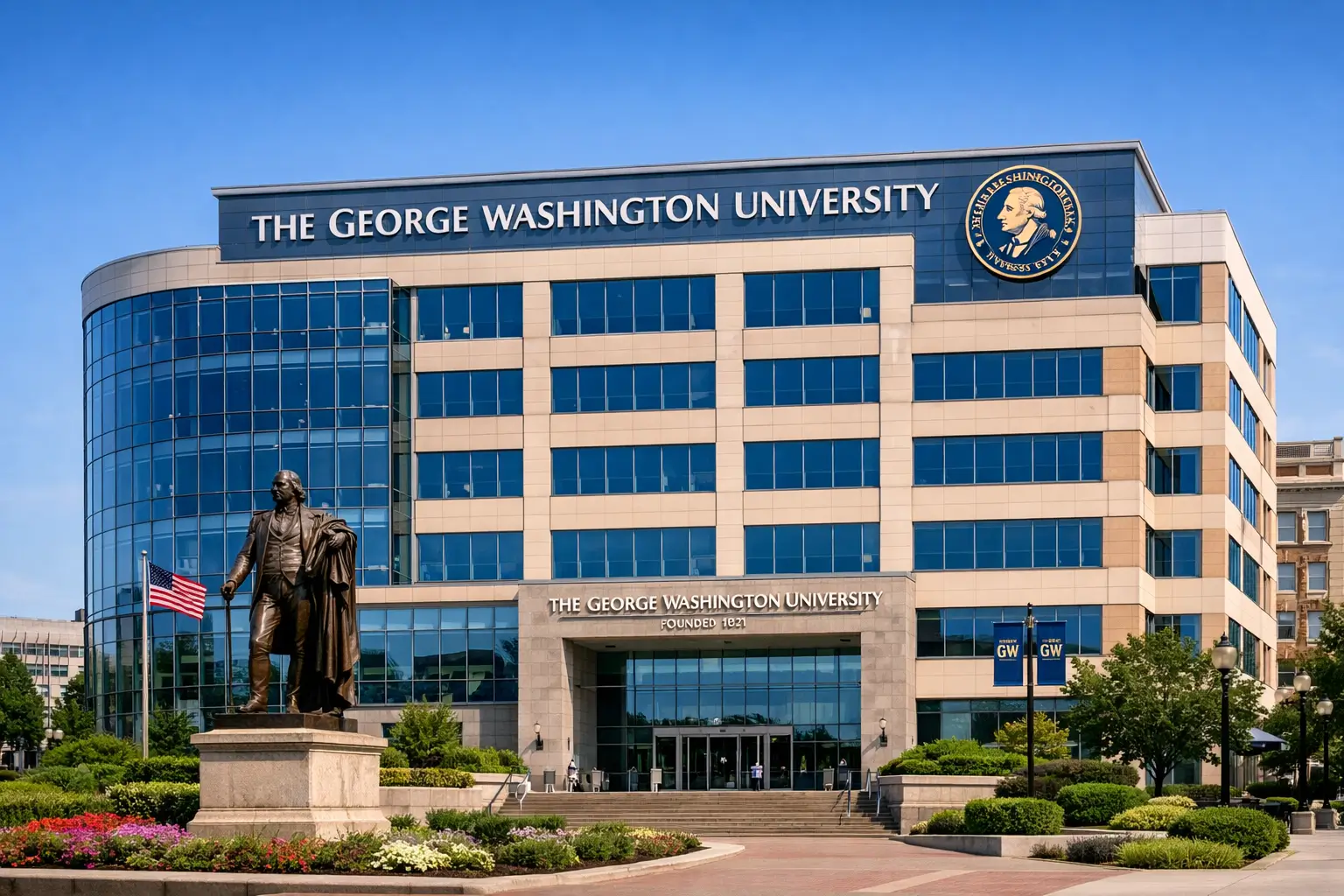
Start Here: Compare GWU by What Matters Most
- Compare institutional strengths → Particularly strong in public health, healthcare administration, public policy, political management, cybersecurity, and government-adjacent professional programs
- Compare accreditation → MSCHE regional accreditation plus AACSB, CEPH, CAHME, CCNE, and NASPAA programmatic credentials
- Compare D.C. network value → Strong alignment for careers connected to federal agencies, NGOs, healthcare systems, policy organizations, and government contracting
- Compare flexibility → Mostly fully online programs, though several healthcare and nursing degrees require practicum, residency, or clinical placements
- Compare alternatives → Johns Hopkins University, Northeastern University, Drexel University, and Arizona State University
What George Washington University Is Known For
George Washington University’s online master’s programs draw their institutional identity from a specific combination: a private research university physically embedded in the D.C. policy ecosystem, with professional schools that have built sustained online programs in fields where that location matters.
Policy and government adjacency.
GWU sits blocks from the White House, federal agencies, the World Bank, and major NGOs. This proximity doesn’t just look good on a brochure — it shapes curriculum, guest speakers, practicum placements, and alumni networks. Programs in public administration, political management, and homeland security are directly informed by relationships with the federal government and international policy organizations.
Public health depth.
The Milken Institute School of Public Health is a CEPH-accredited school — not just a department — offering an online MPH with six concentrations. The distinction matters: students gain access to a public health school with dedicated faculty, research infrastructure, and D.C.-based practicum partnerships rather than an MPH bolted onto a general health sciences program.
Education programs with a practical focus.
The Graduate School of Education and Human Development (GSEHD) offers multiple online MEd and MA programs, including curriculum and instruction, educational leadership, and special education, with specialized tracks like autism spectrum disorders. These are structured for working educators, not career changers.
Engineering and applied technology.
The School of Engineering and Applied Science (SEAS) offers online master’s programs in engineering management, systems engineering, cybersecurity, data analytics, and information systems technology. The cybersecurity program holds an NSA/DHS Center of Academic Excellence in Cyber Defense designation — a meaningful credential in a field where institutional certifications influence hiring.
Healthcare administration and nursing.
GWU’s online MHA is CAHME-accredited, and its MSN programs carry CCNE accreditation. Both require clinical or practicum components, which means they’re structured as clinically rigorous programs, not shortcuts.
Political management — a category of one.
GWU’s Graduate School of Political Management offers an MA in Political Management that has no direct equivalent at other universities. It’s designed for campaign strategists, advocacy professionals, and political operatives.
Established online infrastructure.
GWU has been delivering online master’s programs for over a decade, meaning the learning management systems, student support services, and faculty training are mature — not experimental.
Online Master’s Programs by Subject
GWU’s online master’s portfolio spans seven distinct subject areas. Below is a structured overview grouped by field. Detailed program data — including credit hours, tuition, accreditation, and in-person requirements — appears in the full programs table that follows.
GWU’s AACSB-accredited online MBA offers seven concentrations, including government contracts and healthcare management, both leveraging D.C. institutional access. Additional business-adjacent programs include project management and government contracts (a program with few peers nationally). Students evaluating AACSB-accredited online MBA programs should note that GWU’s MBA carries premium pricing ($1,905/credit, 55 credits) but includes concentrations uncommon elsewhere.
The healthcare cluster includes four programs: the CEPH-accredited MPH (six concentrations, including epidemiology ), the CAHME-accredited MHA , an MS in Health Sciences (four concentrations), and an MS in Clinical Research Administration. The MPH and MHA both require practicum or residency components. These are clinical and professional programs, not academic research degrees.
GWU offers CCNE-accredited MSN programs in two nurse practitioner tracks: Family Nurse Practitioner and Adult-Gerontology Primary Care NP. Both require clinical placement hours and follow deadline-based fall admissions only. These are not accelerated pathway programs — they’re designed for practicing nurses with BSN credentials.
Three online programs through GSEHD: MEd in Curriculum and Instruction (with concentrations in educational technology, literacy, and TESOL), MEd in Educational Leadership and Administration, and MA in Special Education (with four specialized tracks). Education programs are GWU’s most affordably priced online master’s at $1,655/credit.
SEAS offers two online engineering master’s programs: Engineering Management and Systems Engineering. Both are 30-credit programs at $1,905/credit with GRE waivers available. These serve mid-career engineers seeking management credentials rather than entry-level technical training.
Three programs span this space: MS in Cybersecurity in Computer Science (NSA/DHS-designated), MS in Data Analytics, and MS in Information Systems Technology (with concentrations in cybersecurity, data analytics, IT project management, and software engineering). Students interested in cybersecurity master’s programs will find GWU’s NSA/DHS designation a meaningful differentiator.
The NASPAA-accredited MPA offers four concentrations, including federal management and nonprofit management. The MA in Political Management — offered through GWU’s Graduate School of Political Management — is the only degree of its kind in the U.S., with concentrations in advocacy politics, campaign management, political communication, and strategic public relations.
The MPS in Homeland Security offers three concentrations (cybersecurity, emergency management, and intelligence analysis) and draws directly on D.C.’s proximity to DHS and federal security agencies. Students exploring criminal justice programs at the master’s level should note this is a policy-oriented program, not a traditional criminal justice degree.
GWU also offers an ABA-approved MPS in Paralegal Studies, one of the few master’s-level paralegal programs available fully online.
Programs Table
The table below includes all known GWU online master’s programs with structured data fields. Tuition figures are approximate and subject to change; verify current rates directly with GWU.
| Program | Degree | Subject | Credits | $/Credit | Est. Total | Duration | GRE | Accreditation | In-Person |
|---|---|---|---|---|---|---|---|---|---|
| MBA | MBA | Business | 55 | $1,905 | $104,775 | 24–48 mo | No | AACSB | No |
| MS in Project Management | MS | Business | 36 | $1,905 | $68,580 | 18–36 mo | No | — | No |
| MS in Government Contracts | MS | Business | 36 | $1,905 | $68,580 | 18–36 mo | No | — | No |
| MPH | MPH | Healthcare | 45 | $1,750 | $78,750 | 24–48 mo | No | CEPH | Yes |
| MHA | MHA | Healthcare | 48 | $1,750 | $84,000 | 24–48 mo | No | CAHME | Yes |
| MS in Health Sciences | MS | Healthcare | 36 | $1,750 | $63,000 | 18–36 mo | No | — | No |
| MS in Clinical Research Administration | MS | Healthcare | 36 | $1,750 | $63,000 | 18–36 mo | No | — | No |
| MSN — Family Nurse Practitioner | MSN | Nursing | 46 | $1,750 | $80,500 | 24–36 mo | No | CCNE | Yes |
| MSN — Adult-Gerontology Primary Care NP | MSN | Nursing | 44 | $1,750 | $77,000 | 24–36 mo | No | CCNE | Yes |
| MEd in Curriculum and Instruction | MEd | Education | 30 | $1,655 | $49,650 | 12–24 mo | No | — | No |
| MEd in Educational Leadership and Administration | MEd | Education | 30 | $1,655 | $49,650 | 12–24 mo | No | — | No |
| MA in Special Education | MA | Education | 33 | $1,655 | $54,615 | 18–30 mo | No | — | No |
| MS in Engineering Management | MS | Engineering | 30 | $1,905 | $57,150 | 18–36 mo | No | — | No |
| MS in Systems Engineering | MS | Engineering | 30 | $1,905 | $57,150 | 18–36 mo | No | — | No |
| MS in Cybersecurity in Computer Science | MS | Cybersecurity | 30 | $1,905 | $57,150 | 18–36 mo | No | NSA/DHS CAE-CD | No |
| MS in Data Analytics | MS | IT & Data | 33 | $1,905 | $62,865 | 18–36 mo | No | — | No |
| MS in Information Systems Technology | MS | IT & Data | 33 | $1,905 | $62,865 | 18–36 mo | No | — | No |
| MA in Political Management | MA | Public Admin | 40 | $1,835 | $73,400 | 18–36 mo | No | — | No |
| MPA | MPA | Public Admin | 40 | $1,835 | $73,400 | 24–48 mo | No | NASPAA | No |
| MPS in Homeland Security | MPS | Criminal Justice | 36 | $1,835 | $66,060 | 18–36 mo | No | — | No |
| MPS in Paralegal Studies | MPS | Other | 36 | $1,835 | $66,060 | 18–36 mo | No | ABA-approved | No |
How George Washington University Compares
GWU competes for a specific type of online master’s student: someone who wants a nationally recognized private university credential in a policy-adjacent or healthcare field and is willing to pay a premium for it. Here’s how it stacks up against four peer institutions.
GWU vs. Johns Hopkins University
- Johns Hopkins University carries a stronger name recognition in pure health sciences and biomedical research. The Bloomberg School of Public Health is generally ranked higher than GWU’s Milken Institute School. However, GWU offers a broader professional program portfolio — political management, government contracts, public administration, homeland security — that Hopkins doesn’t match. For students focused specifically on public health research or health sciences, Hopkins may be the stronger choice. For students wanting a healthcare-plus-policy combination, GWU’s D.C. ecosystem adds differentiated value.
GWU vs. Northeastern University
- Northeastern University is a strong competitor in online graduate education, particularly for industry-focused programs in technology, analytics, and business. Northeastern’s experiential learning model and corporate partnerships create value for students targeting private-sector careers. GWU’s advantage lies in government, policy, international affairs, and public administration — if your career trajectory involves federal agencies, NGOs, or D.C.-based organizations, GWU’s institutional connections are more directly useful.
GWU vs. Drexel University
- Drexel University is another private university with a mature online graduate portfolio, particularly in health sciences, education, and nursing. Tuition is comparable. The key distinction: GWU’s programs in political management, public administration, and homeland security have no Drexel equivalent, and GWU’s CEPH-accredited public health school operates at a different scale than Drexel’s health offerings. Drexel may be a better fit for students who want co-op-oriented professional development; GWU is stronger for policy-track professionals.
GWU vs. Arizona State University
- Arizona State University offers the starkest contrast: massive program scale at significantly lower tuition (often $500–$800/credit for online programs). ASU is the better choice for students who need affordability, rolling start dates, and maximum flexibility. GWU’s case rests on programmatic accreditation depth (AACSB, CEPH, CAHME, CCNE, NASPAA), D.C. network access, and specialized programs like political management that ASU doesn’t offer. If budget is a primary constraint, ASU — or another public institution — is likely the more rational choice.
| Dimension | GWU | Johns Hopkins | Northeastern | Drexel | ASU |
|---|---|---|---|---|---|
| Tuition per credit | $1,655–$1,905 | ~$1,100–$1,800 | ~$1,300–$1,700 | ~$1,000–$1,400 | ~$500–$80 |
| Program breadth | 40+ online master’s | 20+ online master’s | 40+ online master’s | 30+ online master’s | 100+ online master’s |
| Policy/government strength | Very strong | Moderate | Moderate | Low | Moderate |
| Healthcare program depth | Strong (CEPH, CAHME) | Very strong (JHSPH) | Moderate | Moderate | Moderate |
| Online maturity | 10+ years | 10+ years | 10+ years | 15+ years | 10+ years |
| Key differentiator | D.C. policy ecosystem, unique programs | Health/research prestige | Experiential/industry focus | Co-op heritage, broad health portfolio | Scale and affordability |
Washington University is
Best For
GWU’s online master’s programs are a strong match for specific student profiles — not everyone. Here’s who benefits most:
- Government and policy professionals seeking career advancement in federal agencies, NGOs, or international organizations. GWU’s MPA, political management, homeland security, and government contracts programs are built for this population, and the D.C. alumni network has direct professional utility.
- Healthcare professionals who want CEPH-accredited public health training or CAHME-accredited health administration credentials from a dedicated health sciences school — not a department-level program appended to a general university.
- Working educators who need flexible online MEd or MA programs from a recognized school of education, particularly those interested in specialized tracks like autism spectrum disorders, TESOL, or educational technology leadership.
- Cybersecurity and IT professionals who value the NSA/DHS Center of Academic Excellence designation and want a cybersecurity or information systems master’s from an institutionally credentialed program.
- Mid-career engineers seeking management credentials (engineering management, systems engineering) from a recognized SEAS program without interrupting employment.
- Working professionals who value institutional brand recognition from a well-known private research university and have the financial means — or employer sponsorship — to justify premium tuition.
Not a Best Fit For
GWU’s online master’s programs carry real tradeoffs. This section exists because honest evaluation serves prospective students better than promotional copy.
- Budget-constrained students. GWU’s tuition ranges from $1,655 to $1,905 per credit hour. A 30-credit program starts near $50,000; the 55-credit MBA exceeds $104,000. Many public universities — including Arizona State University — offer comparable online master’s programs at $500–$800 per credit. Unless employer tuition benefits, military education benefits, or financial aid substantially offset the cost, GWU’s premium pricing may not represent the best return for students sensitive to total cost of education. Students carrying existing debt should also explore student loan forgiveness programs that may apply to public service careers.
- Students prioritizing STEM-intensive data science or computer science programs. GWU offers data analytics and cybersecurity programs, but students seeking cutting-edge, research-oriented computer science or data science master’s programs may find stronger options at institutions like Georgia Tech, Purdue University , or ASU — often at lower cost.
- Students who need maximum scheduling flexibility. GWU operates on deadline-based admissions with traditional semester start dates (fall, spring, and sometimes summer). Students who need rolling admissions, frequent start dates, or competency-based pacing will find more flexibility at institutions like Western Governors University or Southern New Hampshire University .
- Students seeking MSW or clinical psychology programs. GWU does not offer online master’s programs in social work or clinical psychology . Students in those fields should look at institutions with established online MSW or clinical psychology programs instead.
- Students who want a fully asynchronous experience in healthcare or nursing. GWU’s MPH, MHA, and MSN programs all require practicum, residency, or clinical components. If you need a program you can complete without any in-person obligations, these programs won’t work.
Featured Programs / Top Picks
These five programs represent GWU’s most distinctive online master’s offerings — programs where institutional strengths, accreditation, and market positioning create genuine differentiation.
CEPH-accredited from the Milken Institute School of Public Health, with six concentrations including epidemiology, global health, and health policy. This is a school-based MPH, not a department-level add-on. The practicum requirement adds clinical rigor. At $78,750 estimated total cost, it’s expensive — but this is one of GWU’s programs where the institutional investment produces a credential with clear professional market value.
The only program of its kind in the United States, offered through GWU’s Graduate School of Political Management. Concentrations in advocacy politics, campaign management, political communication, and strategic public relations serve a highly specific audience: people who work in or around political campaigns, lobbying, and advocacy organizations. There is no equivalent at any peer institution.
Designated as an NSA/DHS National Center of Academic Excellence in Cyber Defense. At 30 credits and $57,150 estimated total cost, it’s one of GWU’s more efficiently priced programs. The NSA/DHS designation is a meaningful hiring signal in government cybersecurity roles — a direct advantage of GWU’s D.C. positioning.
AACSB-accredited with seven concentrations, including government contracts and healthcare management — concentrations that reflect GWU’s institutional niche rather than generic business options. At 55 credits and $104,775 estimated total, this is a premium-priced MBA. The value case is strongest for students targeting government contracting, healthcare management, or D.C.-based consulting careers. Most applicants qualify for GMAT/GRE waivers.
NASPAA-accredited with concentrations in federal management, budget and public finance, nonprofit management, and state/local government management. For students pursuing public sector leadership careers, NASPAA accreditation is the gold standard — and GWU’s D.C. location means the curriculum reflects real-world federal policy dynamics rather than theoretical models.
Admissions Snapshot
GWU uses deadline-based admissions across its online master’s programs. Application deadlines vary by school, program, and semester — there is no universal rolling admission.
GRE/GMAT requirements: Most GWU online master’s programs do not require the GRE or GMAT. Many business programs offer GMAT waivers for applicants with qualifying professional experience or GPA thresholds. Students specifically seeking online master’s programs with no GRE requirement will find that GWU’s current policies align, though individual programs should be verified.
Typical application requirements:
- Bachelor’s degree from a regionally accredited institution
- Official transcripts
- Statement of purpose
- Two to three letters of recommendation
- Current resume or CV
Additional requirements by program:
- Nursing (MSN): Active RN license, BSN from a CCNE- or ACEN-accredited program, clinical experience
- Public Health (MPH): Practicum component requires planning; some concentrations prefer relevant professional experience
- Health Administration (MHA): Professional experience preferred; residency component
Selectivity note: Admissions competitiveness varies significantly across GWU’s schools. Education and business programs tend to be more accessible, while health sciences and nursing programs are more selective. GWU does not publish acceptance rates by program for online master’s students, but applicants should expect a substantive review process — this is not open enrollment.
Start dates: Most programs admit for fall and spring semesters. Some business and education programs also offer summer starts. Nursing programs typically admit in fall only.
Tuition & Cost Overview
GWU is a premium-priced institution for online master’s education. There is no way around this, and prospective students should evaluate cost with clear eyes.
Tuition rates by school (per credit hour, approximate):
- School of Business: $1,905
- School of Engineering & Applied Science: $1,905
- Milken Institute School of Public Health: $1,750
- School of Nursing: $1,750
- Graduate School of Education & Human Development: $1,655
- College of Professional Studies: $1,835
- Graduate School of Political Management: $1,835
Total program cost range:
- Lowest: ~$49,650 (30-credit MEd programs)
- Highest: ~$104,775 (55-credit MBA)
- Typical mid-range: $57,000–$73,000 for most 30–40 credit programs
Cost in context: At $1,655–$1,905 per credit, GWU costs roughly 2–3x more per credit than many public university online master’s programs. A 36-credit program at GWU costs approximately $60,000–$69,000; the same credit count at a mid-tier public university might cost $18,000–$29,000.
Financial aid and offsets:
- Federal financial aid (loans, grants , where eligible) is available to qualifying students
- Military and veteran education benefits accepted, including Yellow Ribbon participation
- Some employer tuition reimbursement partnerships exist
- Merit-based scholarships available for select programs, though not universally
ROI framing: GWU’s cost premium is most justifiable in programs with strong programmatic accreditation (AACSB, CEPH, CAHME, NASPAA) or unique market positioning (political management, government contracts, homeland security). For generic business or education programs where comparable credentials are available at one-third the cost, the premium is harder to justify on financial return alone. Students should weigh whether the specific GWU credential — and its D.C. network — will produce career outcomes that offset the cost difference over 5–10 years.
Visit George Washington University’s official online programs page
Related Rankings
GWU’s program portfolio connects to several OMC ranking pages that may help prospective students contextualize their options:
- AACSB-Accredited Online MBA Programs — GWU’s online MBA carries AACSB accreditation, placing it among a select group of business schools that meet this standard. This ranking helps students compare GWU’s MBA against other AACSB-accredited alternatives, including options at significantly lower price points.
- Online Master’s Programs With No GRE Requirement — Nearly all of GWU’s online master’s programs have dropped or offer waivers for standardized test requirements. Students who prefer to avoid the GRE entirely can use this ranking to identify programs across multiple institutions and fields.
- Online MHA Programs — GWU’s CAHME-accredited MHA is one of the more recognizable online health administration programs nationally. This ranking page provides comparative context for students weighing GWU’s MHA against other accredited options.
FAQ
A. Yes. GWU holds regional accreditation from the Middle States Commission on Higher Education (MSCHE), which is the recognized accrediting body for institutions in its region. Regional accreditation is the standard that matters for credit transfer, employer recognition, and financial aid eligibility.
A. GWU’s online master’s degrees carry the same institutional credential as on-campus degrees — the diploma does not differentiate between delivery modes. In fields where GWU has established programmatic accreditation (AACSB, CEPH, CAHME, CCNE, NASPAA), the credential carries specific professional recognition. GWU’s D.C. alumni network is particularly valued in government, policy, and healthcare sectors.
A. Most GWU online master’s programs do not require the GRE or GMAT. Many business programs offer GMAT waivers based on professional experience or GPA thresholds. Individual programs may have specific requirements, so applicants should verify with the relevant school.
A. Tuition ranges from approximately $1,655 per credit (education programs) to $1,905 per credit (business and engineering). Total program costs range from about $49,650 for a 30-credit MEd to over $104,000 for the 55-credit MBA. GWU is priced as a premium private institution — significantly above most public university online programs.
A. GWU’s most distinctively strong online programs are in public health (CEPH-accredited MPH), political management (the only program of its kind nationally), public administration (NASPAA-accredited MPA), cybersecurity (NSA/DHS-designated), and healthcare administration (CAHME-accredited MHA). These programs combine programmatic accreditation with D.C. institutional positioning in ways that are difficult to replicate elsewhere.
A. Most GWU online master’s programs are fully online with no in-person requirements. However, certain programs — specifically the MPH, MHA, and both MSN nurse practitioner tracks — require practicum, residency, or clinical placement hours. Students in those programs will need to arrange in-person components, though clinical placements can often be completed in the student’s local area.