
Regent University Snapshot Card
20+
Online master’s programs
$575–$695
Per credit hour
—
Public university ranking
—
Public research university
Key policies
Institution type
Private, Nonprofit
Online Master’s Programs by Subject
SACSCOC
Admissions model
Rolling — apply anytime, multiple starts per year
GRE/GMAT required
Not required
Out-of-state premium
—
Notable Programmatic Accreditations
- AACSB
- ACBSP
- ATS
- CACREP
- CAHME
- CCNE
- NSA/DHS CAE-CDE

- Edited By Jeevan D'Souza
Start Here
Quick Fit Summary: Regent is a mid-sized, faith-integrated university with genuine strength in counseling, divinity, government, and education — and respectable breadth across business, cybersecurity, communication, and nursing. It is best understood as a values-driven institution that prioritizes Christian worldview integration across all academic work, not as a large-scale online mega-university competing on price or program volume.
Best For (Quick Version): Students who actively want faith-integrated graduate education, especially in counseling (CACREP-accredited), ministry/divinity (ATS-accredited), government/public policy, or education. Also a strong option for working professionals who value rolling admissions, 8-week terms, and asynchronous delivery within a Christian academic community.
Not a Best Fit (Quick Version): Students who want a secular academic environment, those seeking AACSB-accredited business programs, students who need the lowest possible tuition, STEM-focused learners, or anyone uncomfortable with required faith integration in every course.
Regent University at a Glance
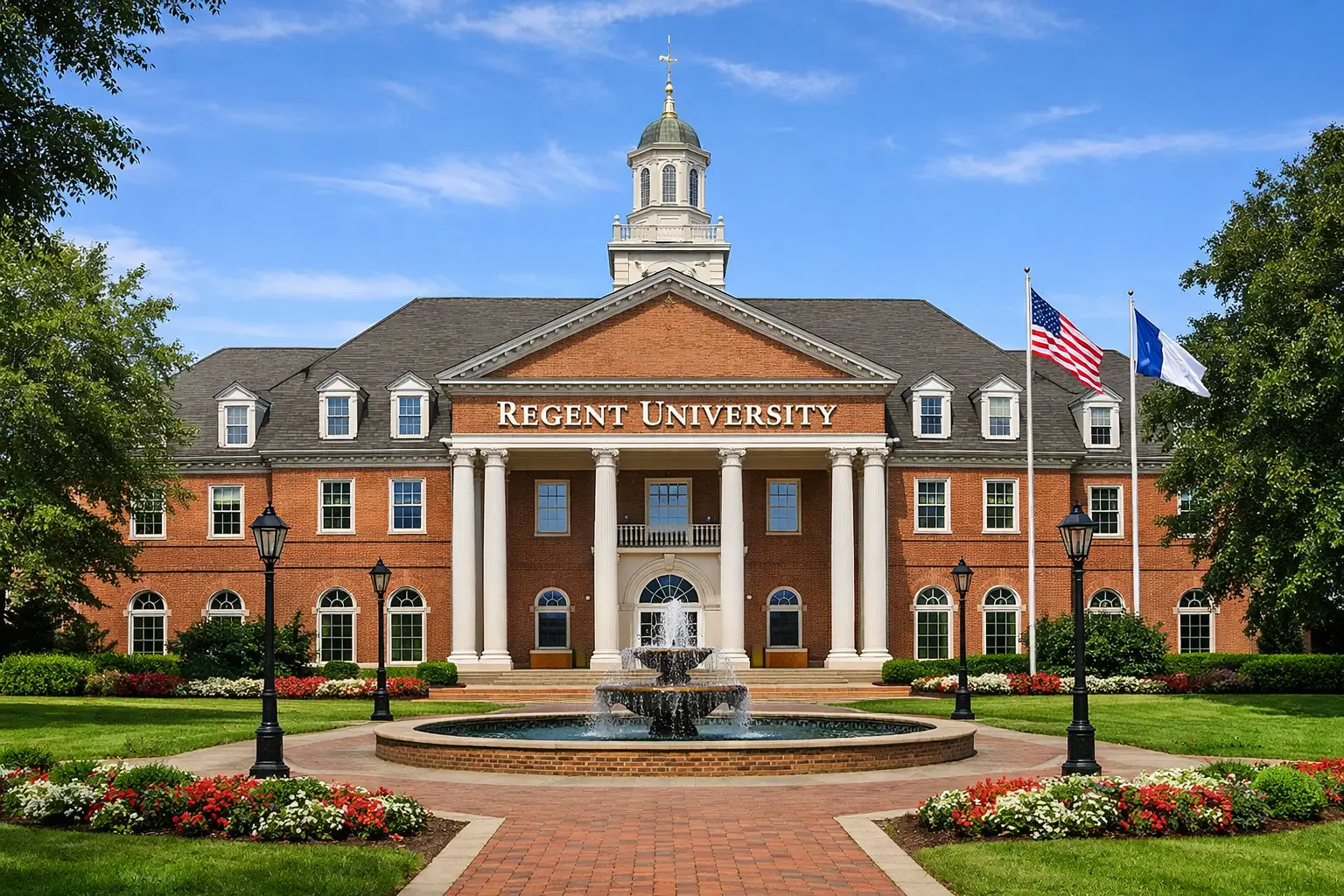
Regent University is a private, nonprofit Christian institution located in Virginia Beach, Virginia. Founded in 1977, the university holds regional accreditation from the Southern Association of Colleges and Schools Commission on Colleges (SACSCOC) — the same accrediting body that oversees institutions such as Duke, Vanderbilt, and the University of Virginia. That accreditation matters: it ensures credit transferability, financial aid eligibility, and employer recognition for every degree Regent confers.
Regent operates eight schools and colleges, and its online graduate catalog spans more than 20 master’s programs across business, education, counseling, government, divinity, communication, cybersecurity, healthcare administration, and nursing. The university enrolls approximately 11,000 students, with a significant majority studying online. Unlike larger faith-based competitors that offer hundreds of programs, Regent maintains a more focused catalog — concentrating depth in areas where it holds specialized accreditation or distinctive institutional strengths.
The defining characteristic of a Regent education is faith integration. Every program incorporates a Christian worldview into curriculum, assignments, and learning outcomes. This is not an optional layer or an elective requirement — it is woven into the academic framework of every course. For students who want that integration, it is a core strength. For students who do not, it is a dealbreaker. Understanding this distinction early will save significant time in the evaluation process.
| Field | Detail |
|---|---|
| Institution Type | Private, Nonprofit |
| Religious Affiliation | Christian (Interdenominational/Charismatic tradition) |
| Regional Accreditation | SACSCOC |
| Location | Virginia Beach, Virginia |
| Founded | 1977 |
| Approximate Enrollment | ~11,000 |
| Online Master’s Programs | 20+ |
| Key Specialized Accreditations | CACREP (Counseling), ACBSP (Business), ATS (Divinity), CCNE (Nursing) |
| Primary Learning Model | Asynchronous online with 8-week terms |
| Start Frequency | Rolling — multiple starts per year |
Quick Decision Guide
Before diving into program details, this guide gives you a rapid-scan assessment of whether Regent University deserves a closer look — or whether your time is better spent evaluating other institutions.
Cost Signal: Moderate — approximately $575–$695 per credit hour depending on the program. Most master’s programs cost between $19,000 and $27,000 total; clinical programs (counseling, nursing) run higher due to additional credit requirements and practicum costs.
Learning Model Signal: Asynchronous online coursework delivered in 8-week terms. Some programs (clinical mental health counseling, FNP nursing) require supervised clinical or practicum hours that involve in-person components.
Admissions Signal: Rolling admissions with multiple start dates per year. Most programs do not require the GRE or GMAT. Generally accessible admission standards with some programs setting higher GPA thresholds.
Flexibility Signal: High flexibility for most programs — 8-week accelerated terms, multiple annual start points, no residency requirements for most degrees. Clinical programs have less scheduling flexibility due to practicum and internship obligations.
Main Tradeoff: Regent offers specialized accreditation and genuine academic depth in its strongest programs (counseling, divinity, government), but the mandatory Christian worldview integration throughout every course limits its appeal to students who want secular graduate education. The tuition is competitive among private faith-based institutions but cannot match the pricing of large-scale online providers like Western Governors University or Southern New Hampshire University .
What Regent University Is Known For
Regent’s national reputation does not rest on size or tuition pricing — it rests on a handful of programs where the institution has built genuine academic credibility, specialized accreditation, and a clear identity that separates it from the broader field of faith-based online providers.
CACREP-Accredited Counseling Programs.
Regent’s MA in Clinical Mental Health Counseling holds accreditation from CACREP (Council for Accreditation of Counseling & Related Educational Programs), which is the gold standard for counseling licensure preparation. This distinction matters enormously: graduates of CACREP-accredited programs face fewer barriers to licensure in most states and are often preferred by employers, insurance panels, and doctoral programs. Among Christian universities offering online counseling degrees, CACREP accreditation is far from universal — Regent’s status here is a legitimate differentiator. Students evaluating clinical psychology and counseling programs should weigh this accreditation heavily.
Robertson School of Government.
Regent’s government and public policy programs — offered through the Robertson School of Government — occupy a distinctive niche. The MA in Government offers concentrations spanning American government, international relations, national security, campaign management, and Middle East studies. Few online master’s programs in government integrate a conservative Christian public philosophy as explicitly as Regent’s, making it a specific draw for students who want to study policy and governance through that lens.
School of Divinity (ATS-Accredited).
Regent’s School of Divinity holds accreditation from the Association of Theological Schools (ATS), the recognized accreditor for graduate theological education in North America. The MDiv and related theology degrees carry this credential, which matters for ordination requirements, chaplaincy credentialing, and transfer to doctoral theology programs. The online MDiv, at 81 credit hours, is one of the most comprehensive online divinity programs available from an ATS-accredited institution.
ACBSP-Accredited Business Programs.
Regent’s School of Business & Leadership holds accreditation from the Accreditation Council for Business Schools and Programs (ACBSP). This is a legitimate business accreditation — though it is not AACSB, which is the more selective standard. Students for whom AACSB accreditation is a hard requirement should look elsewhere; students who prioritize faith integration in their business education and are comfortable with ACBSP will find Regent’s MBA and management programs well-structured.
Education Programs with Licensure Pathways.
Regent’s MEd programs in curriculum and instruction, educational leadership, and special education offer pathways toward licensure in many states, though students must verify requirements with their specific state boards. The education programs are priced lower per credit ($575) than Regent’s business and counseling offerings, making them among the more affordable options in the university’s catalog.
Cybersecurity with NSA/DHS Designation.
Regent is designated as an NSA/DHS Center of Academic Excellence in Cyber Defense Education, which lends credibility to its MS in Cybersecurity. This federal designation is not automatic — it requires meeting specific curricular standards — and it positions Regent’s cybersecurity program above many smaller faith-based competitors in this space.
CCNE-Accredited Nursing Programs.
Regent’s MSN programs (Family Nurse Practitioner, Nurse Administrator, Nurse Educator, and RN-to-MSN) hold accreditation from the Commission on Collegiate Nursing Education (CCNE). For nursing students evaluating RN-to-MSN pathways , CCNE accreditation is an essential baseline — Regent meets it.
Online Master’s Programs by Subject
Regent University offers more than 20 online master’s programs organized across nine subject areas. The table below presents every known online master’s program with structured data on credit hours, tuition, duration, accreditation, and format. Programs are grouped by subject to make comparison within and across disciplines easier.
A few patterns worth noting before reviewing the data: tuition rates vary by school (divinity and education programs charge $575/credit; business, counseling, government, communication, cybersecurity, and healthcare charge $650/credit; nursing charges $695/credit). Most programs run 33–42 credits and can be completed in 12–24 months. The exceptions are the clinical counseling program (60 credits, 24–36 months, requires practicum) and the MDiv (81 credits, 36–48 months). All programs use rolling admissions with multiple annual start dates.
Regent’s School of Business & Leadership offers three ACBSP-accredited online master’s programs. The MBA is the largest at 42 credits with 11 available concentrations, including healthcare management, finance, and servant leadership. The MA in Management and MA in Organizational Leadership are shorter at 33 credits each, designed for professionals who want leadership training without the full MBA scope. All three share the $650/credit rate and rolling admissions.
| Program | Degree | Credits | $/Credit | Est. Total | Duration | Accreditation | GRE | Format |
|---|---|---|---|---|---|---|---|---|
| Master of Business Administration | MBA | 42 | $650 | $27,300 | 18–24 mo. | ACBSP | No | Fully Online |
| MA in Management | MA | 33 | $650 | $21,450 | 12–18 mo. | ACBSP | No | Fully Online |
| MA in Organizational Leadership | MA | 33 | $650 | $21,450 | 12–18 mo. | ACBSP | No | Fully Online |
Education programs at Regent carry a lower per-credit rate ($575) and range from 33 to 36 credits. The MEd in Curriculum and Instruction offers concentrations including Advanced Teaching, Christian School Teaching, and TESOL. The MEd in Educational Leadership may lead to administrative licensure depending on your state. The Special Education MEd and Student Affairs MEd round out the catalog. None of these programs require the GRE, and all use rolling admissions. Students interested in health education should note that Regent does not offer a dedicated program in that area.
| Program | Degree | Credits | $/Credit | Est. Total | Duration | Accreditation | GRE | Format |
|---|---|---|---|---|---|---|---|---|
| MEd in Curriculum and Instruction | MEd | 33 | $575 | $18,975 | 12–24 mo. | — | No | Fully Online |
| MEd in Educational Leadership | MEd | 36 | $575 | $20,700 | 15–24 mo. | — | No | Fully Online |
| MEd in Student Affairs | MEd | 36 | $575 | $20,700 | 15–24 mo. | — | No | Fully Online |
| MEd in Special Education | MEd | 36 | $575 | $20,700 | 15–24 mo. | — | No | Fully Online |
This is one of Regent’s signature areas. The MA in Clinical Mental Health Counseling is the standout — a 60-credit, CACREP-accredited program that satisfies licensure requirements in most states. It requires supervised practicum and internship hours, which means in-person clinical placement is mandatory. Concentrations include addictions counseling, marriage and family counseling, military resilience, and trauma and crisis counseling.
The MA in Human Services Counseling is a shorter, non-clinical alternative (36 credits) that does not lead to licensure — an important distinction that students sometimes miss. It is designed for ministry, coaching, and human services roles. The MA in Psychology offers general and industrial-organizational concentrations for students interested in applied psychology without a clinical track. Students specifically exploring clinical licensure pathways should compare these options against programs reviewed on the clinical psychology programs page.
| Program | Degree | Credits | $/Credit | Est. Total | Duration | Accreditation | GRE | Format |
|---|---|---|---|---|---|---|---|---|
| MA in Clinical Mental Health Counseling | MA | 60 | $650 | $39,000 | 24–36 mo. | CACREP | No | Hybrid (clinical req.) |
| MA in Human Services Counseling | MA | 36 | $650 | $23,400 | 15–24 mo. | — | No | Fully Online |
| MA in Psychology | MA | 36 | $650 | $23,400 | 15–24 mo. | — | No | Fully Online |
Regent’s Robertson School of Government offers two online master’s programs. The MA in Government is highly flexible with eight concentrations ranging from American government and campaign management to national security studies and Middle East studies. The MA in Public Administration is a more traditional MPA program at 39 credits. Both operate at the $650/credit rate. These programs occupy a specific niche — there are very few online government/public policy master’s programs that explicitly operate from a conservative Christian public philosophy.
| Program | Degree | Credits | $/Credit | Est. Total | Duration | Accreditation | GRE | Format |
|---|---|---|---|---|---|---|---|---|
| MA in Government | MA | 33 | $650 | $21,450 | 12–18 mo. | — | No | Fully Online |
| MA in Public Administration | MPA | 39 | $650 | $25,350 | 15–24 mo. | — | No | Fully Online |
All three divinity programs carry ATS (Association of Theological Schools) accreditation and are priced at $575/credit. The Master of Divinity is the largest program in Regent’s entire online catalog at 81 credit hours, with concentrations spanning biblical studies, chaplaincy, pastoral ministry, evangelism, and youth ministry. At an estimated total cost of $46,575, it represents a significant investment — but ATS accreditation ensures the degree is recognized for ordination, chaplaincy, and doctoral admission. The MA in Practical Theology (36 credits) and MA in Church Leadership (33 credits) are shorter alternatives for students who do not need the full MDiv.
| Program | Degree | Credits | $/Credit | Est. Total | Duration | Accreditation | GRE | Format |
|---|---|---|---|---|---|---|---|---|
| Master of Divinity | MDiv | 81 | $575 | $46,575 | 36–48 mo. | ATS | No | Fully Online |
| MA in Practical Theology | MA | 36 | $575 | $20,700 | 15–24 mo. | ATS | No | Fully Online |
| MA in Church Leadership | MA | 33 | $575 | $18,975 | 12–18 mo. | ATS | No | Fully Online |
Regent offers a single MA in Communication with four concentrations: digital media and communication, journalism, strategic communication, and theatre. At 33 credits and $650/credit, the estimated total cost is $21,450. This is a relatively lean program that suits communication professionals seeking credential advancement rather than a career pivot into a new field.
| Program | Degree | Credits | $/Credit | Est. Total | Duration | Accreditation | GRE | Format |
|---|---|---|---|---|---|---|---|---|
| MA in Communication | MA | 33 | $650 | $21,450 | 12–18 mo. | — | No | Fully Online |
Two programs here, both at 36 credits and $650/credit. The MS in Cybersecurity benefits from Regent’s designation as an NSA/DHS Center of Academic Excellence in Cyber Defense Education — a meaningful credential that signals curriculum alignment with federal standards. The MS in Information Technology is a broader program without the same federal designation. Neither requires the GRE.
| Program | Degree | Credits | $/Credit | Est. Total | Duration | Accreditation | GRE | Format |
|---|---|---|---|---|---|---|---|---|
| MS in Cybersecurity | MS | 36 | $650 | $23,400 | 15–24 mo. | NSA/DHS CAE-CDE | No | Fully Online |
| MS in Information Technology | MS | 36 | $650 | $23,400 | 15–24 mo. | — | No | Fully Online |
Regent offers a single MA in Healthcare Administration at 36 credits and $650/credit. The program does not carry specialized accreditation from CAHME (the standard healthcare management accreditor), which is worth noting for students who plan to pursue senior hospital or health system administration roles where CAHME credentials are preferred.
| Program | Degree | Credits | $/Credit | Est. Total | Duration | Accreditation | GRE | Format |
|---|---|---|---|---|---|---|---|---|
| MA in Healthcare Administration | MHA | 36 | $650 | $23,400 | 15–24 mo. | — | No | Fully Online |
Regent’s nursing programs are all CCNE-accredited and carry the highest per-credit rate in the university’s catalog at $695. The MSN — Family Nurse Practitioner track requires clinical practicum hours and is a hybrid program. The MSN — Nurse Administrator and MSN — Nurse Educator tracks are fully online. The RN-to-MSN pathway is a bridge option for registered nurses who hold an associate degree or diploma and want to reach the MSN level without completing a separate BSN first. Students exploring nursing bridge pathways may want to review RN-to-MSN programs across multiple institutions for broader comparison.
| Program | Degree | Credits | $/Credit | Est. Total | Duration | Accreditation | GRE | Format |
|---|---|---|---|---|---|---|---|---|
| MSN — Family Nurse Practitioner | MSN | 42 | $695 | $29,190 | 24–36 mo. | CCNE | No | Hybrid (clinical req.) |
| MSN — Nurse Administrator | MSN | 36 | $695 | $25,020 | 18–24 mo. | CCNE | No | Fully Online |
| MSN — Nurse Educator | MSN | 36 | $695 | $25,020 | 18–24 mo. | CCNE | No | Fully Online |
| RN to MSN | MSN | Varies | $695 | Varies | 24–36 mo. | CCNE | No | Hybrid (clinical req.) |
How Regent University Compares
Regent does not compete in the same category as large-scale online universities that enroll hundreds of thousands of students and compete primarily on price. Its peer set is a mix of faith-based institutions with significant online graduate portfolios and one major secular competitor included for cost and scale perspective. The comparison below focuses on dimensions that matter most to prospective online master’s students: tuition, program count, faith integration, accreditation highlights, format, and start frequency.
| Institution | Tuition/Credit (approx.) | Online Master’s Programs | Faith Integration | Key Accreditation Highlights | Class Format | Start Frequency |
|---|---|---|---|---|---|---|
| Regent University | $575–$695 | ~22 | Full integration (Christian worldview in all courses) | SACSCOC, CACREP, ACBSP, ATS, CCNE, NSA/DHS CAE-CDE | Asynchronous, 8-week terms | Rolling — multiple per year |
| Liberty University | $565–$615 | 150+ | Full integration (Christian worldview) | SACSCOC, CACREP, ACBSP, CCNE | Asynchronous, 8-week terms | Rolling — 8 starts per year |
| Grand Canyon University | $530–$680 | 100+ | Moderate integration (Christian heritage) | HLC, CCNE, ACBSP | Asynchronous, varies | Rolling — multiple per year |
| Eastern University | $600–$720 | ~15 | Moderate (social-justice-oriented Christian) | MSCHE, ACBSP | Asynchronous, varies | Semester and rolling |
| Southern New Hampshire University | $627 | 200+ | None (secular) | NECHE, ACBSP | Asynchronous, 10-week terms | Rolling — every month |
Key takeaways from this comparison:
- What this comparison means for different student types:
- If your primary decision factor is program selection breadth , Liberty and SNHU dwarf Regent. Liberty alone offers more than 150 online master’s programs; SNHU exceeds 200. Regent’s catalog of roughly 22 programs means you are choosing specificity over variety.
- If cost is the dominant concern, Grand Canyon and SNHU generally price lower for comparable programs, and Western Governors University (not shown above) undercuts all of them with flat-rate tuition around $4,500 per six-month term. Regent is moderately priced among private faith-based institutions but is not a budget option.
- If you want the deepest faith integration , Regent and Liberty are the strongest options. Both embed Christian worldview throughout every course. Grand Canyon maintains a Christian identity but with somewhat lighter integration. Eastern integrates faith through a social-justice lens that differs theologically from Regent’s more conservative orientation. SNHU is entirely secular.
- If specialized accreditation in counseling is essential, Regent’s CACREP accreditation puts it in the top tier. Liberty also holds CACREP accreditation for its counseling programs — making these two the primary faith-based competitors for CACREP-accredited online clinical counseling.
- If you need theological accreditation , Regent’s ATS-accredited divinity programs are a significant differentiator. Not all faith-based universities hold ATS accreditation for their theological graduate programs.
- If flexibility and start frequency matter most, SNHU and Liberty offer the most start dates and the largest range of program options at any given enrollment point. Regent’s rolling admissions are flexible but the smaller program catalog means fewer options per start window.
Best For
Regent University is a strong fit for specific student profiles — not for everyone. The following categories represent students who will get the most value from what Regent distinctively offers.
- Students who want faith-integrated graduate education as a core feature, not an add-on. If studying through a Christian worldview lens is a priority rather than a nice-to-have, Regent delivers that integration more consistently and pervasively than most competitors. Every course, every program, every school within the university operates from this foundation.
- Counseling students who need CACREP accreditation from a Christian institution. The MA in Clinical Mental Health Counseling at Regent is one of the relatively few CACREP-accredited counseling programs offered by a Christian university. For students who want both licensure-qualifying accreditation and faith-integrated clinical training, this combination is difficult to find elsewhere.
- Government and public policy students with conservative Christian values. The Robertson School of Government offers a niche that essentially no secular university replicates — online master’s-level study of American government, international relations, and national security through an explicitly Christian conservative philosophical framework.
- Ministry and divinity students seeking ATS-accredited online theological education. The ATS credential matters for ordination, military chaplaincy credentialing, and admission to doctoral theology programs. Regent’s fully online MDiv and related theology degrees meet this standard.
- Education professionals who want a faith-based MEd with licensure pathways. Regent’s education programs are among its most affordable offerings ($575/credit), and several include licensure tracks that may satisfy state requirements — though students must verify with their own state board.
- Nursing professionals who want CCNE-accredited MSN programs in a faith-based environment. Regent’s FNP, Nurse Administrator, Nurse Educator, and RN-to-MSN tracks all carry CCNE accreditation, meeting the standard expected by employers and licensing boards.
- Working professionals who need rolling admissions and accelerated terms. Eight-week terms with multiple annual start dates make it possible to begin quickly and maintain momentum without waiting for traditional semester start windows.
Not a Best Fit For
Honesty about limitations is what separates a useful evaluation from a marketing page. These are the student profiles for whom Regent is unlikely to be the best choice — and where other institutions will serve them better.
Students who want a secular academic environment. Regent’s faith integration is not optional or light-touch. If you are uncomfortable with Christian worldview requirements embedded in coursework, discussion boards, and assignments, this is not the right institution. Southern New Hampshire University or Arizona State University are secular alternatives with large online catalogs.
Students who require AACSB-accredited business programs. Regent’s business school holds ACBSP accreditation, which is a legitimate credential — but it is not AACSB. For students targeting employer audiences or doctoral programs that specifically require AACSB, institutions like Indiana University Online or the University of Florida are better fits.
Students who need the lowest possible tuition. Regent’s per-credit rates ($575–$695) are moderate for a private nonprofit but significantly higher than competency-based or high-volume online providers. Western Governors University charges roughly $4,500 per six-month term regardless of credits completed. SNHU and Liberty also frequently price lower for comparable programs.
Students focused on STEM disciplines. Regent’s STEM offerings are limited to cybersecurity and general IT. There are no online master’s programs in engineering, data science, mathematics, biology, chemistry, or physics. Students seeking STEM graduate education should explore institutions with deeper technical catalogs.
Students who need extensive in-person networking or residency-based experiences. Regent’s online programs are designed for remote learners. If campus community, in-person cohort interaction, or intensive residency weekends are important to your learning style, other models may serve you better.
Students who want a large research university experience. Regent is a teaching-focused institution. It does not carry R1 research classification, and its graduate programs are practice-oriented rather than research-intensive. Students aiming for academic research careers or doctoral preparation in research-heavy fields should look at research universities with stronger graduate research infrastructure.
Students seeking self-paced master’s degrees . Regent’s programs are structured around 8-week terms with set start and end dates — not self-paced or competency-based. Students who want to accelerate entirely at their own pace will find Western Governors University or similar models more appropriate.
Featured Programs and Top Picks
Not every program in Regent’s catalog carries the same weight. These five stand out based on accreditation strength, distinctive positioning, or career-outcome relevance.
This is Regent’s flagship program for a reason. CACREP accreditation sets it apart from the majority of online faith-based counseling programs and means graduates meet licensure prerequisites in most states without the hurdles that non-CACREP graduates often face. The five available concentrations — including military resilience and trauma/crisis counseling — add meaningful specialization. At 60 credits and an estimated $39,000, it is Regent’s most expensive master’s program, but the accreditation justifies the investment for students pursuing clinical licensure.
ACBSP-accredited with 11 concentrations, Regent’s MBA offers genuine breadth for a faith-based program. The servant leadership and not-for-profit management concentrations reflect the university’s institutional identity and attract students who want business skills applied through a values-driven lens. At $27,300 estimated total, it is competitively priced against other private-university MBAs, though students who need AACSB accreditation should look elsewhere.
ATS accreditation, fully online delivery, and 81 credits of theological depth make this one of the most comprehensive online divinity programs available. The eight concentrations cover the full range of ministry preparation — from chaplaincy to youth ministry to evangelism. The total cost (~$46,575) and 3–4 year timeline are significant commitments, but the ATS credential ensures the degree carries weight for ordination, chaplaincy commissioning, and doctoral admission.
The Robertson School of Government occupies a niche that is genuinely difficult to replicate elsewhere. Eight concentrations — including Middle East studies, national security, and campaign management — are taught through a conservative Christian public philosophy. For students who want to study governance and policy from that specific worldview, this is one of very few accredited options.
The NSA/DHS Center of Academic Excellence designation gives Regent’s cybersecurity program a credential that many larger universities have not earned. At 36 credits and $23,400, it is a mid-range option that carries a federal endorsement of its curriculum alignment with national cyber defense standards. This makes it a reasonable pick for students who want faith-based education and a recognized cybersecurity credential.
Admissions Snapshot
Regent University uses rolling admissions across virtually all of its online master’s programs, which means there are no hard application deadlines and students can apply for multiple start dates throughout the year. This is one of the most student-friendly elements of Regent’s model — it removes the pressure of fixed application windows that characterize many traditional graduate programs.
| Admissions Factor | Detail |
|---|---|
| Admissions Model | Rolling — apply anytime, multiple starts per year |
| GRE/GMAT Required | No for most programs. GMAT may be waived for MBA applicants meeting GPA threshold. |
| Minimum GPA (typical) | 2.5–3.0 depending on program (some programs accept conditionally below threshold) |
| Application Components | Online application, transcripts, statement of purpose (varies by program), professional references |
| Conditional Admission | Available for some programs for applicants below GPA minimums |
| Program-Specific Notes | Clinical Mental Health Counseling and MSN-FNP have additional requirements (interviews, prerequisite courses, clinical clearances) |
| International Students | Accepted; TOEFL/IELTS required for non-native English speakers |
The general accessibility of Regent’s admissions is a practical advantage for working adults who decide to pursue a master’s degree on a timeline that does not align with traditional academic calendars. However, students should not confuse rolling admissions with automatic admission — programs in counseling and nursing in particular have more selective intake processes that may include interviews, prerequisite verification, and background checks for clinical placement.
Students who want to benchmark their readiness for graduate-level study may find the GRE exam practice test useful, even though Regent does not require the GRE for most programs — particularly if they are also considering institutions that do.
Tuition and Cost Overview
Regent’s tuition structure is tiered by school rather than uniform across the university. This means the per-credit rate you pay depends on which program you enroll in — not just the degree level. The table below breaks down rates by school or college, along with typical credit ranges and estimated total costs.
| School/College | Per-Credit Rate | Typical Credit Range | Estimated Total Cost Range |
|---|---|---|---|
| School of Business & Leadership | $650 | 33–42 | $21,450–$27,300 |
| School of Education | $575 | 33–36 | $18,975–$20,700 |
| School of Psychology & Counseling | $650 | 36–60 | $23,400–$39,000 |
| Robertson School of Government | $650 | 33–39 | $21,450–$25,350 |
| School of Divinity | $575 | 33–81 | $18,975–$46,575 |
| School of Communication & the Arts | $650 | 33 | $21,450 |
| College of Arts & Sciences (Cyber/IT) | $650 | 36 | $23,400 |
| Healthcare Administration | $650 | 36 | $23,400 |
| School of Nursing | $695 | 36–42+ | $25,020–$29,190+ |
How to read these numbers: Most students will land in the $19,000–$27,000 total cost range. The major outliers are the MDiv ($46,575 due to 81 credits), the MA in Clinical Mental Health Counseling ($39,000 due to 60 credits and practicum requirements), and the MSN-FNP ($29,190 due to higher per-credit rates and clinical requirements).
Cost in context: Regent is moderately priced among private, nonprofit faith-based universities. It is less expensive than many private secular institutions — for example, Northeastern University and George Washington University charge significantly more per credit for comparable online programs. However, Regent is more expensive than high-volume providers like Western Governors University and Southern New Hampshire University , which compete aggressively on price.
Financial aid: Regent participates in federal financial aid programs (FAFSA eligible), offers institutional scholarships, and provides military/veteran tuition discounts. Students should contact Regent’s financial aid office directly for current scholarship availability and net-cost estimates specific to their program.
Hidden costs to consider: Tuition rates do not include technology fees, textbooks, or — for clinical programs — costs associated with securing practicum or internship placements (background checks, liability insurance, travel to clinical sites). Students in the FNP or counseling programs should budget for these additional expenses.
Visit Regent University’s official online programs page
Related Rankings
The following Online Masters Colleges rankings are relevant to students evaluating Regent University’s online master’s programs. These pages provide broader context on how Regent’s offerings compare within specific program categories.
- Self-Paced Master’s Degrees — While Regent is not self-paced, this ranking helps students understand alternatives if scheduling flexibility is their primary concern.
- Clinical Psychology Programs — Useful context for students comparing Regent’s CACREP-accredited counseling program against other clinical and counseling options.
- RN-to-MSN Programs — For nursing students evaluating Regent’s RN-to-MSN bridge pathway against programs at other institutions.
- Online Masters in Health Education — Relevant for healthcare-adjacent students, though Regent does not offer a dedicated health education master’s.
- 6-Month Master’s Degree Online — Context for students interested in accelerated timelines; Regent’s programs typically take 12+ months minimum.
Frequently Asked Questions
Yes. Regent University holds regional accreditation from the Southern Association of Colleges and Schools Commission on Colleges (SACSCOC). Regional accreditation is the highest institutional accreditation standard in the United States and ensures that credits are widely transferable, the university is eligible for federal financial aid, and degrees are recognized by employers and other institutions. Beyond institutional accreditation, several Regent programs hold specialized accreditation: CACREP for clinical mental health counseling, ACBSP for business, ATS for divinity, and CCNE for nursing.
Tuition at Regent varies by school. Per-credit rates range from $575 (education and divinity programs) to $695 (nursing programs), with most programs falling at $650/credit. Typical total program costs range from approximately $19,000 for shorter education degrees to $46,575 for the 81-credit Master of Divinity. The most common cost range for the majority of programs is $21,000–$27,000. These figures do not include fees, textbooks, or clinical placement costs for applicable programs.
No. The vast majority of Regent’s online master’s programs do not require the GRE or GMAT. For the MBA, the GMAT is waived for applicants who meet a minimum GPA threshold. Some programs (particularly in counseling and nursing) have program-specific admissions requirements that may include interviews, prerequisite coursework, or clinical background checks — but standardized test scores are generally not among them.
Most of Regent’s online master’s programs can be completed in 12–24 months. Shorter programs (33 credits) may be finished in as few as 12 months of full-time study, while longer programs require more time. The MA in Clinical Mental Health Counseling takes 24–36 months due to its 60-credit requirement and mandatory clinical hours. The Master of Divinity is the longest program at 36–48 months (81 credits). Regent’s 8-week term structure and multiple start dates per year help students maintain steady progress.
Regent’s SACSCOC regional accreditation ensures that its degrees are recognized across the professional landscape. Programs with additional specialized accreditation — CACREP for counseling, CCNE for nursing, ACBSP for business, ATS for divinity — carry extra weight in their respective fields. Regent graduates work across government, ministry, counseling, education, nursing, and business. That said, Regent’s name recognition is strongest within faith-based professional networks and in the Mid-Atlantic region. Students pursuing careers in sectors where institutional prestige or research reputation are primary hiring factors (e.g., elite consulting, investment banking, R1 academic positions) should consider whether a teaching-focused Christian university aligns with those specific employer expectations.
Regent integrates a Christian worldview throughout its curriculum — this is not limited to divinity or ministry programs. Business students explore ethics through a Christian lens. Counseling students study integration of faith and clinical practice. Government students examine public policy through Christian philosophical frameworks. Course materials, discussion expectations, and learning outcomes reflect this orientation. Students are not required to profess Christian faith for admission, but they should expect to engage with faith-based content in every course. This integration is considered a strength by students who share those values and a limitation by those who prefer secular academic environments.
Regent does not publish official enrollment figures by program, but the MBA and counseling programs are widely reported as among the university’s most enrolled online master’s programs. The MBA’s 11 concentrations and ACBSP accreditation give it broad appeal, while the MA in Clinical Mental Health Counseling draws students specifically because of its CACREP accreditation — a credential that significantly expands licensure portability across states. The education programs also attract substantial enrollment due to their lower per-credit cost and licensure pathway options.