
- Key Findings at a Glance
- Methodology and Data Sources
- Fastest Growing Online Master's Fields by Enrollment
- Program Proliferation: Where Universities Are Investing
- What’s Driving Growth in These Fields
- Growth vs. Saturation: How to Read the Data
- Emerging Fields to Watch
- How to Use This Data When Choosing a Program
- FAQs

- Edited By Jeevan D'Souza
- Expert Reviewed By Sai Yallapragada

OMC Research Findings
This report analyzes enrollment growth, university program expansion, workforce demand, and market saturation across today’s fastest-growing online master’s degree fields. The findings below highlight the most significant patterns identified through OMC’s analysis and summarize the trends that matter most for prospective graduate students.
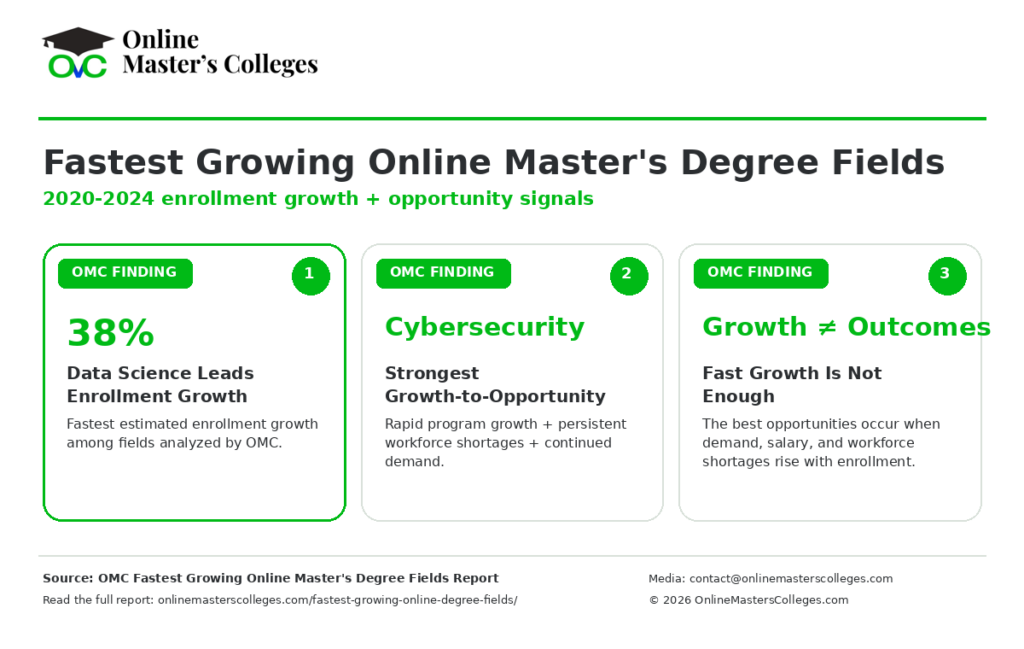
OMC Research Key Finding #1
38% Enrollment Growth — Data Science Leads Online Graduate Expansion
Data science and analytics recorded the fastest estimated enrollment growth among graduate fields analyzed by OMC, increasing by approximately 38% between 2020 and 2024. The growth reflects sustained employer demand for advanced analytics, AI, and data engineering skills across nearly every major industry.
OMC Research Key Finding # 2
Cybersecurity Shows the Strongest Growth-to-Opportunity Profile
Cybersecurity combines rapid enrollment growth, expanding university investment, persistent workforce shortages, and continued salary growth—making it the strongest overall balance of market demand and long-term career opportunity in OMC’s Growth-to-Opportunity Framework.
OMC Research Key Finding #3
Fast Growth Does Not Always Mean Better Career Outcomes
OMC’s analysis found that enrollment growth alone is an incomplete measure of graduate opportunity. Fields experiencing rapid enrollment gains without corresponding employer demand, salary growth, or workforce shortages may face increasing competition as graduate supply expands. The strongest long-term opportunities occur where multiple market indicators align.
Key Findings at a Glance
Before diving into methodology and detailed tables, here are the headline findings from our analysis of online master’s degree enrollment and program growth data.
1. Data science and analytics lead enrollment growth. Online master’s enrollment in data science and analytics fields grew by an estimated 38% over the most recent three-year period — the highest percentage increase of any field tracked. Demand from employers in finance, healthcare, and technology continues to outpace graduate supply.
2. Cybersecurity programs are proliferating faster than any other field. More universities launched new online master’s programs in cybersecurity between 2020 and 2024 than in any other single discipline, reflecting both federal workforce investment and private-sector hiring urgency.
3. Public health saw a post-pandemic enrollment surge — but the curve is flattening. Online master’s in public health programs experienced explosive growth between 2020 and 2022, but enrollment growth rates have decelerated significantly, raising early saturation questions.
4. Nursing and healthcare administration remain structurally undersupplied. Unlike some fast-growing fields where program supply may be catching up with demand, healthcare fields still show persistent labor shortages that outstrip graduate production by wide margins.
5. Business analytics is growing faster than general MBA enrollment. While traditional MBA enrollment has plateaued at many institutions, specialized business analytics master’s programs are posting double-digit enrollment gains — a clear signal of employer preference for technical skills over generalist management credentials.
6. Computer science online enrollment is up 29%, driven by Big Ten and state flagship expansion. Major research universities, including Purdue University and Arizona State University , have significantly expanded online CS master’s capacity, bringing institutional credibility to a field previously dominated by bootcamps and certificates.
7. Social work and counseling programs are growing steadily, fueled by licensure demand. States expanding mental health parity laws and Medicaid behavioral health coverage are driving sustained enrollment increases in MSW and counseling master’s programs.
8. Education leadership is rebounding after a decade of decline. After years of flat or declining enrollment, online master’s in education leadership and administration programs are posting modest but meaningful growth, driven by pandemic-era recognition of school leadership challenges.
What These Growth Trends Reveal
Looking across enrollment growth, university program launches, workforce demand, and labor-market projections reveals a consistent pattern: not every fast-growing graduate field represents the same type of opportunity. Some fields, such as cybersecurity and nursing, continue expanding because employer demand substantially exceeds graduate supply. Others, including public health, experienced rapid enrollment growth driven by extraordinary external events and are now entering a period of normalization. OMC’s analysis suggests that students should evaluate growth alongside workforce demand, salary outcomes, and program expansion rather than treating enrollment growth alone as a signal of long-term career value.
Download the Full Report
Prefer an offline version of this research?
Download the complete Fastest Growing Online Master’s Degree Fields Report, including enrollment growth rankings, university program expansion analysis, workforce demand trends, emerging graduate fields, the OMC Growth-to-Opportunity Framework, and methodology documentation.
The downloadable version is designed for prospective graduate students, higher education professionals, university leaders, researchers, journalists, workforce analysts, and policymakers seeking a comprehensive analysis of graduate education market trends and long-term workforce demand.
The report includes:
- Enrollment growth rankings across major online master’s degree fields
- University program proliferation analysis
- Workforce demand and labor-market trend analysis
- Emerging graduate fields to watch
- OMC Growth-to-Opportunity Framework
- Growth versus saturation analysis
- Key research findings and decision guidance
- Methodology, source documentation, and study limitations
Methodology and Data Sources
Understanding how these growth figures were derived matters — both for evaluating the findings and for applying them to your own program search.
- Growth metrics used. We tracked three primary dimensions of growth: enrollment growth rate (percentage change in online master’s degree enrollment by field), program proliferation (estimated number of new online master’s programs launched by accredited institutions), and institutional adoption rate (the share of regionally accredited universities now offering an online master’s in a given field that did not offer one five years prior).
- Data sources. Enrollment data draws primarily from the National Center for Education Statistics (NCES) Integrated Postsecondary Education Data System (IPEDS), which captures institutional-level enrollment by program classification (CIP code) and delivery mode. Program proliferation estimates are based on IPEDS completions data cross-referenced with institutional program announcements tracked through 2024. Labor market demand signals reference Bureau of Labor Statistics (BLS) Occupational Outlook Handbook projections and employer-demand data from Lightcast (formerly Emsi Burning Glass).
- Time period. The primary analysis window covers the 2020–2024 academic years, capturing both pandemic-era acceleration and post-pandemic normalization. Where relevant, five-year and ten-year trend lines are referenced to distinguish structural growth from temporary surges.
Why OMC Conducted This Analysis
Enrollment growth is one of the most frequently cited indicators in higher education, yet it is also one of the most commonly misunderstood. Rapid program growth may reflect strong employer demand, temporary market conditions, institutional expansion, or a combination of all three. OMC developed this analysis to place enrollment growth within a broader decision-making framework by examining it alongside university program launches, workforce demand, salary outcomes, and long-term labor-market trends. Rather than identifying which fields are simply growing the fastest, the goal is to help prospective graduate students understand why those fields are growing and whether those trends are likely to remain durable over time.
Limitations. IPEDS data carries a one- to two-year reporting lag, so the most recent academic year reflected is typically 2022–2023 completions data. Some institutions — particularly private for-profit schools — report enrollment inconsistently. Growth rates for newer fields (e.g., AI-specific master’s programs) may be understated because IPEDS CIP codes do not yet capture all emerging specializations as distinct categories. Where institutional-level data is cited, it reflects publicly available reporting and may not capture programs still in launch phases.
Note: this page analyzes which fields are growing fastest by enrollment and program count. If you’re looking for programs you can complete in the shortest time, that’s a different dimension entirely—see our guide to the fastest online master’s degree programs for time-to-completion data.
This report should be read alongside OMC’s salary, employment, and ROI research, which evaluate whether fast-growing fields also deliver strong long-term career outcomes.
Fastest Growing Online Master’s Fields by Enrollment
The table below ranks online master’s degree fields by their estimated enrollment growth rate over the 2020–2024 period. Growth rate captures the percentage change in distance-education enrollment within each field’s CIP code cluster. Estimated online enrollment reflects the most recently available IPEDS snapshot. The key growth driver column identifies the primary demand signal behind each field’s expansion.
| Field / Subject Area | Enrollment Growth Rate (%) | Estimated Online Enrollment | Key Growth Driver |
|---|---|---|---|
| Data Science & Analytics | ~38% | 45,000+ | Cross-industry employer demand for data literacy |
| Cybersecurity | ~34% | 38,000+ | Federal cyber workforce mandates and private-sector breaches |
| Public Health (MPH) | ~31% | 42,000+ | Post-pandemic public health infrastructure investment |
| Computer Science | ~29% | 55,000+ | Big Tech hiring and state flagship online expansion |
| Business Analytics | ~28% | 33,000+ | Employer shift from generalist MBA to technical specialization |
| Nursing (MSN/NP) | ~25% | 68,000+ | Chronic nursing shortage and NP scope-of-practice expansion |
| Social Work (MSW) | ~22% | 52,000+ | Mental health parity legislation and Medicaid expansion |
| Healthcare Administration (MHA) | ~20% | 28,000+ | Aging population and healthcare system complexity |
| Applied Behavior Analysis | ~18% | 12,000+ | BCBA certification demand and autism services expansion |
| Education Leadership | ~15% | 35,000+ | Post-pandemic school leadership pipeline rebuilding |
What these numbers tell you — and what they don’t.
The enrollment growth rate signals momentum, not quality or value. A 38% growth rate in data science reflects genuine employer hunger for graduates with statistical and computational skills, but it also means more graduates will be entering the job market each year. The question isn’t just “is this field growing?”—it’s “Is demand growing faster than supply?”
Nursing stands out in this table not for having the highest growth rate, but for having the largest absolute enrollment combined with a growth rate that still cannot fill existing vacancies. The BLS projects a shortage of over 200,000 registered nurses annually through 2031, and nurse practitioner roles are growing at 40% over the decade. That structural undersupply makes nursing one of the safest growth bets in the table.
Public health tells a more cautionary story. The ~31% enrollment surge was heavily concentrated in the 2020–2022 window, and more recent data shows the growth curve flattening. Students entering MPH programs today should carefully evaluate whether the job market in their target subspecialty (epidemiology vs. health policy vs. community health) is absorbing graduates at the rate programs are producing them.
Computer science enrollment growth is being driven substantially by a handful of large-scale online programs at research universities. Arizona State University and Purdue University have both scaled their online CS master’s enrollment significantly, and Johns Hopkins University has expanded its online engineering and CS offerings. This institutional credibility is a meaningful shift: five years ago, the online CS master’s landscape was thinner at the top.
What the Enrollment Rankings Reveal
Looking across all ten graduate fields reveals that enrollment growth alone rarely tells the complete story. The strongest long-term opportunities emerge where enrollment growth is supported by sustained employer demand, workforce shortages, or structural changes in the economy. By contrast, fields experiencing rapid enrollment growth without corresponding increases in employment demand may face greater competition as more graduates enter the market. OMC’s analysis found that the most resilient growth patterns are driven by long-term demographic, technological, or regulatory forces rather than short-term events or temporary shifts in student interest.
For a broader view of which master’s degrees deliver the strongest career and salary outcomes regardless of growth rate, see our analysis of the most useful master’s degrees .
Our AI master’s degree market report tracks program launches and enrollment in the fastest-moving segment specifically.
Program Proliferation: Where Universities Are Investing
Enrollment growth tells you where students are going. Program proliferation tells you where universities are placing their bets — and the two signals don’t always align. When multiple institutions rush to launch programs in the same field, it can signal either a robust market or an emerging oversupply problem.
The table below estimates the number of new online master’s programs launched in each field by regionally accredited institutions over the 2020–2024 window, highlights notable universities expanding in each area, and flags early saturation signals where they exist.
| Field / Subject Area | New Programs Launched (est.) | Notable Universities Expanding | Saturation Signal |
|---|---|---|---|
| Cybersecurity | 80+ | Purdue University , University of Arizona , Western Governors University | Low — demand still far exceeds supply |
| Data Science & Analytics | 70+ | Indiana University Online , Northeastern University , Colorado State University | Moderate — watch employer requirements tightening |
| Public Health (MPH) | 55+ | University of Florida , Johns Hopkins University | Elevated — enrollment growth slowing while programs increase |
| Business Analytics | 50+ | Penn State World Campus , Arizona State University | Moderate — differentiation from MBA matters |
| Nursing (MSN/NP) | 45+ | University of Florida , Grand Canyon University | Very Low — structural shortage absorbs all graduates |
| Social Work (MSW) | 40+ | University of Maryland Global Campus , Southern New Hampshire University | Low — licensure requirements create floor demand |
| Healthcare Administration | 35+ | Liberty University , University of North Texas | Low-Moderate — aging population sustains demand |
| Applied Behavior Analysis | 30+ | Florida International University | Moderate — BCBA certification changes may shift demand |
Reading the proliferation signal.
Cybersecurity tops the program proliferation chart, yet its saturation signal remains low. The disconnect makes sense: the Cyberseek Heat Map consistently shows over 500,000 unfilled cybersecurity positions in the U.S., and federal initiatives like the National Cyber Workforce and Education Strategy are actively pushing universities to produce more graduates. When 80+ new programs still can’t close a half-million-job gap, the supply-demand math favors students.
Contrast that with public health, where 55+ new programs have launched while enrollment growth is already decelerating. The pandemic created a surge of interest in public health careers, and universities responded by rapidly expanding MPH offerings. But the career landscape for MPH graduates outside of epidemiology and biostatistics has historically been more competitive, and the latest job posting data from Lightcast shows public health job postings declining from their 2021 peak. This doesn’t mean MPH programs are a bad choice — it means students should select their concentration carefully and evaluate local market conditions.
The role of large-scale online institutions is worth noting separately. Southern New Hampshire University and Western Governors University have expanded their online master’s portfolios across multiple fields simultaneously, driven by competency-based and enrollment-scaling models that allow rapid program launches. Meanwhile, traditional research universities like Northeastern University and Penn State World Campus have been more selective in their expansions, typically entering fields where they already have faculty depth and employer relationships. This pattern also extends to elite institutions: several Ivy League universities have begun entering the online master’s market in select disciplines, signaling that the reputational ceiling for online graduate education is rising. Both large-scale and selective approaches have merit; the key for students is understanding which type of institution aligns with their career goals and credentialing needs.
What University Expansion Signals
University expansion patterns provide an additional lens for evaluating graduate education markets. Institutions typically invest in new online master’s programs only after identifying sustained student demand, employer interest, or long-term workforce needs. OMC’s analysis found that program launches tend to follow different strategic patterns: some fields, such as cybersecurity and nursing, are expanding because workforce shortages continue to outpace graduate supply, while others, including public health and business analytics, are becoming increasingly competitive as more institutions enter the market. Understanding where universities are investing—and why—helps prospective students distinguish between durable growth opportunities and fields where expansion may eventually outpace demand.
For rankings of programs evaluated on quality, outcomes, and value rather than growth metrics alone, explore the best online master’s programs and the full OMC rankings index .
What’s Driving Growth in These Fields
Growth in online master’s enrollment doesn’t happen in a vacuum. Behind every trend line is a specific set of demand-side forces — and understanding those forces is what separates students who ride a growth wave from those who get caught in it as it breaks.
1. The tech skills gap is structural, not cyclical.
Data science, cybersecurity, and computer science aren’t growing because of a temporary hiring frenzy. The shift is structural: every industry vertical—from banking to agriculture to defense — now requires data infrastructure, analytics capability, and security architecture. The BLS projects 35% growth in information security analyst roles through 2031 and 36% growth in data scientist roles. These projections predate the AI acceleration wave, which has only intensified demand for technical master’s graduates who can build, manage, and govern AI systems. This is the single largest sustained demand driver in online master’s education.
2. Healthcare workforce shortages are demographic, not trend-based.
The growth in nursing, healthcare administration, and public health programs is driven by population aging that will continue for at least two more decades. The U.S. Census Bureau projects that by 2030, all baby boomers will be over 65, expanding the 65+ population by roughly 20 million people in a single decade. Healthcare systems need not just more providers but more administrators, informaticists, and population health specialists to manage this transition. Unlike tech, where demand could theoretically be met by automation, healthcare demand is inherently labor-intensive.
3. Licensure and credentialing are expanding in behavioral health fields.
Social work and counseling master’s programs are growing because an increasing number of states now require or strongly incentivize master’s-level credentials for behavioral health practice. The expansion of telehealth and Medicaid behavioral health coverage has created a pipeline of funded positions that require licensed clinicians, and licensure almost universally requires a master’s degree from an accredited program. This regulatory floor creates durable demand that is less susceptible to market cycles.
4. Employer preference is shifting from generalist to specialist credentials.
The business analytics surge — growing faster than general MBA enrollment — reflects a broader employer preference shift. Hiring managers in Fortune 500 companies increasingly prefer candidates with demonstrable technical specializations over generalist management degrees. This is evident not just in analytics but in fields like supply chain management, information systems, and organizational data strategy. The traditional MBA remains valuable, but its growth has plateaued precisely because specialized alternatives like affordable online MBA programs with analytics concentrations are capturing the incremental student.
5. Institutional legitimacy of online delivery has permanently shifted.
Pre-pandemic, many employers and academic leaders viewed online master’s degrees with skepticism. The forced remote learning experiment of 2020–2021 collapsed that perception barrier. Flagship universities that had resisted online delivery — or offered it only through extension units — began launching fully online master’s programs through their main academic departments. This legitimacy shift is a demand accelerant across all fields, but it particularly benefits technical and professional fields where employer acceptance of online credentials was previously the binding constraint. Programs at institutions like Johns Hopkins University and the University of Florida signal this shift clearly.
Understanding these drivers helps you evaluate whether a field’s growth is likely to continue or whether it was a one-time reaction to a specific event. Fields driven by structural demographics (healthcare) and structural technology shifts (data, cyber) have the most durable growth profiles. Fields driven by event-specific surges (post-pandemic public health interest) require more careful evaluation.
What the Growth Drivers Reveal
Examining the underlying drivers behind enrollment growth reveals an important distinction: the strongest graduate markets are typically supported by long-term structural forces rather than temporary events. Across the fields analyzed, OMC identified three recurring growth patterns—technology transformation, demographic change, and regulatory or licensure requirements. Fields influenced by one or more of these structural drivers have historically demonstrated greater resilience than fields experiencing short-term enrollment surges tied to isolated economic or social events. Understanding why a field is growing is often more valuable than knowing how fast it is growing.
Growth vs. Saturation: How to Read the Data
A field showing 30% enrollment growth sounds exciting — until you discover that the number of programs has grown by 50% and employer job postings have grown by only 10%. Growth data without context is noise. What you need is a framework for evaluating whether growth signals opportunity or oversupply.
The OMC Growth-to-Opportunity Framework
When evaluating any fast-growing online master’s field, assess these four dimensions together rather than relying on any single metric:
| Dimension | What It Measures | Opportunity Signal | Saturation Signal |
|---|---|---|---|
| Enrollment growth rate | How fast students are entering the field | Demand awareness is rising | Supply of graduates is surging |
| Program proliferation rate | How fast universities are launching new programs | Institutions see sustainable demand | Market may be commodifying |
| Job posting growth rate | How fast employers are hiring in the field | Employer demand is real and active | Demand may be peaking |
| Salary trajectory | Whether compensation is rising, flat, or declining | Employers competing for talent | Employer leverage is increasing |
Unlike traditional enrollment rankings, the OMC Growth-to-Opportunity Framework evaluates multiple market indicators together, allowing students to distinguish between sustainable workforce demand and potential market saturation.
The critical ratio is the demand growth rate vs. the supply growth rate. When job postings and salary offers are growing faster than enrollment and program counts, you have a genuine opportunity field. When enrollment and programs are growing faster than job postings and salaries, you have an emerging saturation risk.
Fields where growth clearly signals opportunity:
Cybersecurity shows the strongest growth-to-opportunity ratio in the current landscape. The ~34% enrollment increase and 80+ new programs still leave a gap of roughly 500,000 unfilled positions nationally (Cyberseek, 2024). Median salaries for cybersecurity analysts have risen 12% in real terms over the past five years, and starting salaries for master’s-level graduates consistently exceed $90,000 in major metro areas. Every indicator — enrollment, programs, jobs, salaries — points in the same direction.
Nursing (MSN/NP) has a similarly robust profile. Despite 25% enrollment growth and 45+ new programs, the American Association of Colleges of Nursing reports that nursing schools turned away over 91,000 qualified applicants in 2021 due to capacity constraints. The shortage is so severe that even dramatic supply increases would take years to close the gap.
Fields where growth warrants caution:
Public health presents the clearest saturation risk among high-growth fields. The 31% enrollment increase was concentrated in the 2020–2022 window, while the number of programs continued to grow through 2024. Meanwhile, public health job postings peaked in late 2021 and have declined by approximately 18% since, according to Lightcast labor market data. Salaries for entry-level MPH graduates outside of epidemiology and biostatistics remain relatively modest ($50,000–$60,000 median). Students pursuing an MPH should choose their concentration with precision and verify local job market conditions.
Data science and analytics occupies a more nuanced position. Demand for data professionals remains strong, but the field is experiencing a bifurcation: master’s-level graduates with strong software engineering and statistical modeling skills remain in high demand, while graduates with primarily descriptive analytics skills face growing competition from shorter-credential alternatives (certificates, bootcamps). The growth signal is real, but the value depends heavily on the program’s technical depth.
This framework doesn’t tell you which field to choose—it tells you which questions to ask. Before committing to any fast-growing field, research the specific demand-supply balance in your target geography and subspecialty. The most affordable online master’s programs page can help you evaluate whether the cost-to-outcome math works even in fields where salary growth is moderate.
What the OMC Growth-to-Opportunity Framework Reveals
Applying the OMC Growth-to-Opportunity Framework across the graduate fields analyzed revealed that rapid enrollment growth is not inherently positive or negative. Instead, the strongest long-term opportunities occur when multiple indicators move in the same direction. Fields where enrollment growth, employer demand, salary growth, and workforce shortages reinforce one another generally demonstrate the healthiest long-term outlooks. Conversely, when enrollment and university program expansion accelerate faster than hiring demand or compensation growth, students should evaluate specialization, geographic demand, and program quality more carefully before enrolling.
Emerging Fields to Watch
The fields dominating the growth charts today didn’t appear overnight — five years ago, data science and cybersecurity were emerging categories with just a handful of dedicated online master’s programs. The next wave of high-growth fields is already sending early signals. These are fields that haven’t yet cracked the top-growth tier but show credible evidence of significant near-term expansion.
1. Artificial Intelligence and Machine Learning (standalone master’s programs)
Until recently, AI and ML were concentrations within computer science or data science master’s degrees. That’s changing. A growing number of institutions are launching dedicated MS in Artificial Intelligence programs — distinct from CS, with curricula built around deep learning, NLP, computer vision, and AI ethics. IPEDS data doesn’t yet capture these programs in their own CIP code category, which means their growth is currently understated in national enrollment data. Early enrollment signals from programs at Northeastern University and Johns Hopkins suggest strong initial demand, and BLS projects 23% growth in AI-related roles through 2032.
2. Health Informatics
Sitting at the intersection of healthcare and data, health informatics master’s programs are beginning to separate from both healthcare administration and generic data science. The driver is specific: healthcare systems are investing heavily in electronic health records, predictive analytics for patient outcomes, and population health data infrastructure. AMIA (American Medical Informatics Association) data shows health informatics job postings growing at roughly 20% year-over-year. The field is still relatively small (estimated 8,000–10,000 online master’s students nationally), but program launches are accelerating.
3. Supply Chain Management and Logistics
The pandemic-era supply chain disruptions forced a reckoning across industries: companies realized they lacked the graduate-level talent needed to manage complex global supply networks. Online master’s programs in supply chain management have seen a notable increase in launches since 2021, with institutions like Arizona State University expanding their offerings. The field benefits from concrete, industry-certified career pathways (APICS, CSCP) and strong salary outcomes—median salaries for supply chain managers with master’s degrees exceed $100,000.
4. Instructional Design and Learning Technology
The corporate learning and development market is projected to reach $50 billion by 2026, and much of that spending requires professionals with master’s-level expertise in instructional design, learning experience design, and educational technology. Online master’s programs in this field are growing steadily, with enrollment signals strengthening as companies invest in upskilling infrastructure and K-12 systems continue integrating technology-mediated learning.
5. Climate and Sustainability Science
Still early-stage but worth tracking: online master’s programs in sustainability, environmental management, and climate science are seeing increased program launches, particularly at universities with strong environmental science departments. Federal investment through the Inflation Reduction Act has created new public-sector roles, and ESG (Environmental, Social, Governance) reporting mandates are generating private-sector demand for professionals who understand environmental data and policy. Enrollment numbers remain small, but the policy and funding tailwinds are significant.
The common thread across these emerging fields is that each one sits at an intersection where technology, regulation, or demographic forces are creating new professional roles that didn’t exist at scale a decade ago. That’s the same pattern that preceded the cybersecurity and data science explosions.
What Emerging Fields Have in Common
Although these emerging graduate fields span different industries, they share several characteristics that historically precede sustained long-term growth. Each sits at the intersection of technological innovation, demographic change, regulatory evolution, or new employer skill requirements. OMC’s analysis suggests that the strongest emerging opportunities often appear years before enrollment data fully reflects their momentum, making early workforce signals, university investment, and employer demand valuable indicators alongside traditional enrollment trends. Students evaluating newer graduate disciplines should focus less on whether a field is already popular and more on whether the underlying forces driving demand are likely to persist over the coming decade.
How to Use This Data When Choosing a Program
Growth data is a starting point for program selection, not an endpoint. Here’s how to translate the trends above into smarter decisions about your own master’s degree.
A fast-growing field tells you that something meaningful is happening on the demand side. It doesn’t tell you whether you will benefit. Cross-reference growth data with your own career goals, geographic market, and existing professional experience. A 34% enrollment increase in cybersecurity means little if your career is in hospitality management — unless you’re actively planning a pivot.
National growth data aggregates many sub-specialties. Within data science, demand for machine learning engineers vastly exceeds demand for entry-level data analysts. Within public health, epidemiology job prospects look very different from those in health education. Narrow your research to the specific role you’re targeting, not just the broad field.
In fast-growing fields, new programs launch quickly — and not all of them carry the accreditation or faculty depth needed to deliver genuine career value. Before enrolling in any program, verify regional accreditation and, where applicable, field-specific accreditation (AACSB for business, CCNE for nursing, CSWE for social work). Our guide to accredited online master’s programs provides a starting framework.
Growth fields attract premium pricing. Some of the newest programs in data science and cybersecurity carry tuition rates that assume high starting salaries — but those salaries aren’t guaranteed, especially from programs without established employer pipelines. Compare tuition against median starting salaries in your target role, and consider whether the most affordable online master’s programs in your field offer comparable career outcomes at a lower cost.
The “fastest growing” field in the country may be a poor fit for your skills, interests, and career trajectory. A field growing at 15% that aligns with your professional experience and career goals will almost certainly serve you better than a field growing at 35% where you’d be starting from scratch with no network or domain knowledge.
Growth data is one lens. Layer it with quality rankings from our best online master’s programs analysis, career-outcome data from our most useful master’s degrees page, and cost comparisons from our full rankings index . A good program decision uses multiple data sources — growth trends, program quality, cost, career outcomes, and personal fit — not just one.
What OMC’s Analysis Ultimately Suggests
Across every dataset analyzed in this report—including enrollment growth, university program expansion, workforce demand, salary trends, and the OMC Growth-to-Opportunity Framework—a consistent conclusion emerged: the fastest-growing graduate field is not automatically the best graduate field. Long-term career success depends on how well employer demand, graduate supply, program quality, affordability, and individual career goals align. Students who evaluate multiple indicators together are generally better positioned to identify durable opportunities than those who make decisions based on enrollment growth alone.
FAQs
Data science and analytics, cybersecurity, and public health are currently the three fastest-growing online master’s degree fields by enrollment growth rate, with estimated increases of 38%, 34%, and 31%, respectively, over the 2020–2024 period. Computer science, business analytics, and nursing also rank among the top growth fields. However, growth rate alone doesn’t determine whether a field is a smart choice—you should also evaluate job market demand relative to the number of graduates being produced, salary trajectories, and whether the growth is structural (driven by long-term demand shifts) or event-driven (driven by temporary factors like the pandemic).
No, a growing field is not automatically a good choice. Growth means more students are enrolling and more programs are launching, which can signal a strong opportunity or emerging oversupply. The key question is whether employer demand (measured by job postings and salary growth) is keeping pace with the supply of new graduates. Cybersecurity and nursing show strong demand-supply ratios, meaning growth is a positive signal. Public health, by contrast, saw rapid enrollment growth that may be outpacing job market absorption in some sub-specialties. Always check the demand-supply balance in your specific target role and geography before committing.
Three signals suggest a fast-growing field may be approaching saturation: the number of new programs launching exceeds the growth in job postings, starting salaries are flattening or declining in real terms, and employers begin raising experience or credential requirements for entry-level positions (a sign they have more candidates to choose from). You can track these signals through BLS salary data, Lightcast job posting trends, and by monitoring whether the ratio of program graduates to open positions is shifting. Our growth vs. saturation framework above provides a structured way to evaluate these dimensions.
Cybersecurity, nursing (MSN/NP), and computer science currently have the strongest job market outlooks among fast-growing online master’s fields. Cybersecurity benefits from a persistent 500,000+ job gap nationally. Nursing faces structural shortages projected to last through at least 2031. Computer science demand is supported by the ongoing digital transformation across industries and growing AI adoption. Data science also has a strong outlook, but is increasingly bifurcated—graduates with deep statistical modeling and engineering skills are in high demand, while those with primarily descriptive analytics training face more competition. For a career-outcome-focused view beyond growth trends, see our most useful master’s degrees analysis.
Not necessarily, but newer programs require more due diligence. A program launched by a university with an established reputation and existing faculty depth in the field—such as the University of Florida expanding into public health or Purdue University launching cybersecurity programs—is likely to deliver strong outcomes even if the specific online program is recent. However, programs launched by institutions with no prior expertise in a field, or programs that scale rapidly without proportional faculty investment, warrant skepticism. Check for regional accreditation, field-specific accreditation where applicable, faculty credentials, and employer placement data before enrolling in any newly launched program.
These are entirely different concepts. “Fastest growing” refers to fields experiencing the largest enrollment increases and program proliferation—it’s about market trends and demand signals. “Fastest to complete” refers to programs with accelerated timelines, competency-based structures, or condensed formats that allow you to earn your degree in less calendar time. A field can be fast-growing without offering any accelerated programs, and an accelerated program can exist in a field with flat or declining enrollment. If you’re specifically looking for programs you can finish quickly, our guide to the fastest online master’s degree programs focuses on time-to-completion rather than enrollment growth.