
Colorado State University’s Snapshot
40+
Online master’s programs
$500–900
Per credit hour
~$15–55k
Typical total cost
R1
Public research university
Key policies
Institution type
Public, land-grant university
Regional accreditation
HLC
Admissions model
Rolling (education/business) · Deadline-based (engineering/health)
GRE/GMAT required
Not required (most programs)
Out-of-state premium
None (most programs)
Notable Programmatic Accreditations
- AACSB
- CSWE
- CEPH

- Edited By Jeevan D'Souza
Start Here: Compare CSU by What Matters Most
- Compare institutional strengths → Particularly strong in education, social work, public health, engineering, and applied agricultural sciences
- Compare accreditation → HLC regional accreditation plus AACSB, CSWE, and CEPH programmatic credentials across key programs
- Compare program uniqueness → One of the few R1 universities offering online master’s degrees in agriculture sciences, tourism management, and organizational learning
- Compare flexibility → Mix of rolling and deadline-based admissions, with several programs requiring practicums or field placements arranged locally
- Compare alternatives → Arizona State University, Purdue University, and Penn State World Campus
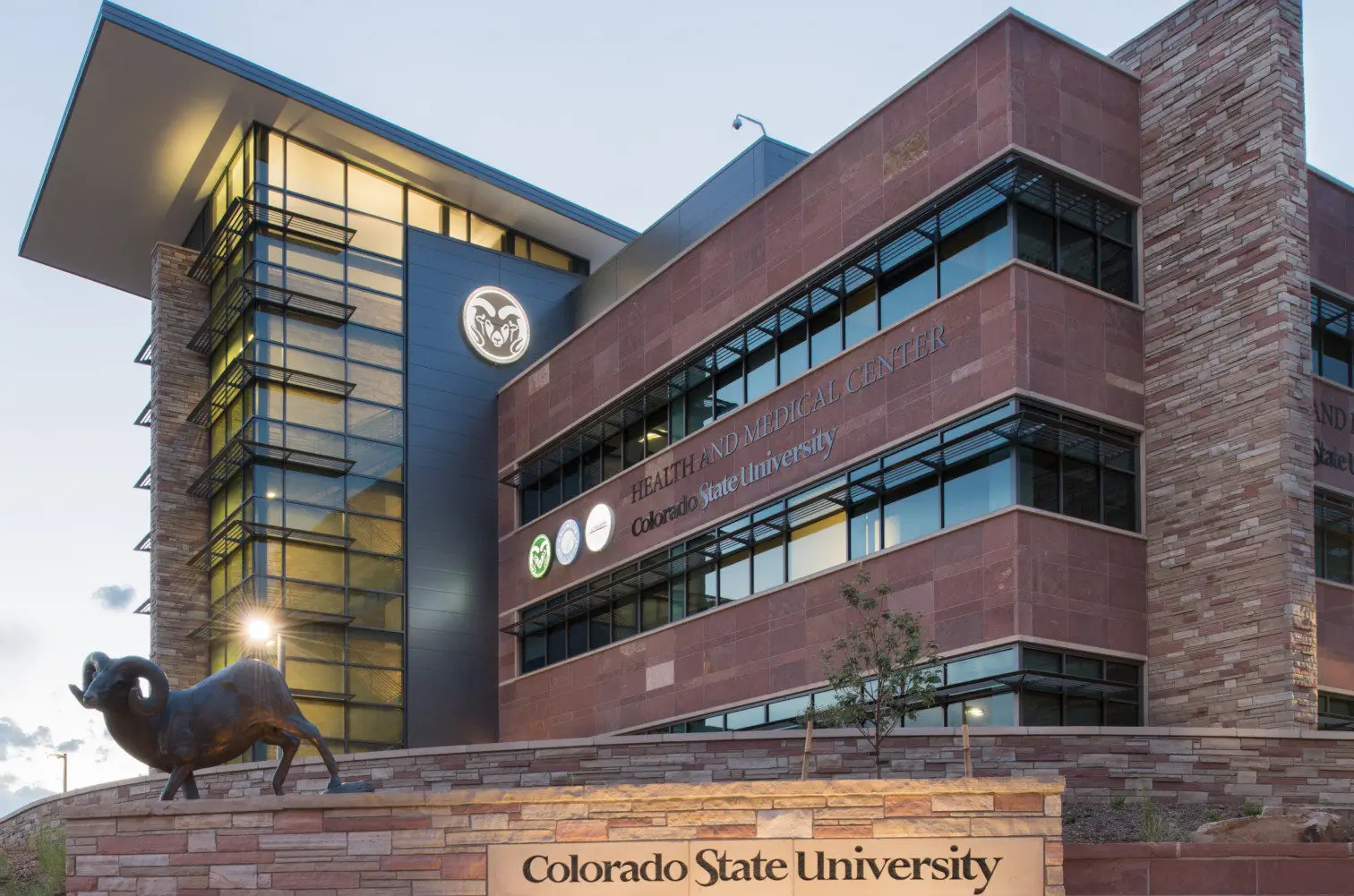
Colorado State University is a public, R1 research and land-grant university based in Fort Collins, Colorado, regionally accredited by the Higher Learning Commission (HLC). CSU offers more than 40 online master’s programs through its Fort Collins campus — spanning business, education, engineering, social work, public health, computer science, and a handful of applied-science disciplines that are genuinely difficult to find online elsewhere.
For prospective online master’s students, the key positioning is this: CSU delivers R1-caliber instruction across a broad portfolio, with particular depth in education (multiple MEd and MS specializations), AACSB-accredited business programs, CSWE-accredited social work, CEPH-accredited public health, and a roster of engineering master’s degrees taught by the same faculty who lead on-campus research. Programs are available to students nationwide, though some require practicum or field placement components that can typically be arranged in a student’s local area.
Important distinction: Colorado State University (Fort Collins) and CSU Global are separate institutions within the CSU System. This page covers only CSU Fort Collins online programs. CSU Global is a fully online university with its own admissions, curriculum, and accreditation profile. Conflating the two is one of the most common mistakes prospective students make.
What Colorado State University Is Known For
CSU’s online reputation rests on a few concrete pillars — not marketing language, but actual programmatic strengths verified by accreditation, employer recognition, and disciplinary standing:
Education programs with unusual breadth.
CSU offers online master’s degrees in educational leadership, adult education and training, organizational learning, performance and change, and student affairs in higher education. For working educators and training professionals, this range means you’re more likely to find a close-fit specialization here than at universities offering a single, general MEd.
CSWE-accredited MSW.
CSU’s online MSW program carries CSWE accreditation — the standard licensure-qualifying credential for social workers. The program allows field placements to be completed locally, which matters for students who can’t relocate. An advanced standing track for BSW holders reduces the program to 39 credits. For a full list of CSWE-accredited online MSW options , see our dedicated ranking.
AACSB-accredited MBA and business programs.
The College of Business MBA holds AACSB accreditation — a marker held by roughly 6% of business schools worldwide. CSU also offers specialized business master’s degrees in finance and human resources management under the same college.
Engineering master’s from an R1 college of engineering.
Online MS programs in electrical, mechanical, civil, and biomedical engineering are taught through CSU’s College of Engineering. This is a meaningful differentiator: many online engineering master’s programs come from professional schools or extension divisions, not from research-active engineering colleges.
Applied sciences that no one else offers online.
CSU’s land-grant identity translates into online master’s programs in agricultural sciences — with concentrations in soil science, crop science, and agricultural education — and a Master of Tourism Management. These are genuine niche programs, not repackaged general degrees.
Long track record in distance education.
CSU has been offering distance-delivered graduate programs since the 1960s, originally through video-based delivery for engineering professionals. This institutional experience with non-traditional delivery predates the online boom by decades.
Online Master’s Programs by Subject
The table below groups CSU’s known online master’s programs by subject area. Credit hours, start dates, and admissions models vary — use this as a decision-support reference, then verify current details with CSU directly.
| Program | Degree | Credits | Duration | Accreditation | GRE/GMAT | Format | Notes |
|---|---|---|---|---|---|---|---|
| Master of Business Administration (MBA) | MBA | 40 | 21–36 months | AACSB | Not required (waiver available) | Fully online | Professional MBA format. Fall, Spring, Summer starts. |
| MS in Human Resources Management | MS | 36 | 18–36 months | — | Not required | Fully online | Rolling admissions. |
| Master of Finance (MFin) | MS | 36 | 18–36 months | AACSB | Not required | Fully online | Fall and Spring starts. |
| Master of Tourism Management | MS | 33 | 18–36 months | — | — | Fully online | Strong fit for hospitality and outdoor recreation sectors. |
| Program | Degree | Credits | Duration | Accreditation | GRE/GMAT | Format | Notes |
|---|---|---|---|---|---|---|---|
| MEd in Educational Leadership | MEd | 30 | 18–36 months | — | Not required | Fully online | Rolling admissions. |
| MEd in Adult Education and Training | MEd | 30 | 18–36 months | — | Not required | Fully online | Rolling admissions. |
| MS in Student Affairs in Higher Education | MS | 42 | 24–36 months | — | Not required | Hybrid (practicum required) | Fall start only. |
| MS in Organizational Learning, Performance, and Change | MS | 36 | 18–36 months | — | Not required | Fully online | Rolling admissions. Draws I/O psychology and corporate training audiences. |
| Program | Degree | Credits | Duration | Accreditation | GRE/GMAT | Format | Notes |
|---|---|---|---|---|---|---|---|
| MS in Electrical Engineering | MS | 30 | 18–36 months | ABET (undergraduate level) | — | Fully online | Deadline-based admissions. |
| MS in Mechanical Engineering | MS | 30 | 18–36 months | — | — | Fully online | Deadline-based admissions. |
| MS in Civil Engineering | MS | 30 | 18–36 months | — | — | Fully online | Deadline-based admissions. |
| MS in Biomedical Engineering | MS | 30 | 18–36 months | — | — | Fully online | Deadline-based admissions. |
| Program | Degree | Credits | Duration | Accreditation | GRE/GMAT | Format | Notes |
|---|---|---|---|---|---|---|---|
| Master of Social Work (MSW) | MSW | 60 | 24–48 months | CSWE | Not required | Hybrid (field placement required, arranged locally) | Advanced standing for BSW holders (39 credits). Fall start only. |
For students comparing online MHA programs or MSN programs , note that CSU’s healthcare-adjacent online master’s offering is centered on public health rather than clinical administration or nursing.
| Program | Degree | Credits | Duration | Accreditation | GRE/GMAT | Format | Notes |
|---|---|---|---|---|---|---|---|
| Master of Public Health (MPH) | MPH | 42 | 24–36 months | CEPH | — | Fully online (practicum can be arranged locally) | Fall start only. |
Students researching online psychology master’s programs should note that CSU offers a counseling-focused degree, not a general or clinical psychology master’s.
| Program | Degree | Credits | Duration | Accreditation | GRE/GMAT | Format | Notes |
|---|---|---|---|---|---|---|---|
| MS in Counseling (Clinical Mental Health Counseling) | MS | 60 | 24–48 months | — | — | Hybrid (practicum + internship hours required) | Check state licensure alignment before enrolling. Fall start only. Students interested in family therapy should verify scope overlap. |
| Program | Degree | Credits | Duration | Accreditation | GRE/GMAT | Format | Notes |
|---|---|---|---|---|---|---|---|
| MS in Computer Science | MS | 32 | 18–36 months | — | — | Fully online | Deadline-based admissions. |
| Master of Applied Statistics | MS | 30 | 18–36 months | — | — | Fully online | Deadline-based admissions. |
| Program | Degree | Credits | Duration | Accreditation | GRE/GMAT | Format | Notes |
|---|---|---|---|---|---|---|---|
| MS in Agriculture Sciences | MS | 30 | 18–36 months | — | — | Fully online | Concentrations in Soil Science, Crop Science, Agricultural Education. One of very few online ag-science master’s from an R1 land-grant university. |
How Colorado State University Compares
Comparing online master’s programs across universities isn’t about declaring a winner — it’s about identifying which tradeoffs matter most for your situation. Here’s how CSU stacks up against three institutions that prospective CSU students frequently also consider.
Key takeaways from this comparison:
CSU vs. Arizona State University
- Arizona State University offers a larger overall online master’s catalog — over 100 programs — which means ASU is more likely to have a specific niche degree you can’t find elsewhere. ASU also tends to have more accelerated pacing options. However, CSU’s portfolio is more curated, and in areas like agriculture, natural resources, and certain education specializations, CSU’s programs are stronger or simply don’t have an ASU equivalent. ASU’s online tuition has been trending upward; CSU’s per-credit rates for many programs remain competitive for a public R1. If breadth and brand recognition are your priorities, ASU may edge ahead. If subject-specific depth in CSU’s strong areas matters more, CSU holds its ground.
CSU vs. Purdue University
- Purdue University is a natural comparison for engineering and STEM-focused students. Both are R1 research universities with strong engineering colleges. Purdue’s online engineering portfolio is slightly broader and carries the Purdue Engineering brand, which has stronger name recognition in some employer circles. CSU counters with competitive engineering tuition, a broader non-STEM online portfolio (education, social work, public health, tourism), and niche applied-science programs Purdue doesn’t offer online. For a student who wants an engineering master’s and nothing else, Purdue may win on reputation. For a student weighing engineering alongside other fields, or drawn to CSU’s specific applied-science strengths, CSU is the more versatile option.
CSU vs. Penn State World Campus
- Penn State World Campus is the closest structural comparison: both are large public research universities with decades of distance education experience and broad online master’s catalogs. Penn State’s brand carries more weight nationally in some fields, and its alumni network is substantially larger. CSU’s advantages are more targeted: stronger positioning in agriculture and natural resources, a CSWE-accredited MSW that Penn State doesn’t offer online, and generally lower tuition in comparable programs. For education professionals, both universities offer strong options, but CSU’s range of education specializations (adult education, organizational learning, student affairs) may provide a closer fit than Penn State’s education catalog. If a nationally recognized brand and the largest possible alumni network drive your decision, Penn State has the edge. If program fit and cost matter more, CSU often wins on specifics.
Colorado State University is
Best For
CSU’s online master’s programs are strongest for these specific student profiles:
- Working professionals who want an AACSB-accredited MBA from a public university without relocating. CSU’s MBA doesn’t require the GMAT/GRE, runs on a professional-pace format, and carries the same accreditation as top-tier business schools — at public university pricing.
- Education professionals expanding beyond classroom teaching. If you’re moving into administration, corporate training, adult education, or student affairs, CSU has more online specializations in these areas than most competitors — and rolling admissions in several programs means you don’t have to wait for a single fall cohort.
- Students who need a CSWE-accredited MSW can complete it while working. The online MSW with local field placement and an advanced standing option for BSW holders is one of CSU’s strongest draws. Explore more CSWE-accredited MSW programs to compare.
- Engineers who want an R1-quality master’s without leaving their job. CSU’s engineering college delivers online MS programs in four disciplines, taught by research faculty. This matters if employer’s perception of program rigor factors into your ROI calculus.
- Students drawn to niche programs that barely exist elsewhere online. Agricultural sciences from a land-grant R1, tourism management, applied statistics — these aren’t programs you’ll find at most online-focused universities. If you know these are your field, CSU may be one of very few credible options.
Not a Best Fit For
No university is the right fit for everyone. Here are specific scenarios where a different institution likely serves you better:
- You’re optimizing for the lowest possible tuition. CSU charges competitive rates for a public R1, but institutions like Western Governors University , Southern New Hampshire University , or University of Maryland Global Campus offer substantially lower per-credit or flat-rate tuition models. If cost is the primary driver and program prestige is secondary, these alternatives will save you thousands.
- You need the fastest possible completion timeline. Some CSU programs follow traditional semester pacing with once-a-year fall starts. If you want to start immediately and finish in 12–18 months, competency-based models at WGU or the accelerated term structures at SNHU will get you to graduation faster.
- You want a dedicated clinical psychology master’s program. CSU’s MS in Counseling is a clinical mental health counseling degree — strong for counseling licensure, but not the same as a clinical or research-oriented psychology master’s. Students specifically targeting clinical psychology should look elsewhere.
- You require a fully asynchronous experience with zero in-person components. Several CSU programs — including the MSW, the counseling MS, and student affairs — require practicum, field placement, or internship hours. These can often be completed locally, but they’re not screen-only. If any in-person obligation is a dealbreaker, confirm format requirements before applying.
- You’re prioritizing elite brand signaling for career advancement in consulting, finance, or tech. CSU is well-regarded in its strong subject areas, but it doesn’t carry the same employer-signaling weight as an Ivy or top-15 national brand. If your career path rewards institutional prestige above all else, that’s a real factor to weigh.
- You’re looking for online nursing programs. CSU doesn’t offer online MSN programs or pathways like BSN-to-MSN or RN-to-MSN . Nursing students should explore other options.
Featured Programs / Top Picks
These aren’t CSU’s only programs, but they represent its most distinctive or strongest online offerings — the ones where CSU has a genuine competitive edge.
AACSB-accredited, no GMAT/GRE required, and available with concentrations in finance, marketing, management, and applied business analytics. The professional MBA format is designed for working adults, with fall, spring, and summer entry points. Among public universities offering AACSB-accredited online MBAs, CSU’s pricing and flexibility make it a consistent contender.
CSWE accreditation makes this degree licensure-qualifying in all 50 states. The standout feature is the local field placement model — students don’t need to relocate to Fort Collins. BSW holders can enter the advanced standing track at 39 credits, cutting both time and cost significantly.
A fully online computer science master’s from an R1 engineering college. The program covers foundational and advanced CS topics through the same department that runs on-campus research. At 32 credits, it’s also one of CSU’s more efficient programs in terms of time-to-completion.
This program sits at the intersection of education, human resources, and organizational development — serving corporate trainers, instructional designers, and change management professionals. It’s a niche that many universities don’t address with a dedicated master’s degree, and CSU’s version has rolling admissions and a fully online format.
Possibly CSU’s most distinctive online offering. Concentrations in soil science, crop science, and agricultural education are delivered through one of the country’s premier land-grant agricultural colleges. If this is your field, your list of R1-quality online options is very short — CSU and Texas A&M University are among the few credible choices.
Admissions Snapshot
Admission requirements vary meaningfully across CSU’s online master’s programs, so treat this as a general framework and verify specifics with your target program.
General requirements across most programs:
- Bachelor’s degree from a regionally accredited institution
- Minimum GPA typically around 3.0 (some programs accept lower with additional documentation)
- Official transcripts from all post-secondary institutions
- Statement of purpose or personal statement
- Letters of recommendation (usually 2–3, varies by program)
- Resume or CV
GRE/GMAT policies: Many CSU online programs do not require the GRE or GMAT, including the MBA, most education programs, and the MSW. Some engineering and science programs may still request scores, though waivers are increasingly available. Verify with your specific program.
Admissions models vary by program:
- Rolling admissions: Several education and business programs accept applications on a rolling basis with multiple start dates throughout the year.
- Deadline-based admissions: Engineering, computer science, public health, and counseling programs typically have fixed application deadlines, often with a single fall cohort.
Selectivity range: Not all CSU online programs are equally competitive. Engineering and computer science programs tend to have more selective admissions with prerequisite coursework requirements. Education and some business programs have broader admission criteria. The MSW program is competitive due to limited cohort sizes and field placement logistics.
Students exploring financial aid options — including loan forgiveness for public service — should apply for aid early, as CSU’s online students are eligible for federal financial aid.
Tuition & Cost Overview
CSU’s online master’s tuition varies by college and program, so there’s no single number that applies across the board. Here’s the decision-relevant context:
General tuition structure: Most CSU online master’s programs charge a per-credit tuition rate. Many programs offer a flat online rate regardless of residency — meaning out-of-state students pay the same as Colorado residents for online coursework. However, this is not universal across all programs, so confirm with your specific department.
Approximate per-credit range: Online master’s tuition at CSU generally falls in the range of $500–$900 per credit hour, depending on the college and program. Business and engineering programs tend toward the higher end; education programs tend toward the lower end.
Estimated total program costs: Using the credit-hour ranges in the programs table above, total program costs for most CSU online master’s degrees fall between $15,000 and $55,000. Programs with higher credit requirements — like the 60-credit MSW and counseling MS — will be at the upper end.
How CSU compares on cost:
- CSU is generally less expensive than Penn State World Campus and Arizona State University for comparable programs.
- CSU is generally more expensive than Western Governors University , SNHU , and UMGC , which prioritize affordability over research-university positioning.
- For engineering specifically, CSU is competitive with Purdue — both charge similar rates for online engineering master’s programs.
Financial aid: Online master’s students at CSU are eligible for federal financial aid (loans, grants where applicable), and many programs allow employer tuition reimbursement. Graduate assistantships are occasionally available for online students, though they’re more common in on-campus programs.
Visit Colorado State University’s official online programs page
Related Rankings
CSU’s programs intersect with several OMC rankings that can help you compare options across institutions:
- Online MBA Programs — Operations Management : Relevant for students considering CSU’s MBA with a management or analytics concentration.
- MSW Programs : Compare CSU’s CSWE-accredited MSW against other top online social work programs.
- CSWE-Accredited MSW Programs : A focused list for students who require CSWE accreditation for licensure.
- Online Masters Programs by State : Useful for comparing CSU with other Colorado-based and regional options.
- Criminal Justice Programs : For students exploring adjacent public-service fields alongside social work or counseling.
- MHA Programs : While CSU offers an MPH rather than an MHA, students weighing healthcare leadership degrees may want to compare both.
- Psychology Programs : Relevant for students evaluating CSU’s counseling MS against psychology-focused master’s options.
- Occupational Therapy Programs : For students in the health and human services space , exploring adjacent program options.
FAQ
Yes. CSU is regionally accredited by the Higher Learning Commission (HLC), which covers all programs — online and on-campus. Individual programs carry additional programmatic accreditations: AACSB for business, CSWE for social work, and CEPH for public health.
They are separate institutions within the Colorado State University System. CSU Fort Collins (the subject of this page) is the main research campus — its online programs are extensions of on-campus departments, taught by the same faculty, and carry the same accreditation. CSU Global is a fully separate online university with its own admissions, tuition, curriculum, and institutional accreditation. Programs and degrees from the two are not interchangeable. Make sure you’re applying to the right institution.
Most CSU online master’s programs are fully online with no campus visits required. However, several programs have in-person components: the MSW requires field placement hours (arranged locally), the MS in Counseling requires practicum and internship hours, and the MS in Student Affairs includes a practicum component. Always verify the specific format requirements of your target program.
Completion timelines range from about 18 months for 30-credit programs taken at full pace to 48 months for 60-credit programs taken part-time. Most students finish in 2–3 years. Programs with rolling admissions and multiple start dates (like several education programs) offer more flexibility to start sooner.
Many programs do not require the GRE or GMAT, including the MBA, most education programs, and the MSW. Some engineering and science programs may require or recommend standardized test scores, though waivers are increasingly available based on professional experience or GPA thresholds. Check with your specific program.
Many CSU online master’s programs charge a flat tuition rate regardless of state residency, effectively eliminating the in-state/out-of-state distinction for online learners. However, this isn’t universal across all programs — some may still have differential rates. Confirm with your target program’s admissions office before budgeting.