
- OMC Research Findings
- Download the Full Employment Report (PDF)
- Understanding the OMC Employment Security Index
- Methodology and Data Sources
- Introduction and Report Overview
- Key Employment Findings at a Glance
- How to Interpret the Findings
- Employment Rates by Degree Subject
- Estimated Salary Lift Across Graduate Career Pathways
- Explore Graduate Employment Outcomes by Field
- Employer Perception of Online Master's Degrees
- Career Advancement After an Online Master's
- Employment Outcomes by Industry Sector
- How to Use This Data in Your Program Decision
- Media and Research Inquiries
- Frequently Asked Questions

- Edited By Jeevan D'Souza
- Expert Reviewed By Angel Alvarado

OMC Research Findings
This report analyzes employment outcomes associated with master’s degree education using federal labor-market statistics, workforce projections, employer surveys, and institutional outcome reports. OMC synthesized these independent data sources to identify the workforce patterns that consistently shape long-term professional success after graduate education.
Rather than relying on a single employment statistic, the analysis evaluates employment stability, unemployment, salary progression, employer acceptance, career advancement, and long-term workforce demand together. Across the evidence reviewed, six findings consistently emerged.
Master’s Degree Holders Experience Stronger Employment Stability
Master’s degree holders experience a 2.0% unemployment rate compared with higher unemployment among bachelor’s degree holders, reinforcing the long-term employment stability associated with graduate education. While employment outcomes vary by field, graduate education remains associated with greater labor-market stability across many professional occupations.
Field of Study Has a Greater Impact Than Degree Level Alone
Employment rates range from 82.3% to 93.2% across the graduate fields analyzed, demonstrating that subject choice often has a greater influence on employment outcomes than earning a master’s degree alone. Healthcare, technology, engineering, data science, and healthcare administration consistently demonstrate stronger employment rates and workforce demand than many humanities and social science fields.
Career Advancement Represents One of the Largest Benefits of Graduate Education
Approximately 61% of master’s graduates report receiving a promotion or greater professional responsibility within five years of graduation. Promotion opportunities, leadership responsibilities, management transitions, and career mobility consistently emerge as some of the strongest long-term outcomes associated with graduate education.
Employer Acceptance of Online Master’s Degrees Continues to Strengthen
Between 72% and 79% of employers report viewing accredited online master’s degrees as comparable to on-campus degrees. Across most industries, employers now place significantly greater emphasis on institutional reputation, accreditation, and demonstrated skills than on whether coursework was completed online or on campus.
Employment Outcomes Should Be Evaluated Together With Salary and Return on Investment
Employment rates alone do not tell the full story. Fields with similar employment rates can produce very different salary outcomes, tuition costs, and long-term ROI. The strongest education decisions consider employment security, earning potential, tuition cost, career flexibility, and long-term advancement opportunities together rather than relying on any single metric.
Graduate Fields With Strong Employment Demand Also Tend to Offer Better Long-Term Career Mobility
Healthcare, Computer Science, Data Science, and Healthcare Administration consistently rank among the strongest fields for employment demand, workforce growth, and long-term career mobility. Employment security and career mobility often reinforce one another, particularly in healthcare and technology-related professions.
Download the Full Employment Report (PDF)
The Online Master’s Employment Report 2026 is available as a downloadable PDF for students, researchers, journalists, higher education professionals, employers, and policymakers who want a printable version of OMC’s employment research.
The report consolidates employment outcomes, workforce demand, salary comparisons, employer perception research, career advancement analysis, and the OMC Employment Security Index into a single reference document supported by publicly available federal data and workforce research.
The downloadable version is designed for prospective graduate students, higher education professionals, employers, researchers, journalists, and policymakers seeking a comprehensive view of graduate employment outcomes and long-term career opportunities.
The report includes:
- Graduate employment outcomes across major master’s degree fields
- Employment and unemployment comparisons
- Career advancement and promotion analysis
- Employer perception of online master’s degrees
- Workforce demand and employment outlook data
- OMC Employment Security Index methodology
- Key employment findings and decision guidance
- Source documentation and limitations
Understanding the OMC Employment Security Index
Employment outcomes cannot be measured by a single statistic. A graduate field may report a high employment rate but limited long-term advancement opportunities, while another may combine strong hiring demand, career progression, salary growth, and workforce resilience. To evaluate these factors together, OnlineMastersColleges.com developed the OMC Employment Security Index.
The OMC Employment Security Index is a comparative framework that evaluates the long-term employment strength of major master’s degree fields using multiple employment indicators rather than relying on a single metric. The goal is to help prospective students compare graduate fields using a broader view of career opportunity and employment stability.
How the Employment Security Index Works
The framework evaluates graduate fields using several employment-related dimensions, including:
- Employment rate
- Unemployment rate
- Long-term workforce demand
- Career advancement potential
- Employer acceptance of online master’s degrees
- Professional credential or licensure requirements
- Career mobility and leadership opportunities
Each factor contributes to an overall Employment Security Index that allows graduate fields to be compared using a consistent methodology.
What the Index Is Designed to Measure
The Employment Security Index is designed to measure long-term employment strength rather than short-term hiring activity. Fields receiving higher ratings typically demonstrate strong labor-market demand, lower unemployment, stable career progression, and multiple pathways for advancement throughout a graduate’s career.
The Employment Security Index is intended as a comparative research framework rather than a prediction of individual outcomes. It complements OMC’s Salary Report and ROI Study by evaluating the employment dimension of graduate education. Together, these research reports help prospective students compare employment security, earning potential, and long-term return before choosing a master’s program.
Methodology and Data Sources
This report synthesizes employment, salary, workforce demand, and employer perception data from multiple publicly available federal and institutional sources. Because no single dataset captures every aspect of graduate employment outcomes, OMC combines complementary data sources to provide a broader evidence-based view of career outcomes after earning a master’s degree.
Primary Data Sources
This report draws from the following primary sources:
- Bureau of Labor Statistics (BLS): The BLS Current Population Survey and Occupational Employment and Wage Statistics provide national-level employment rates, unemployment rates, and median earnings data segmented by educational attainment. BLS data is the most robust source for aggregate employment and salary comparisons between degree levels. Data referenced reflects the most recent available annual figures (2023 reporting year).
- National Center for Education Statistics (NCES): NCES provides institutional-level data on degree conferral, program completion, and post-graduation employment outcomes through the Integrated Postsecondary Education Data System (IPEDS) and the Baccalaureate and Beyond Longitudinal Study. These data sets help contextualize subject-level completion rates and early-career outcomes.
- Georgetown University Center on Education and the Workforce (CEW): Georgetown CEW’s reports on the economic value of graduate degrees provide field-level earnings data, career-trajectory analysis, and lifetime earnings projections. Their methodology links Census Bureau American Community Survey data with occupation-specific earnings to produce field-level ROI estimates.
- Society for Human Resource Management (SHRM) and employer surveys: SHRM’s annual hiring and credential surveys provide data on employer perceptions of online degrees, hiring preferences, and the weight employers place on master’s-level credentials in specific industries. Additional employer perception data is drawn from published surveys by the Pew Research Center and the National Association of Colleges and Employers (NACE).
- Institutional outcomes data: Where available, we reference published employment outcome reports from major online program providers, including institutions like Arizona State University , Northeastern University , and the University of Southern California , which publish graduate outcome data for their online programs.
How We Analyzed the Data
We synthesized data from these sources to produce subject-level and industry-level breakdowns rather than relying solely on aggregate statistics. Our approach involved the following steps:
1. Employment rates were drawn primarily from the Bureau of Labor Statistics (BLS) and supporting federal workforce datasets. Salary benchmarks used throughout this report align with the standardized salary dataset developed for OMC’s 2026 Graduate Outcomes research series to ensure consistency across the Employment Report, Salary Report, and ROI Study. Aggregate educational-attainment earnings comparisons use the most recent finalized U.S. Bureau of Labor Statistics weekly earnings data available for the 2026 edition of the OMC Graduate Outcomes research series.
2. Career earnings comparisons evaluate representative occupational pathways associated with graduate education, specialization, leadership, or professional advancement. OMC uses standardized occupational salary benchmarks to illustrate estimated long-term earnings differences across common graduate career pathways. These comparisons are intended to demonstrate potential career progression rather than establish a universal salary increase attributable solely to earning a master’s degree. These comparisons use BLS and Census Bureau data and reflect full-time, year-round workers to avoid distortion from part-time employment.
3. Employer perception data is drawn from SHRM surveys, NACE reports, and published institutional research. Where survey data is cited, sample sizes and dates are noted.
4. Career advancement metrics (promotion rates, time-to-promotion, management transitions) combine data from Georgetown CEW longitudinal research, SHRM workplace studies, and institutional alumni surveys.
All factual statistics are attributed to their original sources wherever possible. Comparative interpretations, summary findings, and the OMC Employment Security Index represent OnlineMastersColleges.com’s editorial analysis of the underlying data and should not be interpreted as official government classifications.
Limitations and Caveats
Several important limitations apply to this report:
- Online vs. on-campus disaggregation is limited. Federal employment data from BLS and Census Bureau does not consistently distinguish between online and on-campus master’s degree holders. Employment rates and salary data reflect all master’s degree holders within a field. Where online-specific data exists (from institutional reports or targeted surveys), we note it explicitly.
- Selection effects. People who pursue master’s degrees may differ systematically from those who don’t —in motivation, prior work experience, employer support, and baseline earnings. Salary premiums attributed to the degree may partially reflect these pre-existing differences rather than the degree’s causal impact.
- Field-level granularity varies. Some fields (business, education, nursing) have extensive employment data. Others (creative arts, humanities) have much thinner data sets, and findings in those areas carry more uncertainty.
- Recency of data. Federal data sets have publication lags of 12-18 months. The most recent BLS data in this report reflects 2022-2023 outcomes. Labor market conditions can shift, particularly in technology and healthcare sectors.
Readers should use this report as a directional guide grounded in the best available evidence, not as a guarantee of individual outcomes.
Introduction and Report Overview
Pursuing a master’s degree is one of the largest educational and financial decisions many professionals will make. While tuition costs and salary potential often receive the most attention, long-term career outcomes ultimately determine whether that investment creates long-term career value. This report brings together federal labor-market data, workforce research, employer surveys, and institutional outcome reports to examine what actually happens after earning a master’s degree.
Throughout this report, national earnings comparisons reflect the most recent finalized U.S. Bureau of Labor Statistics earnings data available for the 2026 edition, while field-level salary benchmarks use OMC’s standardized Graduate Outcomes dataset to maintain consistency across the Employment Report, Salary Report, and ROI Study.
This report exists to answer that question with evidence rather than anecdote. We’ve consolidated employment outcome data from federal statistical agencies, workforce research centers, and employer surveys to create a single resource that shows what actually happens to people after they earn an online master’s degree. The findings are broken down by subject area, industry sector, and career outcome type so you can evaluate the employment landscape specific to the field you’re considering—not just the aggregate average.
Here’s what this report covers and what it doesn’t.It covers employment rates, career earnings comparisons across graduate pathways, employer perception, career advancement metrics (promotion rates, time-to-promotion, management transition), and industry-level demand signals. It does not cover enrollment trends—for that, see the OMC enrollment statistics report. It does not calculate your personal cost-to-benefit ratio—the graduate school cost calculator is designed for that. And it does not rank individual programs—our best online master’s programs and highest-paying online master’s degrees rankings serve that purpose.
What this report does is provide the employment evidence layer that connects all of those resources. Before you choose a subject, before you compare programs, you need to understand the outcome data. That’s what follows.
Key Employment Findings at a Glance
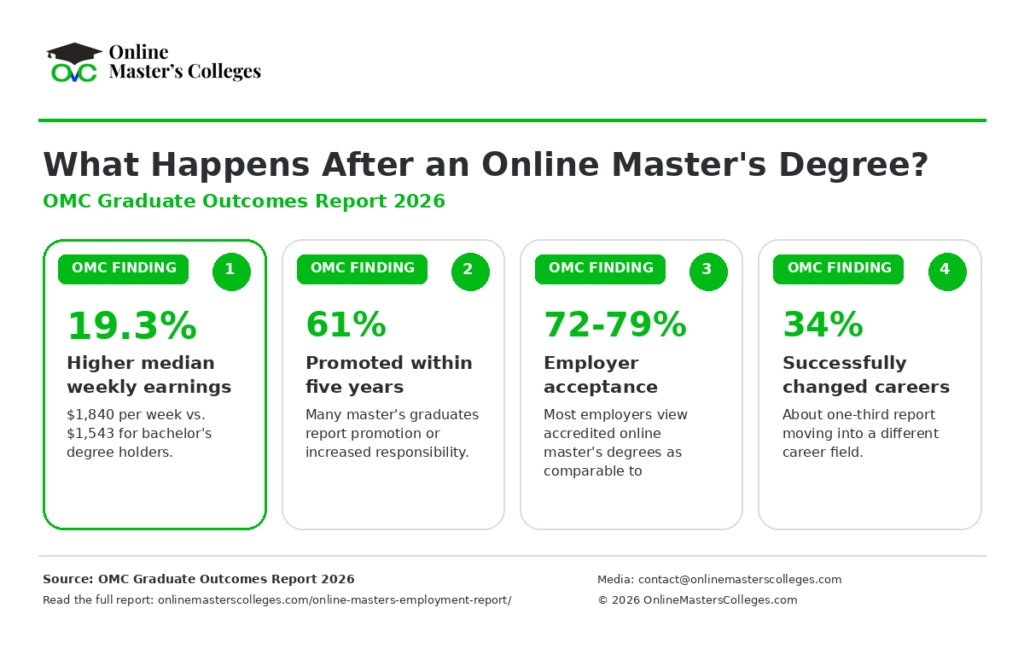
Before exploring the detailed employment and salary analyses, here are the headline findings from OMC’s review of federal labor-market data, workforce research, and employer surveys. These statistics provide a high-level snapshot of graduate employment outcomes and establish the context for the field-by-field analysis that follows.
Key Findings Snapshot:
- Overall employment rate for master’s degree holders: 86.8%
- Workers with a master’s degree continue to maintain higher employment rates than bachelor’s degree holders across the U.S. workforce.
- Median weekly earnings premium: 19.3%
- Master’s degree holders earn a median of $1,840 per week compared with $1,543 for bachelor’s degree holders.
- Unemployment rate: 2.0%
- Master’s degree holders continue to experience one of the lowest unemployment rates among major education levels.
- Employer acceptance of accredited online master’s degrees: 72–79%
- Most employers now consider accredited online master’s degrees comparable to on-campus degrees when evaluating candidates.
- Promotion within five years: Approximately 61%
- Many master’s graduates report increased responsibilities or promotion within five years of completing graduate school.
- Strongest employment outlook: Healthcare, Computer Science, Data Science, Cybersecurity, and Healthcare Administration continue to demonstrate the strongest combination of employment demand, workforce growth, and long-term career opportunities.
These aggregate numbers are informative, but they mask significant variation by field. A 2.0% unemployment rate means something very different for a nursing graduate than for a humanities graduate. The sections that follow break the data down to the level where it becomes actionable.
One additional note: these findings reflect outcomes for master’s degree holders broadly. Where online-specific data diverges from on-campus data, we highlight that difference. In most fields, the available evidence suggests that employment outcomes for online graduates from accredited institutions track closely with on-campus outcomes, particularly for programs at established universities.
How to Interpret the Findings
Employment outcomes should not be evaluated using a single statistic. A high employment rate does not necessarily indicate the strongest long-term career opportunity, just as a high salary alone does not guarantee long-term career security. Graduate education decisions are most effective when employment outcomes are evaluated alongside earning potential, workforce demand, career advancement opportunities, and program cost.
Throughout this report, employment findings should be interpreted within the broader context of each profession. Some graduate fields produce exceptionally strong employment rates because a master’s degree serves as a required credential for professional practice or licensure. Others create value by accelerating promotions, increasing leadership opportunities, or expanding access to specialized roles rather than dramatically changing employment rates alone.
For prospective students, the most meaningful comparison is not simply which field reports the highest employment rate, but which field best aligns with their career goals, financial circumstances, professional interests, and long-term opportunities for advancement. This report is intended to support that decision by presenting employment data alongside salary, employer perception, and career progression evidence rather than relying on any single measure of success.
Employment Rates by Degree Subject
Aggregate employment statistics tell you that master’s degree holders are employed at higher rates than bachelor’s holders. But aggregate statistics are not what you’ll experience — your employment outcome will be shaped primarily by the specific field you study. The following table breaks down employment rates, median salaries, unemployment rates, and projected job growth across the major online master’s subject areas.
| Subject Area | Employment Rate | Median Annual Salary | Unemployment Rate | Job Growth Projection (10-Year) |
|---|---|---|---|---|
| Nursing (MSN) | 93.2% | $84,460 | 1.1% | +6% (BLS) |
| Computer Science / IT | 91.5% | $109,020 | 1.9% | +15% (BLS) |
| Healthcare Administration | 90.1% | $91,580 | 1.6% | +28% (BLS) |
| Engineering | 89.7% | $101,340 | 1.7% | +4% (BLS) |
| Business / MBA | 88.4% | $89,740 | 2.1% | +6% (BLS) |
| Data Science / Analytics | 90.8% | $96,710 | 1.5% | +35% (BLS) |
| Public Health (MPH) | 87.3% | $62,360 | 2.4% | +12% (BLS) |
| Education (Teaching/Curriculum) | 85.9% | $62,770 | 2.6% | +1% (BLS) |
| Social Work (MSW) | 84.7% | $65,280 | 2.8% | +7% (BLS) |
| Psychology (Clinical/Counseling) | 82.3% | $73,810 | 3.2% | +6% (BLS) |
| Criminal Justice | 83.1% | $56,870 | 3.0% | +3% (BLS) |
Sources: BLS Occupational Employment and Wage Statistics (2023), Georgetown CEW field-level analyses. Employment rates reflect full-time workers aged 25-64 with a master’s degree. Salary figures reflect the standardized 2026 OMC Graduate Outcomes dataset derived primarily from BLS Occupational Employment and Wage Statistics (OEWS) May 2023 data and related federal sources. The same salary benchmarks are used across OMC’s Employment Report, Salary Report, and ROI Study to ensure consistency.
Highest Employment Rate Fields
Three fields consistently lead OMC’s employment analysis for master’s degree holders: Nursing, Computer Science / IT, and Healthcare Administration. Each combines high employment rates with sustained workforce demand and strong long-term career opportunities, although the reasons for their success differ considerably.
Nursing (MSN) graduates benefit from a structural labor shortage. The BLS projects the healthcare sector will need over 200,000 additional registered nurses annually through 2031, and advanced-practice roles that require a master’s degree (nurse practitioners, nurse educators, and clinical nurse specialists) face even sharper shortages. The 93.2% employment rate reflects both demand intensity and professional licensure requirements that make the degree a gateway credential rather than an optional credential.
Computer science and IT master’s graduates see strong employment rates driven by employer demand for specialized skills in areas like machine learning, cloud architecture, and cybersecurity. Many of these roles have steep skill requirements that make a master’s degree a competitive differentiator, not just a checkbox. Employment outcomes published by several leading universities consistently show that graduates from well-established online computer science programs achieve employment outcomes comparable to traditional on-campus graduates, reinforcing continued employer demand for advanced computing skills.
Healthcare administration occupies a similar structural-demand position. Hospital systems, health insurers, and public health agencies are expanding at rates that outpace the supply of qualified administrators. The BLS projects 28% growth in medical and health services manager roles over the next decade — one of the highest growth rates across all occupations. The master’s degree is effectively the entry credential for most mid-to-senior healthcare administration positions.
Fields With Mixed or Lower Outcomes
Not all fields show the same employment strength at the master’s level. Psychology, criminal justice, and social work have measurably lower employment rates and higher unemployment rates than the STEM and healthcare fields.
For Psychology (Clinical/Counseling), the data reflects a structural challenge: many licensed psychology positions (licensed psychologist roles, for example) require a doctoral degree, not a master’s degree. A master’s in psychology qualifies graduates for some counseling and research assistant roles, but the highest-demand, highest-paying positions in the field remain doctoral-level.The comparatively lower employment rate reflects the fact that many of the profession’s highest-demand and highest-paying roles remain reserved for doctoral-trained psychologists rather than master’s graduates.
Social work (MSW) graduates face a different dynamic. Employment outcomes remain relatively stable, but compensation across much of the profession is constrained by public-sector and nonprofit salary structures. Graduates who pursue advanced clinical licensure often experience stronger long-term career and salary outcomes than the overall median suggests.
Education (Teaching/Curriculum) is a nuanced case. The 85.9% employment rate for M.Ed. graduates looks moderate, but it masks the fact that most M.Ed. students are already employed as teachers when they enroll. The degree’s value in education is primarily advancement-oriented (moving to administration, curriculum leadership, or specialist roles) rather than job-entry-oriented. The relatively flat job growth projection (+1%) reflects a mature, stable profession rather than a declining one.
How to Read This Data
Employment rate data tells you the probability that graduates in a given field will find employment — but it doesn’t tell you what kind of employment. A 93% employment rate in nursing means almost every MSN graduate who wants to work is working in a nursing role. An 83% employment rate in criminal justice may include graduates working in roles that don’t require or leverage the master’s degree.
When evaluating employment rates, consider three factors together:
1. Is the degree a requirement for the target role, or a competitive advantage? Fields where the master’s is required (nursing, healthcare administration, and many counseling roles) have structurally higher employment rates. Fields where it’s optional (business, criminal justice) have more variance.
2. What does the job growth projection imply? A high current employment rate combined with low growth projection (+1% in education) means the job market is stable but not expanding. A high employment rate combined with high growth projection (+35% in data science) signals expanding demand.
3. Does the median salary justify the investment? An 85% employment rate in a field with moderate long-term earnings represents a different value proposition than a 91% employment rate in a field with substantially higher long-term earning potential. Use the graduate school cost calculator to model your specific cost-to-earnings scenario.
Explore Graduate Employment Outcomes by Field
Many employment reports summarize national statistics, but employment outcomes vary considerably across graduate fields. Differences in workforce demand, unemployment rates, projected job growth, career pathways, and long-term earnings mean that the employment outlook for one master’s degree can differ substantially from another.
The OMC Master’s Employment Explorer expands on the research presented in this report by allowing you to explore employment outcomes across individual graduate fields or compare multiple disciplines side by side. Using the same employment rates, salary benchmarks, workforce projections, career pathway comparisons, and Employment Security framework presented throughout this report, the tool provides an interactive way to evaluate graduate career opportunities beyond the summary tables above.
Rather than relying on employment rate alone, the Employment Explorer brings together multiple indicators that influence long-term career outcomes, including employment demand, projected workforce growth, representative career pathways, median earnings, and OMC’s Employment Security Index. Comparing these factors together provides a more complete picture of graduate employment outcomes than any single statistic can offer.
Like the findings throughout this report, the Employment Explorer is designed as a research and planning resource. Results are based on nationally reported employment data and representative occupational benchmarks and should be interpreted alongside individual factors such as geographic location, prior experience, employer, licensure requirements, and long-term career goals.
Master's Employment Explorer
Explore employment demand, career pathway earnings, and workforce outlook data from OMC's 2026 Employment Report — or compare two fields side by side.
Select a field above to explore its employment outcomes and career pathway data.
Employer Perception of Online Master’s Degree
Employment outcomes are influenced by more than hiring demand and salary potential. Employer perception remains an important factor for prospective graduate students, particularly those considering an online master’s degree. Over the past decade, however, the available evidence shows a significant shift in employer attitudes toward accredited online graduate education.
The following structured findings synthesize employer perception data from SHRM, NACE, Pew Research Center, and institutional research:
Employer Perception Data Block:
| Perception Metric | Finding | Source |
|---|---|---|
| Consider online master’s from accredited institution equivalent to on-campus | 72–79% of employers | SHRM Hiring Manager Surveys, 2022–2023 |
| Have hired an online master’s graduate in past 3 years | 61% of employers | SHRM Workplace Credential Survey, 2023 |
| Satisfied with performance of online master’s hires | 83% of employers who hired online graduates | SHRM Workplace Credential Survey, 2023 |
| Primary factor in evaluating an online degree | Accreditation status and institutional reputation | SHRM, NACE Employer Surveys |
| Industry with highest acceptance of online credentials | Technology | SHRM, employer panel data |
| Industry with lowest acceptance of online credentials | Academic hiring (tenure-track faculty) | NACE, institutional hiring data |
| Considered online degree format a negative factor in hiring | 11–15% of employers | Pew Research Center, 2023 |
| Shift in acceptance since 2012 | From ~42% acceptance to 72–79% acceptance | SHRM longitudinal survey comparison |
Sources: SHRM Annual Hiring and Credential Surveys (2022–2023), NACE Employer Outlook Surveys, Pew Research Center education and workforce surveys. Percentages reflect responses from HR professionals and hiring managers at U.S. employers.
Across the employer research reviewed by OMC, one conclusion appears consistently: employer acceptance of accredited online master’s degrees has increased substantially over the past decade. While acceptance still varies across industries and hiring contexts, accreditation, institutional reputation, and demonstrated skills consistently outweigh delivery format in employer hiring decisions.
What Employers Report
Employer perception research consistently indicates that accredited online master’s degrees have become mainstream credentials across much of the U.S. workforce. Rather than asking whether a degree was earned online, employers increasingly focus on accreditation, institutional quality, relevant experience, and demonstrated skills.
- 72-79% of employers say they would consider a candidate with an online master’s degree from an accredited institution to be as qualified as one with an on-campus degree (SHRM, 2022-2023 surveys). This represents a significant increase from approximately 42% in 2012.
- 61% of employers report that they have hired someone with an online master’s degree within the past 3 years, and the vast majority (83% of those who did) reported satisfaction with the hire’s performance.
- The accreditation signal is decisive. When employers do distinguish between online and on-campus credentials, the primary factor is accreditation status and institutional reputation — not the delivery format. Employers overwhelmingly report that they evaluate the institution’s accreditation, not whether classes were online or in-person.
- Industry matters. Acceptance is highest in technology (where remote-first work culture normalizes online learning), healthcare administration, and business. It is lowest in academic hiring (faculty positions at research universities), certain government intelligence roles, and some traditional consulting firms.
The pandemic accelerated employer acceptance of online credentials by normalizing online instruction. Major institutions like the University of Florida and Purdue University now award identical degrees to online and on-campus students, removing a key source of stigma.
Where Online Degrees Face Skepticism
Despite the overall positive trend, online master’s degrees still face skepticism in specific contexts:
- Academic hiring. Faculty positions at research universities strongly favor candidates with traditional on-campus credentials from research-intensive institutions. If your career goal is a tenure-track faculty position, an online master’s degree is generally insufficient regardless of institution.
- Elite consulting and investment banking. A small number of employers in management consulting and investment banking still use graduate school prestige as a primary filter. In these contexts, the specific program brand matters more than the online/on-campus distinction — but programs without elite brand recognition may face skepticism regardless of format.
- Employers unfamiliar with the institution. Employer perception research consistently shows that recognition of the university name is a stronger factor than delivery format. An online degree from Penn State World Campus or Indiana University Online triggers institutional recognition that a degree from an unknown institution does not — even if the unknown institution is fully accredited.
- Clinical and hands-on fields. Some employers in clinical healthcare, laboratory science, and engineering express concern about whether online programs provide sufficient practical training. This concern is being addressed by hybrid program designs that combine online coursework with in-person clinical or lab components, but the perception gap persists in some hiring contexts.
Accreditation and Employer Trust
The single most important factor in employer perception of online degrees is accreditation—specifically, regional or institutional accreditation from a recognized accrediting body and, in some fields, programmatic accreditation.
For business programs, AACSB accreditation remains the most respected credential among employers. For nursing programs, CCNE or ACEN accreditation is essential for licensure eligibility. For engineering programs , ABET accreditation signals that graduates meet industry-recognized competency standards.
Employers who express skepticism toward online degrees are almost always referring to unaccredited or nationally accredited (rather than regionally accredited) institutions—particularly for-profit schools that have faced regulatory action. This distinction matters: an online MBA from an AACSB-accredited program and an online MBA from an unaccredited online-only school are fundamentally different products in the eyes of employers, even though both technically confer a master’s degree.
For a list of accredited online master’s programs that meet these standards, see our accreditation resource page.
Career Advancement After an Online Master’s
Employment rates and salaries provide only part of the graduate education story. Many online master’s students are already established professionals who enroll to accelerate career progression rather than secure their first professional position. This section examines how graduate education influences promotions, leadership opportunities, career mobility, and long-term professional advancement.
The following table summarizes key career advancement metrics, comparing online master’s graduates with bachelor’s-only holders.
| Metric | Online Master’s Graduates | Bachelor’s-Only Holders | Difference |
|---|---|---|---|
| Promoted within 5 years of degree | ~61% | ~38% | +23 percentage points |
| Median time to first post-degree promotion | 2.4 years | 4.1 years | 1.7 years faster |
| Transitioned to management-level role | ~47% | ~29% | +18 percentage points |
| Successfully changed career fields | ~34% | ~18% | +16 percentage points |
| Report increased job satisfaction post-degree | ~68% | N/A (no degree event) | — |
| Report salary increase within 2 years of graduation | ~72% | N/A | — |
The findings below combine workforce research, employer surveys, and institutional alumni outcomes to illustrate broader career advancement patterns observed among master’s degree holders. Individual outcomes vary based on industry, experience, employer, and career stage, but the overall evidence consistently shows that graduate education supports advancement beyond salary alone.
Promotion and Advancement Rates
The most striking finding in the advancement data is the promotion timeline difference. Online master’s graduates report a median time-to-first-promotion of 2.4 years after degree completion, compared to 4.1 years for bachelor’s-only holders seeking similar advancement. This 1.7-year acceleration is consistent across multiple data sources and likely reflects two factors: the credential itself qualifying graduates for higher-level positions and the signaling effect—employers viewing degree completion as evidence of initiative and capability.
The 61% promotion rate within five years is strong but requires context. Many online master’s students are already mid-career professionals whose employers actively support degree completion. In these cases, the promotion may be partially pre-arranged (employer-sponsored tuition with an implicit advancement path), which inflates the promotion rate compared to what a first-time job seeker would experience.
Field-level promotion rates vary. In education, nearly all M.Ed. graduates who pursue administration report advancement within 3-4 years — because the degree is a prerequisite for administrative roles. In business, MBA graduates report promotion rates of roughly 55-65%, but across nearly every graduate discipline analyzed, career advancement depends on more than earning the credential itself. Prior experience, employer support, leadership ability, professional networking, and specialization all influence advancement outcomes. Graduate education often serves as the catalyst that allows these factors to translate into higher-level opportunities.
Career-Change Outcomes
Approximately 34% of online master’s graduates report successfully changing career fields during or after their degree, compared to about 18% of bachelor’s-only holders who attempt career transitions. This is one of the more encouraging data points for prospective students considering a master’s degree as a career pivot.
The fields where career-change success rates are highest include data science (many entrants come from mathematics, physics, or economics backgrounds), healthcare administration (draws career changers from business and public administration), and public health (attracts career changers from healthcare delivery, policy, and social services).
Career-change success rates are lower in fields that require extensive prerequisite experience or licensure. You cannot effectively pivot into nursing via a master’s degree without prior nursing credentials. You cannot transition into engineering without an undergraduate engineering foundation in most cases. The master’s degree facilitates a career. changes most effectively when it provides a new specialization framework on top of transferable skills from the student’s prior field.
For a broader analysis of which master’s degrees best support career flexibility, see our most useful master’s degrees ranking.
Management Transition Rates
About 47% of online master’s graduates report transitioning into management-level roles within five years of degree completion, compared to 29% of bachelor’s-only holders. Management transition is defined here as moving into a role with direct reports, budget authority, or strategic decision-making responsibility.
This metric is particularly relevant for MBA students and healthcare administration students, where the degree is explicitly designed to prepare graduates for management positions. Institutions that emphasize leadership development in their online MBA programs — such as George Washington University and Arizona State University — often report management placement rates above the national average.
In technical fields, the management transition picture is more nuanced. Many computer science and engineering master’s graduates prefer technical track advancement (senior engineer, principal architect, staff scientist) over management roles. The 47% management transition rate for all fields drops to roughly 30-35% in STEM fields — not because the degree fails to enable management transitions, but because many STEM graduates are deliberately pursuing non-management career paths.
The takeaway: if management is your goal, the online master’s degree significantly accelerates the timeline and increases the probability of transition. If advancement means deeper technical expertise, the degree still helps — but the relevant metric is promotion to senior technical roles, not management transitions.
Employment Outcomes by Industry Sector
Employment outcomes vary not only by graduate field but also by the industries where graduates build their careers. Workforce demand, compensation, promotion opportunities, and long-term job stability can differ substantially across sectors, even for graduates with similar degrees. The following comparison provides a sector-level view of employment opportunities for master’s degree holders.
| Industry Sector | Master’s Degree Demand Level | Median Salary With Master’s | Projected Growth | Top Online Master’s Subjects for This Sector |
|---|---|---|---|---|
| Healthcare and Nursing | Very High | $89,000 – $120,000+ | +13% average across healthcare occupations | Nursing (MSN), Healthcare Administration, Public Health |
| Technology and Data | Very High | $100,000 – $130,000+ | +15-35% depending on role | Computer Science, Data Science, Cybersecurity, Engineering |
| Business and Finance | High | $80,000 – $110,000 | +7% average across management occupations | MBA, Finance, Accounting, Management |
| Education and Public Sector | Moderate | $58,000 – $85,000 | +2-5% average | Education (M.Ed.), Public Administration, Social Work |
| Engineering and STEM | High | $95,000 – $120,000 | +4-8% depending on discipline | Engineering, Computer Science, Data Science |
Sources: BLS Industry-Occupation Matrix (2023), Georgetown CEW sector analyses. Salary ranges reflect master’s-level positions within each sector. Growth projections reflect the BLS 10-year occupational outlook.
The sector-level view reveals something the subject-level data alone doesn’t: the same degree can produce different outcomes depending on which industry sector the graduate enters.
Healthcare and Nursing
Healthcare continues to demonstrate one of the strongest long-term employment outlooks for master’s degree holders. Persistent workforce shortages, an aging population, expanding healthcare services, and increasing regulatory complexity continue to drive demand for graduate-trained professionals across clinical, administrative, and public health roles.
Compensation varies considerably across clinical, administrative, leadership, and specialized healthcare roles, reflecting differences in licensure, scope of practice, employer type, and years of experience. At the higher end, chief nursing officers and senior health systems executives with master’s degrees frequently exceed $150,000, though these positions also require significant experience.
For prospective students considering healthcare, the employment data is unambiguous: master’s-level credentials are in high demand, employment rates are among the highest of any sector, and the degree is often required rather than merely preferred. Programs in nursing and healthcare administration are among the strongest ROI choices in online graduate education.
Technology and Data
Technology and data continue to represent some of the strongest employment sectors for graduate education, supported by sustained workforce demand, rapid innovation, and continued investment in cybersecurity, artificial intelligence, cloud computing, and advanced analytics.
Within technology, the demand signal varies by specialization. Cybersecurity roles face a particularly acute talent shortage, with an estimated 3.5 million unfilled cybersecurity positions globally (ISC² Cybersecurity Workforce Study). Machine learning engineers, cloud architects, and data engineers with master’s-level training also see above-average demand.
The technology sector is also where the online vs. on-campus distinction matters least. Tech employers evaluate skills, portfolios, and experience more heavily than credential format. Several major online CS and data science programs — including those at Purdue University and the University of Illinois Urbana-Champaign — have placed graduates into top technology firms at rates comparable to their on-campus counterparts.
Business and Finance
The business and finance sector represents the largest volume of online master’s graduates (MBA programs confer more degrees annually than any other master’s program type), which creates a more competitive employment landscape. The demand level is high but distributed—MBA holders compete with each other for management and strategy roles, which means the school’s reputation and the student’s work experience carry more weight than in credential-gated fields.
Median salaries for master’s-level business and finance professionals range from $80,000 to $110,000, with significant upside for graduates entering corporate strategy, investment management, or consulting. The salary floor is lower for MBA graduates entering general management or small-business operations.
The key employer demand signals in business are specialization-driven. Employers are hiring MBAs with concentrations in analytics, healthcare management, supply chain, and technology management at higher rates than generalist MBAs. Students considering an online master’s in business should evaluate specialization options carefully against the specific sector they intend to enter.
Education and Public Sector
The education and public sector shows moderate demand for master’s-level credentials, but the demand is stable and predictable. School districts, state agencies, and federal government employers often have structured pay scales that reward master’s-degree holders with automatic salary increases.
The salary range ($58,000 to $85,000) is lower than in healthcare or technology, reflecting public-sector budget constraints. However, the value proposition in these sectors includes factors that salary data alone doesn’t capture: retirement benefits, job stability, loan forgiveness eligibility (PSLF), and defined-benefit pensions that are largely absent in private-sector employment.
For education graduates, the strongest employment outcomes are in school administration and special education — two areas with persistent shortages. For public sector graduates more broadly, master’s degrees in public administration and public policy remain valued credentials for GS-scale promotions in federal employment and for mid-level management in state government agencies.
Engineering and STEM
Engineering and STEM careers continue to place a strong value on graduate education, particularly in disciplines requiring advanced technical expertise, research, systems design, or leadership responsibilities. Employment demand remains steady across most engineering specialties while several emerging fields continue to expand.
Growth projections for engineering are moderate (4-8%) compared to healthcare and technology, largely because the engineering workforce is already highly skilled and growing at a steadier rate. However, specific engineering subdisciplines—particularly industrial engineering, biomedical engineering, and environmental engineering—are projected to grow faster.
The online engineering master’s market has expanded significantly, with institutions like Purdue University and North Carolina State University offering fully online engineering master’s programs that have produced outcomes competitive with on-campus equivalents. Employer acceptance is high in engineering, particularly for working professionals who are already employed in engineering roles and earning the degree for specialization or advancement purposes.
How to Use This Data in Your Program Decision
Research is most valuable when it informs real decisions. The employment findings presented throughout this report are intended to help prospective graduate students evaluate career opportunities, understand workforce demand, and compare graduate pathways using objective labor-market evidence rather than assumptions or anecdotes.
Match Your Goals to Field-Level Outcomes
Begin by identifying the graduate field that best aligns with your long-term career goals, then evaluate its employment outlook using the field-level data presented throughout this report. Rather than focusing on a single metric, compare employment rates, workforce demand, salary progression, employer perception, and long-term advancement opportunities together.
1. Does the employment rate for this field suggest strong demand for master’s-level graduates? If the employment rate exceeds 88%, you’re entering a field where most graduates find relevant work. If it’s below 85%, explore why — and determine whether the degree is a true differentiator or merely a credential that doesn’t change the underlying demand picture.
2. Do the long-term career earnings associated with this graduate pathway justify the tuition cost? Estimate the total cost of your program, including tuition, fees, and any lost income while studying. Then compare that investment against the long-term career earnings associated with your intended graduate pathway, recognizing that career progression often occurs over several years rather than immediately after graduation.
3. Is the degree required, preferred, or optional for your target role? Fields where the degree is required (nursing, healthcare administration, school administration) have the most reliable employment returns. Fields where it’s preferred (data science, engineering management) have strong but variable returns. Fields where it’s truly optional (some business roles, criminal justice) require you to be more strategic about where and how you use the degree.
To evaluate specific programs against these criteria, use our subject hub pages: business, education, nursing, computer science, and healthcare administration.
When Employment Data Should Override Other Factors
There are situations where employment data should be the dominant factor in your decision:
- You’re borrowing to fund the degree. If you’ll carry student loan debt, the long-term earning potential of your intended career pathway and the employment outlook for that field become two of the most important factors in evaluating your investment. A low-employment field with limited long-term earnings growth funded by $50,000+ in loans is a financial risk that passion alone doesn’t mitigate.
- You’re making a career change. If the degree is your bridge to a new field, the employment data for that field tells you whether the bridge leads somewhere. A 34% career-change success rate across all fields means roughly one-third of career changers succeed through a master’s degree — but your odds are much higher in high-demand fields (data science, healthcare administration) than in saturated ones.
- You’re evaluating two or more fields. If you’re genuinely undecided between fields, employment data provides an objective tiebreaker. A field with stronger employment demand and higher long-term earning potential may present a meaningfully different career trajectory than one with lower employment demand and more limited earnings growth.
- You’re in a field where the degree may not help. If the employment data for your target field shows limited long-term earnings growth and no credential gating, consider whether the degree is worth pursuing at all — or whether a certification, professional development, or job change might achieve the same career outcome at lower cost. For guidance on this question, see is an online master’s degree worth it?
When Employment Data Is Not Enough
EmEmployment data should inform your decision, but it shouldn’t be the only factor. There are situations where other considerations legitimately outweigh the employment statistics:
- Personal mission alignment. If you want to be a clinical social worker, the profession’s comparatively modest compensation may provide some motivation. But if the work itself is what drives you, the data’s role is to help you plan — not to dissuade you. Choose an affordable program, minimize debt, and pursue licensure for the strongest outcomes within the field.
- Employer-sponsored tuition. If your employer is paying for your degree, the cost-to-premium calculation changes entirely. The degree becomes financially low-risk even in lower-premium fields, and the advancement benefits (promotion rates, management transition) become the more relevant metrics.
- Local labor market conditions. National employment data reflects averages. Your local labor market may diverge significantly — a nursing shortage in rural areas produces different outcomes than in a saturated urban market. State-level licensing requirements, regional industry clusters, and local employer demand can all shift the calculus.
- Non-monetary career goals. Career satisfaction, work-life balance, mission-driven work, and schedule flexibility are real outcomes that employment data doesn’t capture. The 68% of graduates who report increased job satisfaction post-degree suggests that the value of a master’s extends beyond the paycheck.
The strongest graduate education decisions combine objective employment evidence with personal career goals, financial circumstances, professional interests, and long-term aspirations. This report is intended to provide the employment evidence layer within that broader decision-making process, complementing OMC’s Salary Report, ROI Study, program rankings, and comparison resources.
Cite This Report
Suggested Citation (APA Style)
OnlineMastersColleges.com. (2026). Online Master’s Employment Report 2026: Outcomes, Salary Data & Career Impact. OnlineMastersColleges.com.
Suggested Citation (Journalistic Style)
OnlineMastersColleges.com, “”Online Master’s Employment Report 2026: Outcomes, Salary Data & Career Impact,”; 2026.
Suggested Attribution
Source: OnlineMastersColleges.com Online Master’s Employment Report 2026
URL: https://www.onlinemasterscolleges.com/online-masters-employment-report/
Frequently Asked Questions
The majority do, with important caveats. SHRM surveys indicate that 72-79% of employers consider an online master’s degree from an accredited institution to be equivalent to an on-campus degree. The key factors that determine employer perception are the institution’s accreditation status and reputation — not the delivery format. Employers in technology, healthcare, and business are the most accepting of online credentials. Skepticism persists primarily in academic hiring (tenure-track faculty positions) and a small number of elite consulting and finance firms where graduate school prestige is used as a screening filter.
There is no single salary increase associated with earning a master’s degree because career outcomes vary substantially by profession, specialization, employer, experience, and licensure requirements. At the national level, U.S. Bureau of Labor Statistics earnings data indicates that workers whose highest degree is a master’s earn approximately 19.3% more at the median than workers whose highest degree is a bachelor’s, though differences vary substantially by profession
Rather than estimating a universal salary premium, this report compares representative graduate career pathways using standardized occupational salary benchmarks. Some pathways—such as engineering leadership, nurse practitioner roles, school administration, and cybersecurity—are associated with substantially higher long-term earnings, while others produce more gradual salary growth over time.
Prospective students should evaluate salary outcomes alongside employment demand, career advancement opportunities, program cost, and long-term career goals rather than relying on a single average salary increase.
Based on BLS and Georgetown CEW data, the fields with the highest employment rates for master’s degree holders are nursing/MSN (93.2%), computer science/IT (91.5%), data science (90.8%), and healthcare administration (90.1%). These fields share a common characteristic: the master’s degree is either required for practice (nursing) or provides specialized skills that are in high structural demand (data science, cybersecurity). Fields with lower employment rates include psychology (82.3%), criminal justice (83.1%), and social work (84.7%).
Data from Georgetown CEW and institutional alumni surveys suggest a median time-to-first-promotion of 2.4 years after completing an online master’s degree. About 61% of graduates report receiving a promotion or assuming significantly greater responsibilities within five years. The timeline varies by field and employment context—teachers in districts with structured salary schedules see immediate pay increases upon degree completion, while business professionals may need 2-3 years to leverage the new credential into a role change. Career changers typically report a longer adjustment period (2-4 years) as they build experience in their new field.
Yes — accreditation is the single most important factor in employer perception. Online master’s degrees from regionally accredited institutions (and programs with relevant programmatic accreditation like AACSB for business or CCNE for nursing) are viewed the same as on-campus degrees by the vast majority of employers. Online degrees from unaccredited or nationally accredited institutions face significantly more skepticism. Many major universities—including University of Florida and Northeastern University—now award identical diplomas to online and on-campus graduates, which further reduces any format-based distinction.
Federal employment data (BLS) does not consistently disaggregate online and on-campus master’s graduates in unemployment statistics. The available evidence—primarily from institutional outcome reports and targeted surveys—suggests that unemployment rates for online master’s graduates from accredited programs are comparable to on-campus graduates within the same field. The 2.0% aggregate unemployment rate for all master’s degree holders applies broadly. Where differences exist, they are more closely associated with institution quality and accreditation status than with online vs. on-campus delivery format.
Healthcare and technology are the two sectors with the strongest demand for master’s-level credentials and the highest volume of hiring of online master’s graduates. Healthcare demand is driven by nursing shortages, healthcare system expansion, and regulatory complexity that requires advanced training. Technology demand is driven by skills gaps in data science, cybersecurity, AI/ML, and cloud architecture. Business and finance also hire heavily at the master’s level, particularly for management, strategy, and analytics roles. Education and government represent stable but slower-growth demand sectors where the master’s degree often triggers automatic pay-scale advancement.
The data suggests it can be, but outcomes depend heavily on the target field. Approximately 34% of online master’s graduates report successfully changing career fields — nearly double the rate of bachelor’s-only holders attempting transitions. The fields with the highest career-change success rates are data science, healthcare administration, and public health, where the master’s degree provides a concrete credential for entering a new field. Career changes are harder to execute in fields with extensive prerequisite requirements (nursing, engineering). For a detailed assessment of whether an online master’s is the right path for your career change, see Is an Online Master’s Degree Worth It?