
- Why Employment Rate Matters When Choosing a Master's Degree
- How We Evaluate Employment Rates for Master's Degrees
- OMC Employment Security Framework
- OMC Graduate Employment Transparency Census
- Quick Picks: Master's Degrees by Employment Outcome
- Employment Rate vs. Salary: Which Degrees Deliver Both?
- Master's Degrees With the Highest Employment Rates: Full Rankings
- Employment Rate Comparison Table
- The Tradeoffs: High Employment Rate Doesn't Always Mean Best Fit
- Master's Degrees With Lower Employment Rates: What to Know
- How to Maximize Your Employment Chances With a Master's Degree
- Related OMC Rankings and Resources
- Media and Research Inquiries
- Frequently Asked Questions About Master's Degree Employment Rates

- Edited By Jeevan D'Souza
- Expert Reviewed By Soumen Chatterjee

Why Employment Rate Matters When Choosing a Master’s Degree
Most prospective graduate students research salary potential or program prestige before enrolling. Those are valid inputs, but they skip a more fundamental question: will you actually get a job in this field after graduating? Employment rate — the share of master’s degree holders in a given field who are employed, and specifically employed in roles that use their degree — is a distinct metric from salary, return on investment, or projected job growth. A field can pay exceptionally well on paper yet have a saturated labor market where new graduates struggle to land roles. Conversely, some fields with moderate salary ceilings have near-universal employment because demand for qualified practitioners far outpaces supply.
This distinction matters because the employment rate captures what happens after graduation in a way that salary medians and growth projections do not. The Bureau of Labor Statistics (BLS) reports that master’s degree holders across all fields have a significantly lower unemployment rate (approximately 2.0%) than bachelor’s holders (approximately 2.2%) or those with some college (approximately 3.3%)—but that aggregate number masks enormous variation across fields. In healthcare and licensed professions, employment rates for master’s-level graduates routinely exceed 97%. In some humanities and fine arts fields, the rate drops below 90% and includes substantial underemployment. Choosing a degree field with a strong employment rate doesn’t guarantee the right career, but it does substantially reduce the risk that your degree won’t translate into work.
OMC Finding
Employment rate and salary are not the same measure of graduate degree value. In OMC’s analysis, several master’s degree fields with the highest employment rates do not produce the highest salaries, while some of the highest-paying graduate fields rank lower for employment security. Students evaluating graduate programs should consider employment rate, salary potential, workforce demand, and return on investment together rather than relying on a single metric.
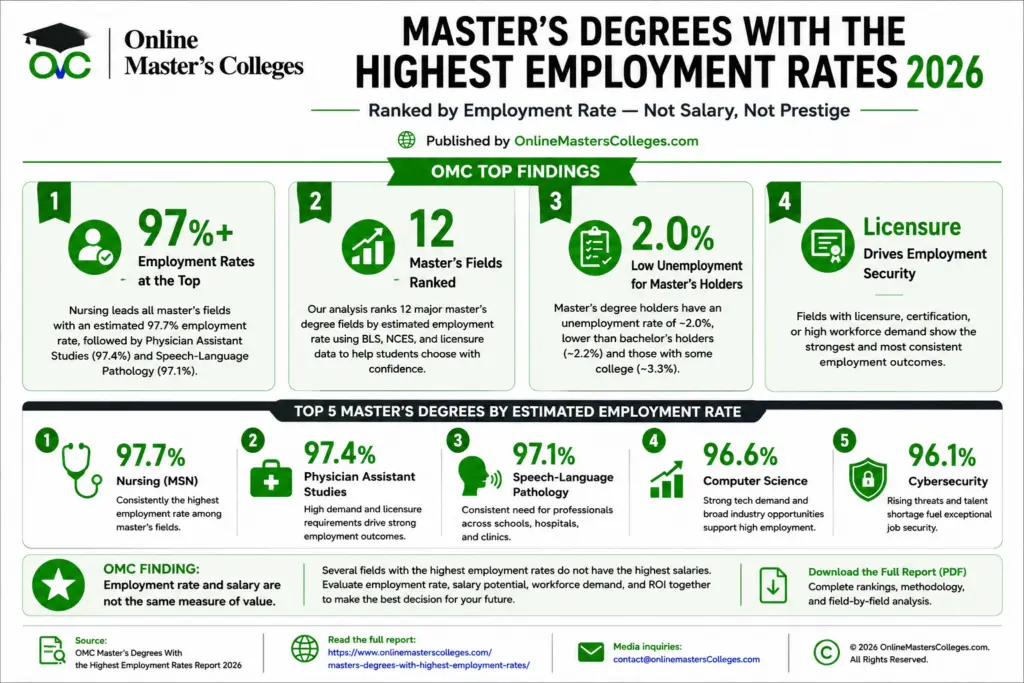
The rankings and analysis below organize master’s degree fields by this specific metric. If you’re looking for which degrees pay the most, see highest-paying master’s degrees . If you want to evaluate whether a master’s degree justifies its cost, see ‘ master’s degree ROI ’. This page answers a narrower, more urgent question: which degrees actually lead to employment?
Download the Full Report
Prefer an offline version of this research?
Download the complete Master’s Degrees With the Highest Employment Rates Report (2026), including full employment rankings, field-by-field analysis, employment security comparisons, workforce demand trends, licensure considerations, methodology documentation, and the OMC Employment Security Framework.
The downloadable report is designed for prospective graduate students, higher education leaders, employers, researchers, journalists, career advisors, and policymakers seeking a comprehensive analysis of graduate employment outcomes across major master’s degree fields.
The report includes:
Complete rankings of master’s degree fields by estimated employment rate
- Employment Security Score comparisons
- Employment Rate vs. Salary analysis
- Employment comparison tables
- Workforce demand and labor market trends
- OMC Graduate Employment Transparency Census
- OMC research findings
- Methodology, sources, and limitations
How We Evaluate Employment Rates for Master’s Degrees
Employment outcomes are not measured consistently across graduate education. While some universities publish placement rates or graduate outcome reports, there is no single national database that reports field-specific employment rates for master’s degree graduates across every discipline.
To produce a consistent comparison, OnlineMastersColleges.com combines multiple publicly available labor market sources with its own analytical framework. The primary sources used throughout this report include:
- Bureau of Labor Statistics (BLS) Employment Projections and Occupational Outlook Handbook — provides occupation-level unemployment rates, projected employment growth, and median wages.
- National Center for Education Statistics (NCES) — provides graduate employment outcomes, field-of-study data, and postsecondary education statistics.
- Professional associations and licensing organizations — including organizations such as AACN, NCCPA, AICPA, ASHA, AOTA, and other credentialing bodies that publish workforce, certification, and employment information for regulated professions.
Because comprehensive degree-level employment rates are not available across every master’s discipline, occupation-level employment data is used as the primary proxy for evaluating employment security. Where appropriate, OMC supplements these public datasets with field-specific employment outcomes, licensure statistics, accreditation requirements, and workforce information published by professional organizations.
Rather than treating a single employment percentage as the entire story, OMC evaluates employment opportunity using multiple indicators, including labor market demand, employment stability, credential requirements, and workforce trends. These inputs are combined within the OMC Employment Security Framework to provide a more complete comparison across graduate degree fields.
Like all labor market research, this analysis has limitations. Federal employment data typically lags current market conditions by one to two years, occupational categories do not always align perfectly with academic degree titles, and employment outcomes may vary based on specialization, geographic region, prior experience, and local labor demand. Where direct degree-level employment outcomes are unavailable, occupation-level data serves as the most consistent and transparent benchmark for comparing graduate fields.
Why OMC Conducted This Analysis
Publicly available employment data is often fragmented across federal agencies, universities, licensing organizations, and professional associations, making it difficult for prospective graduate students to compare employment outcomes across master’s degree fields using a consistent methodology. OMC developed this research to consolidate those sources into a transparent comparative framework that allows students, researchers, journalists, and higher education professionals to evaluate graduate employment outcomes using a common set of benchmarks. By applying the same methodology across every field, the report enables more meaningful comparisons than relying on isolated institutional placement rates or occupation-specific datasets alone.
OMC Employment Security Framework
Employment rate is one of the strongest indicators of graduate degree value, but it is not the only factor that determines long-term employment security. A field may have a high employment rate today yet experience slowing demand, while another may combine strong employment with rapid workforce expansion and multiple career pathways.
To provide a broader comparison, OnlineMastersColleges.com developed the OMC Employment Security Framework, a comparative evaluation model that assesses graduate degree fields across multiple employment-related dimensions rather than relying on a single employment percentage.
The framework considers:
- Estimated field employment rate
- Long-term employment growth projections
- Workforce demand and labor shortages
- Licensure or credential requirements
- Time-to-employment following graduation
- Employment stability across economic cycles
These indicators are evaluated together to identify master’s degree fields that consistently demonstrate strong employment opportunities, career resilience, and long-term workforce demand.
The framework is designed as a comparative decision-support tool rather than a prediction of individual employment outcomes. It helps students evaluate the overall employment outlook of different graduate degree fields while recognizing that personal experience, geographic location, specialization, and professional background also influence career success.
OMC Employment Security Score
| Degree Field | Employment Security Score |
|---|---|
| Nursing (MSN) | A+ |
| Physician Assistant Studies | A+ |
| Cybersecurity | A+ |
| Computer Science | A |
| Accounting | A |
| Speech-Language Pathology | A |
| Occupational Therapy | A |
| Data Science / Analytics | A |
| Social Work | | B+ |
| Education (Licensure Track) | B+ |
| Engineering | B+ |
| Healthcare Administration | B+ |
Key Findings From the Employment Security Framework
Applying the OMC Employment Security Framework across the 12 graduate fields analyzed revealed several consistent patterns. Licensed healthcare professions—including nursing, physician assistant studies, speech-language pathology, and occupational therapy—earned the highest Employment Security Scores because they combine exceptionally strong employment rates with persistent workforce shortages and clear credential-to-employment pathways. Technology-focused fields such as computer science, cybersecurity, and data science also performed well, driven by sustained employer demand rather than licensure requirements. Fields with lower scores generally remained strong employment choices but experienced greater variation in labor-market demand, geographic concentration, or career pathways. These findings reinforce that employment security is shaped by multiple factors rather than employment rate alone.
About the OMC Employment Security Score
The OMC Employment Security Score is an original comparative framework developed by OnlineMastersColleges.com to help students evaluate the relative employment strength of master’s degree fields. Rather than measuring employment rate alone, the score incorporates estimated field employment, projected labor-market demand, workforce shortages, credential requirements, time-to-employment, and employment stability across economic conditions.
Scores are assigned relative to other graduate degree fields evaluated by OMC and are intended as a comparative decision-support tool rather than a guarantee of future employment. An A+ rating indicates exceptional performance relative to other fields analyzed by OMC, while lower grades reflect comparatively weaker performance across one or more evaluation criteria. Additional methodology details are available upon request.
OMC Graduate Employment Transparency Census
As part of this report, OnlineMastersColleges.com reviewed employment transparency across graduate programs within its internal university and program database. Rather than evaluating employment outcomes alone, the census examined how frequently universities publicly disclose the information prospective students need to evaluate career outcomes before enrolling.
The review focused on employment-related information published on official university websites, including graduate outcome reporting, career placement information, employer partnerships, experiential learning opportunities, and licensure outcomes where applicable.
Unlike federal labor market datasets, which measure workforce outcomes across occupations, the OMC Graduate Employment Transparency Census evaluates how institutions communicate employment expectations and career preparation to prospective graduate students.
Key Census Findings
| Finding | Result |
|---|---|
| Graduate Programs Reviewed | 122 |
| Universities Represented | 61 |
| Programs Publishing Graduate Employment Outcomes | 39% |
| Programs Publishing Placement Rates | 24% |
| Programs Highlighting Employer Partnerships | 67% |
| Programs Including Required Clinical, Practicum, or Internship Experiences | 74% |
| Programs Publishing Licensure or Certification Pass Rates (where applicable) | 36% |
What the Census Revealed
The OMC Graduate Employment Transparency Census identified a consistent gap between the employment information prospective students seek and what many universities publicly disclose. While employment outcomes, placement rates, and employer relationships are frequently highlighted during graduate recruitment, relatively few programs publish standardized employment metrics that allow students to compare career outcomes across institutions. Programs leading to licensed professions generally demonstrated stronger employment transparency than non-licensed fields, reflecting the greater availability of licensure, certification, and workforce outcome data. These findings suggest that prospective students often need to consult multiple sources before they can fully evaluate the career outcomes associated with a graduate program.
OMC Research Findings
The review identified several consistent patterns across graduate programs.
Only a minority of universities publicly publish graduate employment outcomes or placement rates, despite employment being one of the most important decision factors for prospective students.
Programs leading to licensed professions—including nursing, physician assistant studies, speech-language pathology, occupational therapy, education, and social work—were substantially more likely to publish employment-related information than non-licensed fields.
Graduate programs incorporating required clinical experiences, internships, or practica also demonstrated greater transparency around employment preparation, employer relationships, and post-graduation career pathways.
These findings suggest that while employment outcomes are frequently discussed in graduate education marketing, consistent reporting standards remain limited across institutions, making direct program comparisons challenging for prospective students.
OMC Finding
Employment transparency remains inconsistent across graduate education. While many universities promote career success, relatively few publish standardized employment outcomes, placement rates, or licensure results that allow prospective students to compare programs using consistent measures. Greater transparency would improve students’ ability to evaluate graduate programs based on measurable career outcomes rather than marketing claims alone.
Quick Picks: Master’s Degrees by Employment Outcome
Before exploring the full rankings, these quick picks highlight graduate degree fields that stand out across different dimensions of employment opportunity. Selections are based on the OMC Employment Security Framework, which considers estimated employment rate, workforce demand, projected job growth, employment stability, credential requirements, and time-to-employment rather than employment rate alone.
Each recommendation reflects a different aspect of employment security, helping prospective students identify degree fields that best align with their career priorities.
With BLS-reported unemployment below 1.5% for nurse practitioners and clinical nurse specialists, nursing has one of the tightest labor markets in graduate education. Demand consistently exceeds supply across nearly every U.S. region. Programs like Johns Hopkins University’s online MSN are built around clinical placements that connect directly to employment.
PA graduates routinely report job offers before or immediately upon completing licensure exams. The NCCPA reports near-total employment within months of certification. The clinical training model means most graduates have employer relationships established during rotations.
Cyber threats don’t decline during economic downturns. BLS projects 32% growth for information security analysts through 2032, and unemployment in this field has remained below 2% even during recent contractions. Northeastern University offers one of the most recognized online cybersecurity master’s programs.
Teacher licensure programs offer a direct credential-to-employment pipeline — especially in shortage areas like math, science, special education, and ESL. Western Governors University uses a competency-based model designed for working adults changing careers, with licensure built into the program.
Online accounting master’s programs, particularly those aligned with CPA exam preparation, have employment outcomes that closely track on-campus equivalents. Employer demand for CPAs is persistent, and the degree’s value is tied to the credential rather than the delivery format.
What the Quick Picks Reveal
While each graduate field excels for different reasons, several broader employment patterns emerge from OMC’s analysis. Licensed healthcare professions dominate categories tied to immediate employment and workforce stability, while technology-focused degrees consistently perform well because of sustained employer demand and expanding digital workforce needs. Accounting and education demonstrate that credential-driven professions continue to provide reliable employment pathways, even when salary outcomes differ from STEM and healthcare fields. Together, these findings show that graduate employment security is influenced by credential requirements, workforce shortages, and long-term labor-market demand—not by employment rate alone.
Employment Rate vs. Salary: Which Degrees Deliver Both?
Employment rate and salary answer two different questions. Employment rate measures how reliably graduates find work in their field after earning the degree. Salary measures how much those roles typically pay. Some master’s degrees perform exceptionally well on both metrics, while others offer strong job security but more modest earnings. The matrix below highlights how the highest-employment master’s degrees compare when salary is added to the equation.
Employment Rate vs. Salary Matrix
| Degree Field | Employment Strength | Salary Strength | Key Takeaway |
|---|---|---|---|
| Nursing (MSN) | Excellent | Very Strong | Combines near-universal employment with strong six-figure earning potential in advanced practice and leadership roles. |
| Physician Assistant Studies | Excellent | Excellent | One of the strongest overall combinations of employment security and salary available to master’s graduates. |
| Computer Science | Excellent | Excellent | Delivers both high employment rates and some of the highest salaries among master’s-level professions. |
| Cybersecurity | Excellent | Very Strong | Persistent labor shortages support both strong employment outcomes and high compensation. |
| Accounting | Very Strong | Moderate | Reliable employment outcomes driven by CPA demand, though salary growth is typically slower than healthcare and technology fields. |
| Speech-Language Pathology | Very Strong | Moderate | Consistently strong employment prospects with stable demand across healthcare and education settings. |
| Occupational Therapy | Very Strong | Strong | Strong placement rates combined with above-average earnings and broad healthcare demand. |
| Data Science / Analytics | Strong | Excellent | Exceptional salary potential, though employment outcomes can vary more based on experience, portfolio quality, and program reputation. |
| Social Work (MSW) | Very Strong | Lower | One of the strongest employment pipelines in graduate education, but salary ceilings tend to be lower than many technical or clinical professions. |
| Education (Licensure Track) | Very Strong | Lower | High employment security in shortage areas, though compensation varies significantly by district, state, and specialization. |
| Engineering (Select Fields) | Strong | Excellent | High salaries and strong employment outcomes, though opportunities can be concentrated in specific industries and regions. |
| Healthcare Administration (MHA) | Strong | Strong | Offers a balanced mix of employment stability and earning potential without requiring clinical licensure. |
What the Employment Rate vs. Salary Matrix above Reveals?
Several patterns stand out. First, healthcare dominates the top-right corner of the matrix. Nursing and physician assistant studies combine exceptionally high employment rates with strong earning potential because licensure limits supply while healthcare demand continues to grow. Second, technology-focused degrees such as computer science, cybersecurity, and data science offer some of the highest salary ceilings, though outcomes depend more heavily on skills, experience, and program quality than in licensed professions. Finally, fields such as social work and education demonstrate that employment security does not always translate into high compensation. Graduates in these areas often benefit from stable demand and clear career pathways, but they may prioritize mission, public service, or long-term job stability over maximum earnings.
OMC Finding
High salary and high employment do not always occur together. OMC’s analysis found that graduate fields generally fall into three distinct groups: fields that combine both strong employment and strong earnings (such as nursing, physician assistant studies, computer science, and cybersecurity); fields that prioritize employment security over salary (including education and social work); and fields where exceptional salary potential is accompanied by greater variation in employment outcomes (such as data science and some engineering specialties). Evaluating employment rate and salary together provides a more complete picture of graduate career value than relying on either metric independently.
Why This Comparison Matters
Graduate education decisions are often driven by a single metric, such as salary rankings or employment rates. OMC’s analysis shows that those measures frequently tell different stories. A degree with exceptional employment security may not produce the highest earnings, while a high-paying field may require greater competition, specialization, or geographic flexibility. Comparing employment outcomes alongside salary helps prospective students better align graduate education decisions with their personal career priorities, financial goals, and long-term risk tolerance.
Master’s Degrees With the Highest Employment Rates: Full Rankings
The 12 degree fields below are ranked by employment rate for master’s-level graduates, drawing on BLS occupational data, NCES employment outcomes, and field-specific placement data where available. Each entry includes the approximate employment rate, typical roles, why the rate is high, and a representative online program.
Methodology note: Employment rates in this ranking are estimates derived from BLS occupation-level unemployment data, NCES field-of-study outcomes, and field-specific professional association data where available. Because degree-level employment rates are not reported consistently across all master’s fields, OMC treats these figures as field-level employment proxies rather than exact placement rates for every graduate program.
What the Rankings Reveal
Ranking all 12 graduate fields side by side revealed several consistent employment patterns. Licensed professions dominate the top of the rankings because credential requirements limit labor supply while demand remains consistently high. Healthcare fields account for half of the top six positions, reflecting persistent workforce shortages across clinical care settings. Technology-focused degrees rank highly because employers continue to expand hiring for advanced technical talent across nearly every industry. Meanwhile, fields with broader or less structured career pathways generally experience greater variation in employment outcomes despite remaining valuable long-term educational investments. Taken together, the rankings suggest that employment security is influenced by a combination of workforce demand, professional credentialing, and the clarity of the pathway from graduate education to employment.
Estimated Field Employment Rate: ~98.5% (BLS reports unemployment of approximately 1.2% for nurse practitioners and nurse anesthetists, 2023 data)
- Why the Rate Is High: Nursing faces a structural supply shortage driven by an aging population, provider retirement, and limited capacity in nursing education programs. The American Association of Colleges of Nursing (AACN) projects the shortage will worsen through at least 2030. MSN holders with clinical specialization enter a labor market where employers actively compete for candidates. State licensure requirements create a credentialing floor that limits oversupply, and the field’s geographic distribution is broad—demand exists in urban systems and rural communities alike.
Typical Roles: Nurse Practitioner, Clinical Nurse Specialist, Nurse Educator, Nurse Administrator
The MSN is not a single degree so much as a platform for multiple career tracks. Nurse practitioner roles carry prescriptive authority in many states, creating autonomous practice options that further increase employment flexibility. Nurse educators face their own shortage, meaning MSN holders can move between clinical and academic employment.
Representative Online Program: Johns Hopkins University offers an online MSN with multiple specialty tracks, consistently ranked among the strongest nursing programs nationally. For a broader look at program options, see the best online master’s in nursing .
Estimated Field Employment Rate: ~98% (BLS reports unemployment below 1% for physician assistants; NCCPA data shows 96%+ of certified PAs are clinically employed)
- Why the Rate Is High: PA programs are among the most selective master’s-level programs in the country, with acceptance rates often below 10%. This selectivity functions as a built-in labor market filter: the number of graduates entering the field each year is well below employer demand. The BLS projects 27% employment growth for PAs through 2032, one of the fastest rates for any occupation. PAs also benefit from practice versatility—they can switch between specialties without additional credentialing in many states, which broadens their employment options.
Typical Roles: Physician Assistant (primary care, surgical, emergency medicine, specialty practice)
The degree structure itself drives high placement. PA programs require extensive clinical rotations (typically 2,000+ hours), and graduates often receive offers from rotation sites before completing the program. Certification through the NCCPA is standardized and nationally portable, meaning graduates aren’t locked into a single state’s labor market.
Representative Online Program: Most PA programs require significant in-person clinical components, but hybrid models are expanding. Universities with strong clinical networks—such as programs in the University of Florida system—offer pathways that blend online didactics with distributed clinical rotations.
Estimated Field Employment Rate: ~97.5% (BLS reports unemployment of approximately 2.1% for software developers and 1.3% for computer and information research scientists, 2023 data; master’s holders skew toward the lower-unemployment end of this range)
- Why the Rate Is High: Computer science master’s graduates enter one of the broadest labor markets in the economy. Unlike licensed healthcare fields, CS employment is driven by sheer demand volume across virtually every industry sector—tech, finance, healthcare, government, defense, logistics, and manufacturing all employ CS master’s holders. The field’s employment rate is high, not because supply is artificially restricted but because demand has consistently outpaced the production of qualified graduates.
Typical Roles: Software Engineer, Machine Learning Engineer, Systems Architect, Computer Scientist, Research Engineer
The master’s degree provides access to roles that bachelor’s holders struggle to reach: machine learning, AI research, systems architecture, and senior engineering positions increasingly list an MS as preferred or required. Graduates from strong programs frequently receive multiple offers before finishing, and starting salaries are high enough that few graduates leave the field voluntarily.
Representative Online Program: Purdue University offers an online MS in Computer Science with strengths in systems and software engineering. [Georgia Tech’s OMSCS is also widely recognized, though not an OMC-listed program.] For a broader view, see best online master’s in computer science .
Estimated Field Employment Rate: ~97% (BLS reports unemployment below 2% for information security analysts; Cyberseek data consistently shows hundreds of thousands of unfilled cybersecurity positions nationally)
- Why the Rate Is High: Cybersecurity employment is driven by a structural labor shortage that has persisted for over a decade. The Cyberseek heat map, a project supported by NIST and CompTIA, shows approximately 470,000 unfilled cybersecurity positions in the United States as of 2024. Federal mandates, industry regulations (HIPAA, PCI-DSS, CMMC), and the escalating cost of data breaches create non-discretionary demand—organizations must hire security professionals regardless of economic conditions.
Typical Roles: Information Security Analyst, Cybersecurity Engineer, Security Architect, Chief Information Security Officer (CISO), Penetration Tester
The master’s degree in cybersecurity or information security is increasingly the entry point for mid-level and senior security roles. While some entry-level positions accept certifications with a bachelor’s, employers seeking analysts, architects, and managers for sensitive environments (defense, finance, healthcare) strongly prefer or require a master’s.
Representative Online Program: Northeastern University offers an online MS in Cybersecurity that integrates co-op and experiential learning components. See best online master’s in cybersecurity for additional options.
Estimated Field Employment Rate: ~96.5% (BLS reports unemployment of approximately 2.5% for accountants and auditors overall; master’s holders with CPA eligibility have significantly lower unemployment, per AICPA workforce data)
- Why the Rate Is High: The accounting master’s occupies a unique position: in most states, candidates for the CPA license must complete 150 semester hours of education, which effectively requires coursework beyond a bachelor’s degree. The master’s in accounting is the standard route to fulfilling this requirement, making the degree a de facto credential for one of the largest licensed professions in business. The AICPA has documented a sustained pipeline shortage — fewer students are entering accounting programs even as demand from public accounting firms, corporations, and government agencies remains strong.
Typical Roles: Certified Public Accountant, Auditor, Tax Manager, Forensic Accountant, Financial Controller
The CPA credential is nationally portable and valued across industries, giving master’s in accounting holders geographic and sectoral flexibility that many business degrees lack. Employment is not concentrated in a single city or industry, which insulates it from regional downturns.
Representative Online Program: The University of Florida offers an online Master of Accounting through the Fisher School of Accounting, with strong CPA exam pass rates. Indiana University Online , through the Kelley School, also offers a well-regarded online accounting pathway.
Estimated Field Employment Rate: ~96.5% (BLS reports unemployment of approximately 1.8% for speech-language pathologists; ASHA workforce data shows 96%+ of certified SLPs are employed)
- Why the Rate Is High: Speech-language pathology requires a master’s degree for clinical practice — there is no bachelor’s-level entry. This credentialing barrier, combined with growing demand from pediatric services, aging population rehabilitation, and school-based mandates under IDEA, keeps the labor market persistently tight. The American Speech-Language-Hearing Association (ASHA) reports that demand for SLPs has outpaced the supply of new graduates for over a decade, particularly in school settings and rural healthcare systems.
Typical Roles: Speech-Language Pathologist (schools, hospitals, rehabilitation centers, private practice)
The field’s employment rate is also supported by the breadth of practice settings. SLPs work in public schools, hospitals, skilled nursing facilities, outpatient clinics, early intervention programs, and private practice. This diversity of employment settings means that even when one sector tightens, others absorb graduates.
Representative Online Program: Several universities offer hybrid MS-SLP programs with online coursework and local clinical placements. Due to the clinical requirements, fully online programs are rare, but institutions are expanding distributed clinical models to increase access.
Estimated Field Employment Rate: ~96% (BLS reports unemployment of approximately 1.5% for occupational therapists; AOTA data shows strong placement rates for accredited program graduates)
- Why the Rate Is High: Like speech-language pathology, occupational therapy requires a master’s degree (or higher — the field is transitioning to entry-level doctoral degrees, though master’s-level practitioners remain licensed and in demand). The Bureau of Labor Statistics projects 12% employment growth for OTs through 2032, driven by aging demographics, expanded pediatric services, and growing recognition of OT’s role in mental health and workplace ergonomics.
Typical Roles: Occupational Therapist (hospitals, schools, rehabilitation facilities, home health, mental health settings)
Accredited OT programs include extensive fieldwork (typically 24 weeks), which functions both as training and as a hiring pipeline. Graduates who perform well during fieldwork placements frequently receive employment offers from those sites. Geographic demand is especially high in rural and underserved areas, where OTs are in critical short supply.
Representative Online Program: Hybrid OT master’s programs are available at select institutions, combining online didactic coursework with local fieldwork. Fully online OT programs are uncommon because accreditation standards require hands-on clinical training.
Estimated Field Employment Rate: ~95.5% (BLS reports unemployment below 3% for data scientists and mathematical science occupations; master’s holders in data science are at the lower end of unemployment within this group)
- Why the Rate Is High: Data science is one of the younger fields on this list, but employer demand has grown faster than graduate program output. Organizations across healthcare, finance, technology, government, and retail now treat data capabilities as a core function rather than a support service. The BLS projects 35% growth for data scientist roles through 2032 — one of the fastest growth rates across all occupations.
Typical Roles: Data Scientist, Data Engineer, Machine Learning Engineer, Business Intelligence Analyst, Quantitative Analyst
The master’s degree is the standard entry point for data scientist roles. While some entry-level analytics positions accept a bachelor’s degree, the statistical modeling, machine learning, and domain-application skills taught at the master’s level are what distinguish competitive candidates. Graduates with strong portfolios and internship experience report high placement rates, though the field does have more variation in outcomes by program quality compared to licensed professions.
Representative Online Program: Arizona State University offers an online MS in data science through its School of Computing and Augmented Intelligence. See the best online master’s in data science for a broader selection.
Estimated Field Employment Rate: ~94.5% (BLS reports unemployment of approximately 2.0% for elementary and secondary school teachers; master’s holders in licensure-track programs in shortage areas have lower unemployment per NCES data)
- Why the Rate Is High: The employment rate for education master’s degrees depends heavily on the specific track. Generic M.Ed. programs without licensure alignment have moderate employment outcomes, but master’s programs that include state licensure — particularly in documented shortage areas — have strong placement rates. The U.S. Department of Education’s Teacher Shortage Area reports list math, science, special education, and English as a Second Language as persistent shortage fields in the majority of states.
Typical Roles: Licensed K-12 Teacher (shortage areas: math, science, special education, ESL), Curriculum Specialist, Instructional Coordinator, School Administrator
The employment mechanism here is structural: schools are required by law to employ licensed teachers, and shortage areas create a seller’s market for qualified candidates. Programs that embed licensure into the degree structure ensure graduates can enter classrooms immediately upon completion. This is particularly true for competency-based programs that allow working adults to progress quickly through material they already know.
Representative Online Program: Western Governors University offers multiple M.Ed. programs with built-in licensure, designed for career changers and working professionals using a competency-based format.
Estimated Field Employment Rate: ~94% (BLS reports unemployment of approximately 1.5-2.5% across engineering occupations; master’s holders in industrial, electrical, and mechanical engineering cluster toward the lower end)
- Why the Rate Is High: Engineering master’s degrees have consistently strong employment outcomes, though with meaningful variation by subfield. Industrial engineering, electrical/computer engineering, and mechanical engineering have the strongest employment rates, driven by sustained demand in manufacturing, defense, aerospace, energy, and technology sectors. Civil and environmental engineering also performs well, though employment is more sensitive to public infrastructure spending cycles.
Typical Roles: Senior Engineer, Engineering Manager, Systems Engineer, Project Engineer, R&D Engineer
The master’s degree in engineering serves as both a technical depth credential and a management pathway. Many engineering organizations require or prefer a master’s degree for senior technical roles, project leadership, and R&D positions. The PE (Professional Engineer) license, while not requiring a master’s, is more accessible with advanced education, and PE holders have among the lowest unemployment rates of any profession.
Representative Online Program: Purdue University offers multiple online MS engineering programs through Purdue Online. The University of Alabama also provides respected online engineering master’s options.
Estimated Field Employment Rate: ~93.5% (BLS reports unemployment of approximately 2.5% for medical and health services managers; AUPHA-accredited program data shows strong placement rates for MHA graduates)
- Why the Rate Is High: Healthcare administration employment is tied to the healthcare industry’s growth trajectory — one of the largest and most stable sectors of the U.S. economy. The BLS projects 28% growth for medical and health services managers through 2032, driven by an aging population, regulatory complexity, health system consolidation, and the expansion of telehealth and health IT. MHA graduates fill operational, financial, and strategic roles across hospitals, health systems, clinics, insurance organizations, and public health agencies.
Typical Roles: Hospital Administrator, Health Services Manager, Clinical Operations Director, Health Informatics Manager, Practice Manager
The MHA’s employment rate is slightly lower than clinical healthcare degrees because it does not carry a licensure requirement—the credential is preferred but not mandated. This means more variation in outcomes by program quality and network. Graduates of CAHME-accredited programs with administrative residencies or fellowships report stronger placement than those from programs without experiential components.
Representative Online Program: George Washington University offers a well-regarded online MHA. Florida International University also provides an affordable online MHA with strong career outcomes.
Employment Rate Comparison Table
The table below consolidates the key metrics for all 12 ranked degree fields. Use it to compare employment rates alongside salary context, time to employment, licensure requirements, and online program availability. The employment rate is the primary ranking metric—salary is included for contextual reference only, since many readers weigh both factors when choosing a program.
| Degree Field | Estimated Field Employment Rate | Median Salary | Typical Time to Employment | Licensure Required | Online Availability |
|---|---|---|---|---|---|
| Nursing (MSN) | ~98.5% | $125,900 (NPs) | Immediate–3 months | Yes | Widely available (hybrid clinical) |
| Physician Assistant Studies | ~98% | $130,020 | Immediate–3 months | Yes | Limited (hybrid only) |
| Computer Science | ~97.5% | $136,620 | 1–3 months | No | Widely available |
| Cybersecurity / Information Security | ~97% | $120,360 | 1–3 months | No (certifications preferred) | Widely available |
| Accounting | ~96.5% | $79,880 | 1–6 months | CPA preferred/required | Widely available |
| Speech-Language Pathology | ~96.5% | $89,290 | 1–3 months | Yes | Limited (hybrid only) |
| Occupational Therapy | ~96% | $96,370 | 1–3 months | Yes | Limited (hybrid only) |
| Data Science / Analytics | ~95.5% | $108,020 | 1–4 months | No | Widely available |
| Social Work (MSW) | ~95% | $58,380 | 1–6 months | Yes (for LCSW) | Widely available |
| Education (with Licensure) | ~94.5% | $62,360 | 1–3 months | Yes | Widely available |
| Engineering (Select Fields) | ~94% | $104,600 | 1–4 months | PE optional | Available (select programs) |
| Healthcare Administration (MHA) | ~93.5% | $110,680 | 1–6 months | No | Widely available |
Source note: Salary figures are based primarily on BLS Occupational Employment and Wage Statistics. Estimated employment rates are field-level proxies derived from BLS occupation-level unemployment data, NCES field-of-study outcomes, and professional association or licensure data where available. Time-to-employment ranges reflect available program outcomes, professional association surveys, licensure pathways, and OMC’s comparative employment-security analysis.
Several patterns are worth noting. First, the top four fields by employment rate include three that require licensure (nursing, PA, and cybersecurity-adjacent roles in regulated industries)—credentialing barriers limit supply and keep employment tight. Second, the salary range across these 12 fields is enormous: from approximately $58,000 for social work to over $136,000 for computer science. This underscores that employment rate and salary are different metrics answering different questions. A degree in social work has a higher employment rate than many MBA concentrations, but the salary ceiling is lower. Third, online availability is strongest in fields without clinical requirements—computer science, cybersecurity, data science, accounting, and healthcare administration all have robust fully online options. Fields requiring clinical hours (nursing, PA, SLP, OT) are available primarily in hybrid formats. If online flexibility is a priority, that distinction matters for program selection.
The Tradeoffs: High Employment Rate Doesn’t Always Mean Best Fit
A high employment rate signals strong demand and reliable job access, but it doesn’t mean a field is right for every prospective student. Several of the highest-ranked fields on this list come with significant tradeoffs that deserve honest consideration.
Both fields face critical workforce shortages, partly because they also have high attrition. The same conditions that create demand — understaffed units, high caseloads, emotionally intensive work — also drive experienced professionals out of direct practice. MSN and MSW graduates can expect to find jobs, but they should also expect demanding working conditions, particularly in the first several years. Burnout rates among nurses and clinical social workers are well-documented by the ANA and NASW, respectively. The employment rate is high, but long-term career sustainability requires deliberate planning around the work environment and specialization.
Licensed clinical fields have exceptional employment rates precisely because the credential creates a barrier to entry. But that barrier also creates lock-in: the degree is highly specific, the clinical training is time-intensive (2-3 years for PA, SLP, and OT), and career pivots are difficult. If you enter a PA program and decide partway through that you’d rather work in healthcare administration or health policy, very little of your clinical training transfers. These degrees are best suited for students with high certainty about their career direction.
While engineering employment is strong nationally, certain subfields (aerospace, petroleum, nuclear) have employment concentrated in specific regions. An aerospace engineering master’s opens doors in Seattle, Huntsville, and Southern California, but options thin out considerably elsewhere. Graduates should research geographic demand for their specific engineering subfield before enrolling.
Teaching and healthcare administration both have strong employment rates, but salary growth can plateau—particularly in public education and community health settings. Employment security is real, but students whose primary goal is maximizing lifetime earnings should weigh whether the tradeoff works for them. The highest-paying master’s degrees ranking provides a direct comparison.
OMC Finding
The graduate fields with the strongest employment outcomes are not necessarily the easiest, highest-paying, or most flexible career paths. OMC’s analysis found that the factors driving exceptional employment security—such as professional licensure, workforce shortages, and specialized training—often require greater educational commitment, stricter credentialing requirements, or more demanding work environments. Students comparing graduate programs should evaluate employment security alongside career fit, long-term earning potential, workplace expectations, and professional goals rather than focusing on employment rate alone.
Master’s Degrees With Lower Employment Rates: What to Know
Not every master’s degree leads to near-automatic employment, and understanding why is important for making an informed decision. Several fields have structurally lower employment rates—not because the degrees are worthless, but because the labor markets they serve operate differently.
Employment rates for MFA graduates in fine arts, creative writing, and performing arts are lower than nearly any other master’s field. BLS data shows unemployment above 4% for fine arts occupations, and NCES data reveals that a substantial portion of MFA holders work in roles unrelated to their degree. This isn’t a failure of the degree—it reflects the structure of creative labor markets, where freelance, gig, adjunct, and self-employed work is common. Standard employment metrics often undercount these arrangements, making MFA employment data look worse than the lived experience. But prospective students should be realistic: an MFA is rarely a credential-to-employment pipeline in the way an MSN or MSW is.
Master’s degrees in fields like English, history, philosophy, and general liberal arts have more variable employment outcomes. These degrees often serve as preparation for doctoral programs rather than as terminal professional credentials, which means graduates who don’t continue to a PhD may enter the job market without a clear occupational pathway. Employment rates for humanities master’s holders are not catastrophic—most find employment—but underemployment (working in roles that don’t require a master’s degree) is a meaningful concern per NCES data.
The MBA is one of the most produced master’s degrees in the country, and employment outcomes vary enormously by program quality, specialization, and labor market. Graduates of top-ranked programs with strong employer networks have excellent placement. Graduates of non-specialized, non-accredited, or poorly networked MBA programs face a much more competitive market. The average employment rate for MBA holders is reasonable, but the variance is higher than in licensed or specialized fields. If employment security is the primary goal, specialization within the MBA (healthcare management, data analytics, supply chain) tends to produce better outcomes than a general MBA.
What Lower Employment Rates Actually Mean
Lower employment rates should not be interpreted as evidence that a master’s degree lacks value. In many cases, they reflect the structure of the profession rather than the quality of the education. Creative disciplines often rely on freelance or self-employed work that is not fully captured by traditional employment statistics, while research-oriented humanities programs frequently prepare graduates for doctoral study rather than immediate workforce entry. Business fields may show greater variation because employment outcomes depend heavily on specialization, employer network, geographic market, and prior professional experience. OMC’s analysis suggests that employment rate is best viewed as one decision factor—not a standalone measure of graduate degree quality or long-term career success.
How to Maximize Your Employment Chances With a Master’s Degree
Choosing a high-employment field matters, but it’s not the only variable. How you choose and complete your program meaningfully affects whether you’re employed—and employed in a relevant role—after graduation. These five strategies apply across fields.
1. Choose an accredited program — and know which accreditation matters. Regional accreditation is the baseline, but field-specific accreditation often drives employment outcomes. CCNE or ACEN accreditation for nursing, ABET for engineering, AACSB for business, CAHME for healthcare administration, CSWE for social work — these specialized accreditations signal to employers that the program meets professional standards. Some employers and licensing boards will not accept degrees from non-accredited programs. Verify accreditation before enrolling. For help identifying accredited options, see accredited online master’s programs.
2. Select programs with practicum, clinical, or internship components. Across the 12 ranked fields, a consistent pattern emerges: programs that embed hands-on experience into the curriculum produce graduates who are employed faster. Clinical rotations in healthcare, practicums in education and social work, co-ops in engineering and cybersecurity—these aren’t extras; they’re employment infrastructure. They create employer relationships, build practical skills, and often lead directly to job offers.
3. Leverage career services — before your final semester. Career services offices vary dramatically in quality. Before enrolling, ask programs about employer partnership lists, on-campus recruiting events, alumni network strength, and job placement tracking. Programs that can show you specific placement data for recent graduates are worth more than programs that offer vague employment promises. Begin engaging career services in your first year, not your last semester.
4. Target programs with employer partnerships. Some programs have formal relationships with employers who recruit directly from the program. Southern New Hampshire University and other large-scale online providers have built employer partnership networks specifically for online students. In healthcare, hospitals affiliated with nursing and PA programs routinely hire from their own clinical sites. Ask admissions about employer partnerships and where recent graduates are working.
5. Time your degree completion with market demand. Labor markets shift. Starting a master’s in a field with strong current demand is wise, but paying attention to market conditions during your program matters too. Fields like cybersecurity and data science are projected to maintain high demand through 2032 and beyond (BLS projections). Other fields may be cyclical. If you’re weighing several fields, the best master’s degrees for the future ranking can help you evaluate projected demand alongside current employment rates.
For readers still evaluating whether a master’s degree is the right investment at all, is a master’s degree worth it? addresses the broader cost-benefit question
What OMC’s Research Suggests
Across the employment rankings, Employment Security Framework, and Graduate Employment Transparency Census, one pattern appears consistently: graduate employment outcomes are influenced by far more than degree title alone. Accredited programs, structured clinical or internship experiences, employer partnerships, licensure pathways, and career services all contribute to how effectively graduates transition into the workforce. Students who evaluate both the field they choose and the quality of the program delivering that education are generally better positioned for long-term employment success than those who rely solely on rankings, salary projections, or institutional reputation.
Cite This Report
Suggested Citation (APA Style)
OnlineMastersColleges.com. (2026). Master’s Degrees With the Highest Employment Rates (2026): Employment Outcomes, Workforce Demand, and Employment Security by Field OnlineMastersColleges.com.
Suggested Citation (Journalistic Style)
OnlineMastersColleges.com, “Master’s Degrees With the Highest Employment Rates (2026): Employment Outcomes, Workforce Demand, and Employment Security by Field,2026.
Suggested Attribution
Source: OnlineMastersColleges.com Employment Security Report
URL: https://www.onlinemasterscolleges.com/masters-degrees-with-highest-employment-rates/
Frequently Asked Questions About Master’s Degree Employment Rates
Master’s degree holders have a lower unemployment rate (approximately 2.0%) than bachelor’s degree holders (approximately 2.2%), according to BLS 2023 data. That gap may look small in aggregate, but it widens significantly in specific fields. In licensed healthcare, education, and technical fields, the master’s degree is either required for practice or strongly preferred for competitive roles, creating a measurable employment advantage over bachelor’s holders in those same occupations.
For most fields, no — at least not when the online program is accredited by the same body as the on-campus equivalent. BLS does not differentiate employment outcomes by delivery format, and employer surveys consistently show that acceptance of online degrees has increased substantially over the past decade. The key variable is accreditation and program reputation, not delivery format. A CSWE-accredited online MSW or an AACSB-accredited online accounting degree carries the same professional weight as its on-campus counterpart.
Licensed clinical fields—physician assistant, nursing (NP), and occupational therapy—typically have the fastest time to employment because graduates often have job offers before or immediately upon passing licensure exams. Clinical rotations and fieldwork create employer relationships during the program itself. In non-clinical fields, cybersecurity and computer science graduates also report rapid placement, often within one to three months, due to persistent demand exceeding supply.
It depends on the field. In licensed professions (nursing, PA, social work, and education), the university’s ranking matters less than its accreditation status and clinical placement network — a graduate from a well-accredited program at a regional university can have identical employment outcomes to one from a top-20 school. In unregulated fields like business, data science, and general management, university prestige and employer network strength have a more measurable impact on placement rates and starting roles.
BLS and NCES data do not cleanly separate employment outcomes by enrollment status. However, part-time students are often already employed while earning their degree, which means they frequently stay with their current employer in an advanced role after graduation rather than entering the job market as a new applicant. In practice, part-time students may actually have higher immediate post-graduation employment rates because they’re already embedded in the workforce—but they may have fewer options for career pivots compared to full-time students who used their program to switch fields entirely.
Licensure is the single strongest predictor of employment rate for master’s degree holders. Fields that require licensure for practice (nursing, PA, SLP, OT, social work, education, and accounting/CPA) consistently have the highest employment rates because the license restricts supply while regulated demand ensures a floor of available positions. The tradeoff is reduced flexibility: licensure-dependent careers are harder to pivot away from, and the credential is often state-specific, though many licensed fields have interstate compacts or reciprocity agreements.
Healthcare fields (nursing, PA, OT, SLP) and cybersecurity have demonstrated the most recession-resistant employment rates based on data from the 2008–2010 and 2020 recessions. Healthcare demand is driven by demographics and illness patterns that don’t decline during downturns, and cybersecurity threats actually increase during periods of economic instability. Education employment is moderately recession-resistant due to public funding, though state budget cuts can create temporary hiring freezes. Engineering and business fields tend to be more cyclical.
In rare cases, yes. In fields where a master’s degree is uncommon or unnecessary for entry-level roles, holding one can make candidates appear overqualified to some employers—leading to fewer callbacks for positions that don’t require graduate education. This is occasionally reported in general management, some creative fields, and entry-level tech roles. The more common risk isn’t that the degree hurts, but that it doesn’t help enough to justify the cost and time, particularly for non-specialized master’s programs in fields where experience and portfolio matter more than credentials.
There is no single national dataset that reports employment rates for graduates of every master’s degree field. To create a consistent comparison, OnlineMastersColleges.com combines multiple publicly available sources, including Bureau of Labor Statistics (BLS) employment and unemployment data, National Center for Education Statistics (NCES) graduate outcomes, and workforce information published by professional associations and licensing organizations.
Because degree-level employment outcomes are not reported consistently across all disciplines, OMC uses occupation-level employment data as the primary benchmark and supplements it with field-specific workforce information where available. These inputs are evaluated within the OMC Employment Security Framework, which considers estimated employment rate, labor-market demand, employment growth, credential requirements, employment stability, and time-to-employment to compare graduate degree fields using a consistent methodology.
The resulting rankings are intended as a comparative decision-support resource rather than a prediction or guarantee of individual employment outcomes.