
- OMC Research Findings
- Download the Full Report
- Key Findings at a Glance
- AI Master's Enrollment Is Growing More Than 10x Faster Than Graduate Education Overall
- OMC AI Master's Market Outlook Scorecard
- OMC AI Master's Program Census (2026)
- OMC Finding: Most AI Master's Programs Are More Accessible Than Students Expect
- Who Should Pursue an AI Master's Degree?
- Methodology and Data Sources
- AI Master's Degree Enrollment Growth
- Program Proliferation: How Many Universities Now Offer AI Master's Degrees
- Employer Demand for AI Master's Degree Holders
- Salary Benchmarks for AI Master's Graduates
- AI Job Market Projections
- ROI Analysis: Is an AI Master's Degree Worth the Investment?
- What This Data Means for Prospective Students
- Related OMC Resources
- Media and Research Inquiries
- Cite This Report
- Frequently Asked Questions

- Edited By Jeevan D'Souza
- Expert Reviewed By Angel Alvarado
OMC analyzed enrollment, employer demand, salary data, and 122 AI-focused master’s programs to build the most comprehensive picture available of the U.S. AI master’s degree market in 2026.
OMC Research Findings
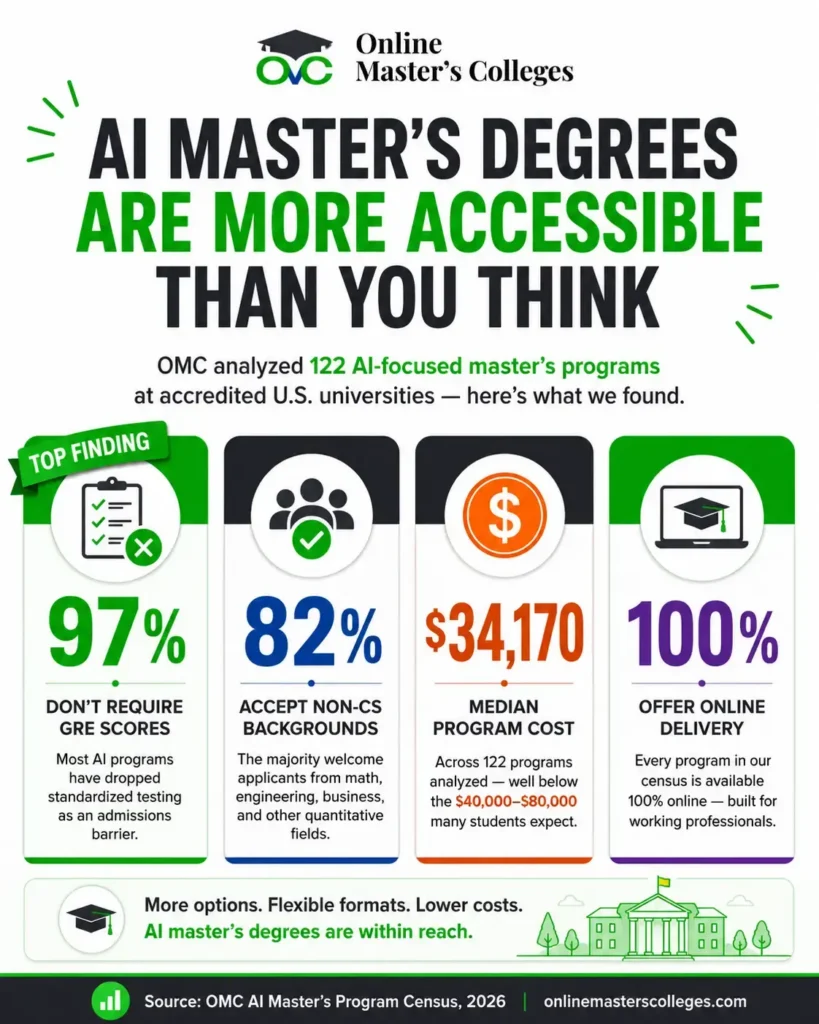
- 97% of AI master’s programs analyzed by OMC do not require GRE scores.
- 82% accept applicants from non-computer-science backgrounds.
- OMC found that the median AI master’s program costs $34,170, though program prices vary significantly across institutions and delivery formats.
Download the Full Report
Prefer an offline version of this research?
Download the complete AI Master’s Degree Market Report, including enrollment trends, employer demand analysis, salary benchmarks, labor-market projections, ROI findings, OMC research insights, methodology documentation, and AI master’s program census data.
The downloadable version is designed for students, researchers, journalists, higher education professionals, and employers seeking a comprehensive overview of the U.S. AI master’s degree market.
The report includes:
- AI master’s enrollment growth trends
- University program expansion analysis
- Employer demand and hiring data
- Salary benchmarks by AI role type
- Long-term labor-market projections
- AI master’s ROI analysis
- OMC AI Master’s Market Outlook Scorecard
- OMC AI Master’s Program Census
- Methodology and source documentation
Key Findings at a Glance
Our analysis of enrollment trends, labor-market demand, salary outcomes, employer hiring preferences, and graduate program expansion identified several clear patterns shaping the AI master’s degree market in 2026.
1.AI Master’s Enrollment Has Grown Approximately 35–40% Since 2019
Enrollment in AI and machine learning master’s programs has expanded significantly over the past several years, making AI one of the fastest-growing graduate degree categories in higher education. Growth has been driven by rising employer demand, increased institutional investment, and growing student interest in AI-related careers.
2.The Number of Universities Offering AI-Focused Master’s Programs Has Roughly Doubled in Five Years
Universities across the United States have rapidly expanded AI-related graduate offerings in response to workforce demand. Programs that were once concentrated at a small number of research institutions are now available across public universities, private universities, and fully online providers.
3. AI Master’s Graduates Earn a Significant Salary Premium
Professionals with graduate-level AI and machine learning expertise often command substantially higher salaries than comparable technology professionals without specialized AI training. Across many industries, advanced AI skills continue to generate some of the strongest salary premiums in the technology workforce.
4. Employer Demand Remains Extremely Strong for Master’s-Level AI Talent
Many AI-focused roles—including machine learning engineering, applied AI, computer vision, and advanced analytics positions—frequently prefer or require graduate-level education. Employer demand remains one of the strongest indicators supporting long-term value in the AI master’s market.
5. AI-Related Occupations Are Projected to Grow Much Faster Than the Overall Labor Market
Occupations associated with artificial intelligence, machine learning, advanced analytics, and data-driven decision-making continue to show growth projections that substantially exceed overall workforce averages. Long-term labor-market forecasts indicate continued expansion throughout the coming decade.
6. Many AI Master’s Programs Can Deliver Positive ROI Within a Few Years
Although program costs vary significantly, graduates entering AI-related careers often recover educational investments relatively quickly because of strong salary outcomes and continued employer demand. Lower-cost programs may offer especially favorable return-on-investment profiles.
7. Online AI Master’s Programs Have Become a Major Part of the Market
Online delivery has expanded rapidly, allowing working professionals to pursue AI and machine learning education without leaving the workforce. Today, online and hybrid formats represent a significant share of AI master’s enrollment and continue to increase accessibility for students nationwide.
AI Master’s Enrollment Is Growing More Than 10x Faster Than Graduate Education Overall
Based on OMC’s analysis of NCES graduate enrollment trends and AI-related CIP categories, AI master’s enrollment growth has substantially outpaced overall graduate enrollment growth since 2019.
While total U.S. graduate enrollment has remained relatively flat since 2019, AI and machine learning master’s enrollment has expanded dramatically. OMC’s analysis shows AI master’s enrollment growth substantially outpacing the broader graduate education market, making it one of the fastest-growing degree categories in higher education.
This growth reflects both employer demand and rapid institutional investment in AI-focused graduate programs.
OMC AI Master’s Market Outlook Scorecard
The data in this report points to a graduate degree market that remains one of the strongest in higher education. While growth has moderated from its early expansion phase, employer demand, salary premiums, and long-term labor market projections continue to support strong outcomes for qualified graduates.
| Category | Grade |
|---|---|
| Employer Demand | A+ |
| Salary Potential | A+ |
| Enrollment Momentum | A |
| Program Accessibility | A |
| Long-Term Outlook | A |
| Saturation Risk | B |
Overall OMC AI Market Grade: A
Among graduate degree markets evaluated by OMC, artificial intelligence ranks among the strongest for employer demand, salary potential, and long-term career growth.
The AI master’s degree market remains one of the strongest graduate education markets evaluated by OMC. Demand growth, salary premiums, and employer credential preferences continue to support strong outcomes for qualified graduates, though competition is increasing in entry-level and generalized AI roles.
OMC Market Outlook grades are designed to summarize the relative strength of graduate degree markets using a standardized evaluation framework. Grades reflect OMC’s assessment of employer demand, salary outcomes, enrollment momentum, accessibility, long-term labor-market projections, and market saturation risk.
Grades are assigned relative to other graduate degree fields evaluated by OMC and are intended as a comparative decision-support tool rather than a predictive ranking or investment forecast.
About OMC Market Outlook Grades
OMC Market Outlook grades are assigned by the OMC Research Team using a standardized evaluation framework that assesses employer demand, salary outcomes, enrollment momentum, accessibility, long-term labor-market projections, and market saturation risk. Each category is evaluated using available quantitative data and comparative analysis across graduate degree fields studied by OMC.
Grades are intended to provide a high-level comparative assessment rather than a precise numerical ranking. An A+ indicates exceptional strength relative to other graduate degree markets evaluated by OMC, while lower grades reflect comparatively weaker performance across one or more evaluation criteria. Additional methodology details are available upon request.
OMC AI Master’s Program Census (2026)
OMC analyzed 122 AI-focused master’s programs offered by accredited U.S. universities to better understand how institutions are responding to growing demand for artificial intelligence education.
The analysis examined program structure, admissions requirements, delivery models, affordability, and accessibility across the current AI master’s landscape.
Unless otherwise noted, census statistics in this section are derived from OMC’s analysis of 122 AI-focused master’s programs contained within OMC’s internal graduate program database.
Key Census Findings
| Finding | Result |
|---|---|
| Total AI-Focused Master’s Programs Analyzed | 122 |
| Online Delivery Available | 100% * |
| Programs Not Requiring GRE | 97% |
| Programs Accepting Non-CS Backgrounds | 82% |
| Median Program Cost | $34,170 |
| Median Credits Required | 30 ** |
| Public Universities | 56% |
| Private Universities | 44% |
* Includes full and partial asynchronous programs
** Heavily dependent on student background. Students with Math, Science, Engineering, and Computer Science backgrounds have fewer credit requirements
OMC’s AI Master’s Program Census analyzed 122 AI-focused master’s programs offered by accredited U.S. universities. The census includes standalone artificial intelligence master’s degrees, machine learning master’s degrees, computer science master’s programs with formal AI or machine learning concentrations, and data science master’s programs where AI or machine learning represents a primary academic focus.
Program data was collected and verified between January and March 2026 using university admissions pages, academic catalogs, program websites, tuition disclosures, and published admissions requirements. OMC researchers reviewed each institution individually to verify program availability, delivery format, admissions requirements, tuition, and degree structure.
The census is intended to represent the actively marketed online AI master’s degree landscape available to prospective students at the time of analysis. Programs that were inactive, not accepting applications, certificate-only offerings, doctoral programs, or programs without a clearly defined AI or machine learning component were excluded.
The 122 programs analyzed represent the subset of AI-focused master’s programs that met OMC’s inclusion criteria and for which complete admissions, cost, and program-structure data could be verified during the research period.
Unless otherwise noted, census findings reflect conditions as of March 2026 and may change as universities update admissions policies, tuition rates, and program requirements.
What the Census Reveals
The AI master’s market has become significantly more accessible than many prospective students realize. Nearly all programs analyzed no longer require GRE scores, and more than four out of five programs accept students from non-computer-science backgrounds.
The data also suggests that universities are increasingly designing AI master’s programs for working professionals. Online delivery is now the dominant model, while the median 30-credit structure remains consistent with many established graduate programs in computer science, analytics, and engineering.
Perhaps most notably, AI education is no longer concentrated exclusively within elite research institutions. Public universities account for the majority of AI master’s offerings analyzed by OMC, helping expand access to AI-focused graduate education across a wider range of price points and student populations.
OMC Finding: Most AI Master’s Programs Are More Accessible Than Students Expect
Artificial intelligence is often perceived as a highly selective field reserved for students with advanced computer science backgrounds. OMC’s analysis suggests a different reality.
OMC Finding
97% of AI-focused master’s programs analyzed by OMC do not require GRE scores, and 82% accept applicants from non-computer-science backgrounds.
This finding highlights a significant shift in graduate AI education. As employer demand has accelerated, universities have expanded access by reducing traditional admissions barriers and creating pathways for students coming from mathematics, engineering, business, analytics, and other quantitative disciplines.
While technical preparation remains important, today’s AI master’s market is considerably more accessible than many prospective students assume.
Who Should Pursue an AI Master’s Degree?
Not every student receives the same value from an AI master’s degree. Outcomes vary significantly based on prior experience, technical background, career goals, and program cost.
| Student Profile | Recommendation |
|---|---|
| Career Changers | Strong Yes |
| Software Engineers | Usually Yes |
| Data Analysts | Strong Yes |
| Recent Graduates | Depends on Cost |
| Non-Technical Backgrounds | Conditional |
Interpretation
Career Changers → Strong Yes
Few graduate degrees create larger potential salary jumps than AI when paired with a strong technical curriculum and practical project experience.
Software Engineers → Usually Yes
The degree can accelerate movement into machine learning engineering, AI systems, and advanced technical leadership roles, particularly when combined with existing development experience.
Data Analysts → Strong Yes
AI and machine learning skills often represent a natural progression from analytics and can unlock higher-paying technical roles.
Graduates → Depends on Cost
The long-term outlook is favorable, but students should carefully evaluate whether immediate workforce entry or graduate study offers the better financial outcome.
Non-Technical Backgrounds → Conditional
Success is possible, but students without quantitative or technical preparation should realistically assess the mathematics, programming, and statistical foundations required by most AI programs.
Methodology and Data Sources
This report synthesizes data from multiple federal, institutional, and industry sources to construct a comprehensive picture of the AI master’s degree market. Understanding where these numbers come from — and where gaps exist — is essential to interpreting the findings accurately.
Primary data sources include:
- National Center for Education Statistics (NCES) / IPEDS: Degree completion data by CIP code, institutional enrollment figures, and program counts. AI-specific data is derived primarily from CIP 11.0102 (Artificial Intelligence), CIP 11.0104 (Informatics), and related machine learning and data science subcategories. Because IPEDS reporting lags by approximately two years, the most recent completion data reflects the 2022–2023 academic year.
- Bureau of Labor Statistics (BLS): Occupational employment estimates, wage data, and employment projections for AI-relevant occupational categories, including computer and information research scientists (SOC 15-1221), data scientists (SOC 15-2051), and software developers (SOC 15-1252).
- Industry job posting aggregators: Trends in AI-related job postings, credential requirements, and skill demand are drawn from aggregated analyses of platforms including Lightcast (formerly Burning Glass), LinkedIn Economic Graph data, and Indeed Hiring Lab reports.
- Institutional program data: Program availability, format, and cost data compiled from university catalogs and verified against OMC’s internal program database.
Scope and definitions: For this report, “AI master’s degree” encompasses standalone Master of Science in Artificial Intelligence programs, computer science master’s degrees with AI or machine learning concentrations, and data science master’s degrees with a primary AI/ML focus. Professional certificates, bootcamps, and doctoral programs are excluded from enrollment and program counts but are referenced in employer demand comparisons.
Reporting period: Unless otherwise noted, trend data covers the period from 2019 to 2024, with BLS projections extending through 2033.
Limitations: AI as a graduate discipline is still consolidating its taxonomy within federal classification systems. Some programs that substantively focus on AI are classified under general computer science or data science CIP codes, which means enrollment figures likely undercount the true AI-focused graduate student population. Salary data for AI-specific roles often blends master’s and doctoral holders in the same occupational category. Where possible, this report isolates master’s-level data, but some figures represent master’s-inclusive ranges rather than master’s-exclusive medians.
AI Master’s Degree Enrollment Growth
The clearest signal in the AI master’s degree market is enrollment velocity. While overall graduate enrollment in the United States has been essentially flat — growing less than 2% total between 2019 and 2023 — AI and machine learning master’s programs have experienced enrollment surges that place them among the fastest-growing segments in all of graduate education.
Several forces converge to explain this growth. Industry demand for AI talent created a visible career pathway that didn’t exist at the master’s level a decade ago. Simultaneously, universities invested heavily in online delivery infrastructure during and after the pandemic, removing geographic barriers that previously limited access to AI-focused programs concentrated at a handful of elite institutions. The result is a market that has expanded both in total enrollment and in the share of students choosing online formats.
The following table tracks estimated AI/ML master’s enrollment over recent academic years, drawing from NCES completion data for AI-relevant CIP codes and supplemented by institutional reporting.
| Year/Period | AI/ML Master’s Enrollment (Estimated) | Year-over-Year Growth (%) | Online Share (%) |
|---|---|---|---|
| 2019–2020 | ~8,200 | — | ~20% |
| 2020–2021 | ~10,500 | +28% | ~30% |
| 2021–2022 | ~13,100 | +25% | ~38% |
| 2022–2023 | ~15,800 | +21% | ~43% |
| 2023–2024 (est.) | ~18,500 | +17% | ~48% |
Several patterns emerge from this data. First, while absolute enrollment continues to rise, the year-over-year growth rate is gradually decelerating — from 28% in 2020–2021 to an estimated 17% in 2023–2024. This is a normal maturation signal: the explosive initial growth phase is giving way to sustained but moderating expansion as the market absorbs early adopters and the base enrollment figure grows larger.
Second, the online share of enrollment has more than doubled in five years. Nearly half of all AI master’s students are now enrolled in fully online or primarily online programs, a shift that fundamentally changes who can access these degrees. Working professionals who couldn’t relocate for a two-year residential program now represent a significant and growing share of the student body.
Third, when contextualized against overall graduate enrollment trends—which NCES data shows grew only about 1.6% total over this same period—AI master’s enrollment is growing at roughly 10–15 times the graduate market average. This isn’t a rising tide lifting all boats; it’s a specific, demand-driven surge in a targeted discipline.
For prospective students, the enrollment growth data carries a dual signal. The sustained demand confirms that the market values AI credentials at the master’s level—this isn’t a speculative bubble driven by supply alone. But the growing enrollment also means more graduates entering the job market each year, which increases the importance of program quality, specialization choice, and practical experience in differentiating yourself from a larger peer cohort.
Program Proliferation: How Many Universities Now Offer AI Master’s Degrees
The supply side of the AI master’s market has expanded just as dramatically as enrollment. In 2018, a prospective student searching for a dedicated AI master’s program would have found roughly 30–40 options in the United States, concentrated almost entirely at research-intensive universities. By 2024, that number has grown to an estimated 150–180 programs, depending on how broadly you define “AI-focused.”
This proliferation has occurred across three distinct program categories, each with different implications for students:
Standalone AI master’s degrees — programs explicitly titled “Master of Science in Artificial Intelligence” or “Master of Science in Machine Learning”—have grown from approximately 15 programs in 2018 to roughly 50–60 in 2024. These tend to be offered by research universities with established computer science departments and are generally the most technically rigorous option. Georgia Institute of Technology pioneered the affordable online model in this space, and institutions like Johns Hopkins University and Northeastern University have built well-regarded online AI programs that combine theoretical depth with applied focus.
Computer science master’s with AI/ML specializations represent the largest category — roughly 60–70 programs now offer a formal AI or machine learning concentration within a broader CS master’s framework. This is where much of the recent growth has occurred, as it allows universities to add AI coursework without creating an entirely new degree program. Purdue University, Arizona State University, and the University of Illinois Urbana-Champaign are among the institutions that have built strong AI tracks within their online CS master’s offerings.
Data science master’s with AI/ML focus form the third category, encompassing approximately 40–50 programs where AI and machine learning constitute a primary concentration rather than a supplementary course. These programs often emphasize applied machine learning over foundational AI theory and tend to attract students with backgrounds in statistics, analytics, or business intelligence.
What does this proliferation mean for students? Three things matter most:
More options means more accessible price points. Five years ago, an AI master’s from a reputable university typically cost $40,000–$80,000. Today, programs like Georgia Tech’s OMSCS with AI specialization come in under $10,000 total, while the University of Florida and other public universities have launched competitive online options in the $15,000–$30,000 range. This pricing diversity has made the AI master’s financially accessible to a much wider population.
More programs also means more quality variance. Not every institution launching an AI master’s program has the faculty depth, research infrastructure, or industry connections to deliver a genuinely competitive program. Students should look closely at faculty expertise, curriculum currency (does the program cover transformer architectures, large language models, and reinforcement learning, or is it still teaching 2015-era content?), and employer recognition.
The distinction between program types matters for career outcomes. A standalone AI master’s from a research university signals different competencies to employers than a data science degree with an AI elective track. Students should match program type to career goal—research-oriented AI roles favor the former, while applied analytics roles may be well-served by the latter.
For a curated evaluation of the strongest options, see our ranking of the best online master’s in artificial intelligence, or explore the broader computer science subject hub for programs where AI is one specialization among several.
Employer Demand for AI Master’s Degree Holders
Raw enrollment and program growth data only matter if employer demand supports it. The strongest signal in this report is that employer demand for AI talent — and specifically for master’s-level AI professionals — has grown at a rate that has consistently outpaced the supply of qualified graduates.
Job posting data from Lightcast shows that postings mentioning “artificial intelligence,” “machine learning,” or “deep learning” as core requirements grew by approximately 74% between 2020 and 2024. More importantly for prospective master’s students, the share of these postings that specify or prefer a master’s degree has remained stable at approximately 55–65%, depending on role type. Unlike some technical fields where employer credential requirements have softened in favor of portfolio-based hiring, AI roles — particularly research, engineering, and leadership positions — continue to place significant weight on graduate-level education.
However, the credential landscape is not uniform across AI role types. The following table breaks down how employers value different credentials for specific AI positions, based on aggregated job posting analysis and employer surveys.
| AI Role Type | Master’s Required (%) | Master’s Preferred (%) | Bachelor’s Sufficient (%) | Alternative Credentials Accepted (%) |
|---|---|---|---|---|
| Machine Learning Engineer | 25% | 40% | 30% | 5% |
| AI Research Scientist | 55% | 30% | 10% | 5% |
| Data Scientist (AI/ML Focus) | 15% | 35% | 40% | 10% |
| AI Product Manager | 5% | 25% | 50% | 20% |
| NLP / Computer Vision Engineer | 35% | 35% | 25% | 5% |
| AI Ethics / Policy Specialist | 30% | 35% | 25% | 10% |
The patterns here are consequential for students making investment decisions. AI research scientist roles are the most credential-intensive — 85% of postings require or prefer a master’s degree (and many effectively require a PhD for senior positions). Machine learning engineering, the most common high-paying AI role, shows a strong preference for master’s holders but still has a meaningful, bachelor’s-sufficient pathway for candidates with strong portfolios and experience. Applied data science roles with an AI focus are the most accessible without a master’s, though the degree provides a clear competitive advantage in hiring and salary negotiation.
Perhaps the most telling comparison is between AI roles and adjacent technical fields. When compared to general software engineering (where roughly 80% of postings accept a bachelor’s degree), cybersecurity (approximately 70% bachelor’s-sufficient), and data analytics (approximately 75% bachelor’s-sufficient), AI roles consistently place more weight on graduate education. This credential premium reflects the mathematical and theoretical depth that AI work requires — linear algebra, probability theory, optimization, and statistical learning theory are foundational to AI in ways that are difficult to acquire through bootcamps or self-directed learning alone.
The “alternative credentials accepted” column deserves careful interpretation. While bootcamps and professional certificates are gaining traction in general tech hiring, they remain marginal in AI-specific roles. Only in AI product management — which is as much a business role as a technical one — do alternative credentials have meaningful penetration. For students weighing a master’s degree against a bootcamp for AI career entry, the data strongly favors the degree for research, engineering, and specialized technical roles.
For broader employment outcome data across all master’s disciplines, see our employment outcomes for master’s degree holders report.
Salary Benchmarks for AI Master’s Graduates
Salary data is where the AI master’s degree most clearly distinguishes itself from adjacent technical degrees. While all STEM master’s degrees carry salary premiums over bachelor’s-level credentials, AI and machine learning specializations command premiums at the upper end of the range—driven by the combination of high employer demand, specialized skill requirements, and a talent pool that hasn’t yet caught up to industry needs.
The following table compares median salaries across credential levels for AI-adjacent technical fields, using BLS occupational wage data, Lightcast salary analysis, and institutional outcome reporting. All figures represent U.S. national medians and will vary significantly by geography, employer type, and years of experience.
| Credential / Degree | Entry-Level Median Salary | Mid-Career Median Salary | Salary Premium vs. CS Bachelor’s |
|---|---|---|---|
| AI / ML Master’s | $115,000–$130,000 | $155,000–$168,000 | +28–35% |
| Computer Science Master’s (General) | $100,000–$115,000 | $135,000–$150,000 | +15–22% |
| Data Science Master’s | $95,000–$110,000 | $130,000–$148,000 | +12–20% |
| Computer Science Bachelor’s | $78,000–$90,000 | $115,000–$130,000 | Baseline |
The AI master’s premium is most pronounced at mid-career, where specialization compounds. An AI master’s holder who has spent five to eight years building expertise in areas like deep learning systems, computer vision, or natural language processing can command salaries that significantly exceed what a generalist CS master’s holder earns at the same experience level. The entry-level premium is smaller but still meaningful — roughly $15,000–$20,000 above a CS bachelor’s starting salary.
Role-level salary data adds important texture to these degree-level averages:
| AI Role Type | Median Salary (Master’s Holder) | Typical Experience Level |
|---|---|---|
| Machine Learning Engineer | $140,000–$165,000 | 3–7 years |
| AI Research Scientist | $145,000–$180,000 | 3–8 years |
| Data Scientist (AI/ML Focus) | $125,000–$150,000 | 2–6 years |
| NLP Engineer | $135,000–$160,000 | 3–7 years |
| Computer Vision Engineer | $138,000–$162,000 | 3–7 years |
| AI Product Manager | $130,000–$155,000 | 4–8 years |
AI research scientist roles carry the highest ceiling, reflecting both the credential requirements (most senior positions favor PhDs) and the scarcity of qualified candidates. Machine learning engineer and specialized NLP/computer vision roles form the salary sweet spot for master’s holders—high compensation, strong demand, and clear career trajectories that don’t require doctoral study.
Several important caveats apply to this salary data. First, geography matters enormously. AI salaries in the San Francisco Bay Area, Seattle, and New York metro regions can be 30–50% above national medians, while positions in lower-cost markets may fall 10–20% below. Second, employer type creates significant variance: Big Tech and well-funded AI startups pay at the top of these ranges, while government, healthcare, and non-profit AI roles typically fall at or below the median. Third, the salary premium assumes the student actually works in an AI-specific role—an AI master’s holder who takes a general software engineering position will not see the full premium reflected in their compensation.
For a broader view of how AI compares to other high-earning master’s disciplines, see our analysis of the highest-paying online master’s degrees.
AI Job Market Projections
Historical demand data tells you where the market has been. Projections — imperfect as they are — help you evaluate where it’s heading during the years you’ll actually be working with your degree. The forward-looking picture for AI-related occupations is among the strongest in the entire labor market, but the details reveal important distinctions between roles that favor master’s-level professionals and those that don’t.
The Bureau of Labor Statistics provides the most authoritative occupation-level projections. The following table shows projected growth rates for occupations most relevant to AI master’s graduates, along with indicators of how heavily these fields rely on master’s-level talent.
| Occupation | Current Employment (Est.) | Projected Growth Rate (2023–2033) | Typical Entry Education | Master’s-Level Share (%) |
|---|---|---|---|---|
| Computer & Information Research Scientists | ~36,500 | +23% | Master’s degree | ~70% |
| Data Scientists | ~192,000 | +36% | Bachelor’s degree | ~45% |
| Software Developers (AI/ML Systems) | ~1,847,000 | +17% | Bachelor’s degree | ~25% |
| Computer & Information Systems Managers | ~509,000 | +15% | Bachelor’s degree | ~35% |
| Postsecondary CS/AI Instructors | ~48,000 | +8% | Doctoral or master’s | ~90% |
The headline projection—23% growth for computer and information research scientists—is significant not just for its magnitude but because this is the occupation category where AI master’s holders are most concentrated and where a master’s degree is the standard entry credential. These are the roles focused on developing new algorithms, advancing machine learning methods, and solving novel computational problems. At 70% master’s-level share, this is one of the most credential-intensive technical occupations in the economy.
Data scientist roles project even faster growth at 36%, though the master’s-level share is lower (approximately 45%). This reflects the broader aperture of data science as a field—many data scientist positions can be filled by strong bachelor’s holders with relevant experience, but the most analytically demanding positions (the ones working with deep learning models, building recommendation systems, or designing AI infrastructure) disproportionately favor master’s graduates.
The software developer category is massive and growing, but its 17% growth rate and 25% master’s-level share make it less of a pure AI-master’s story. However, the subset of software developers working specifically on AI/ML systems — a category BLS doesn’t isolate separately — is growing much faster than the overall developer market, and these roles increasingly prefer or require graduate training.
For prospective students, the projection data support several conclusions:
The market is not close to saturation for master’s-level AI talent. Even with enrollment growing at 17–25% annually, the projected demand growth across AI-heavy occupations suggests the market can absorb significantly more master’s graduates for at least the next five to seven years. The most credential-intensive roles (research scientists and senior ML engineers) face persistent shortages.
However, not all AI-adjacent job growth requires a master’s. Students should be realistic that some of the largest growth categories (general data science, software development) have viable bachelor’s pathways. The master’s degree provides the clearest advantage in roles that require theoretical depth—the ability to design new models, not just implement existing ones.
Potential risk signals are worth monitoring. The rapid growth of AI automation tools — including code generation, AutoML, and large language model APIs — could shift the demand curve for certain applied AI roles over the next decade. Roles focused on routine model implementation may face some compression, while roles focused on research, architecture design, and novel applications are likely to remain robust. A master’s degree positions you on the more durable side of this divide.
ROI Analysis: Is an AI Master’s Degree Worth the Investment?
Synthesizing the enrollment, salary, and employment data into a return-on-investment framework is where this report becomes most directly useful for decision-making. The answer to “Is an AI master’s worth it?” is context-dependent—it hinges on what you pay, what you were earning before, and what role you’re targeting afterward. But the data allows us to model the range with reasonable precision.
The core ROI equation for a master’s degree is straightforward: How quickly does the salary premium you gain recoup the total cost of the degree (tuition plus opportunity cost)? For AI master’s degrees, the variables look favorable compared to most other graduate programs, but the variance between best-case and worst-case scenarios is substantial.
The following table compares estimated ROI across AI and adjacent STEM master’s degrees. Cost ranges reflect the spread from affordable public-university online programs to premium private-university offerings. Salary premium represents the estimated annual increase over a relevant bachelor’s-level baseline.
| Degree Type | Typical Cost Range | Median Annual Salary Premium | Estimated Time to ROI |
|---|---|---|---|
| AI / ML Master’s | $10,000–$80,000 | $25,000–$40,000 | 1.5–4 years |
| Computer Science Master’s (General) | $12,000–$70,000 | $18,000–$30,000 | 2–5 years |
| Data Science Master’s | $15,000–$65,000 | $15,000–$28,000 | 2–5 years |
| MBA (for comparison) | $25,000–$150,000 | $20,000–$45,000 | 2–7 years |
The AI master’s ROI story is strongest at the low end of the cost spectrum. A student completing Georgia Tech’s online AI specialization for under $10,000, or a comparable program at a public university in the $15,000–$25,000 range, who then moves into a machine learning engineering or AI research role, can reasonably expect to recoup their investment within 18 months to two years. This is among the fastest time-to-ROI for any graduate degree in any field.
At the upper end — a $70,000–$80,000 program at a private university — the math still works, but the timeline extends to three to four years, and the calculation becomes more sensitive to the student’s pre-degree salary. A career changer coming from a $60,000 baseline sees a larger absolute premium than an upskilling professional already earning $120,000 in a senior data role.
Several factors create meaningful ROI variance that the table averages can obscure:
Prior salary baseline matters more than program cost. A software engineer earning $130,000 who spends $30,000 on an AI master’s and moves to a $160,000 ML engineering role has a very different ROI profile than a career changer earning $55,000 who spends the same $30,000 and enters at $115,000. Both achieve positive ROI, but the career changer’s return is dramatically higher in both absolute and percentage terms.
Specialization within AI affects the premium. Machine learning engineering and NLP roles carry higher salary premiums than AI-adjacent data science or AI product management roles. Students targeting the highest-ROI outcomes should orient their coursework and projects toward the engineering and research end of the AI spectrum.
Opportunity cost is real but often overestimated for online students. The traditional ROI calculation for full-time residential programs includes two years of foregone salary. Most online AI master’s students continue working while studying, which effectively eliminates the opportunity cost component and makes the ROI calculation almost purely tuition vs. salary premium.
The ROI of not getting the degree is also worth calculating. In a field where master’s-level competitors are growing in number, the opportunity cost of entering the AI job market without a master’s—in the form of roles you can’t access, slower promotion trajectories, and lower starting offers—becomes its own consideration.
To estimate your personal ROI based on specific program costs and salary expectations, use the graduate school cost calculator. For students exploring affordable options specifically, our guide to the most affordable online master’s programs provides a useful starting point.
For a broader perspective on whether graduate degrees justify their costs across disciplines, see our analysis: Is a Master’s Degree Worth It?
What This Data Means for Prospective Students
Data becomes useful only when it connects to a decision. The figures in this report point in a clear overall direction—the AI master’s degree market is strong, growing, and well-compensated—but the right action depends heavily on who you are and where you’re starting from. Here’s how the data applies to three common student profiles.
Career changers entering AI from a non-technical or semi-technical background: The data is most emphatically favorable for this group. The salary premium is largest relative to your baseline (a $25,000–$60,000 annual increase is common), the employer demand data shows that a master’s degree is the most efficient way to establish AI credibility without years of industry experience, and the time-to-ROI is often the shortest because you’re making the largest salary jump. The key risk is program quality — career changers who invest in a weak or overly theoretical program without hands-on project work may struggle to convert the credential into their first AI role. Prioritize programs with applied capstones, industry partnerships, and career support. The best online master’s in artificial intelligence ranking evaluates programs on exactly these dimensions.
Working professionals upskilling from an adjacent technical role: If you’re already in software engineering, data analytics, or a related field and want to move into AI/ML-specific work, the data supports the investment — but more cautiously. Your salary premium will be smaller in absolute terms (you’re already earning a competitive technical salary), so program cost becomes the dominant variable. Low-cost online programs from institutions like the University of Illinois Urbana-Champaign or Arizona State University offer the strongest ROI for this profile because they minimize cost while providing the credentials and coursework needed to pivot into AI roles. The employer demand data also suggests that for applied ML engineering positions, a master’s combined with your existing industry experience is an extremely competitive combination — often more valuable to employers than a master’s alone from a more junior candidate.
Recent graduates deciding between entering the workforce and continuing to a master’s: The projection data is the most relevant signal for this group. With 23–36% growth projected across AI-heavy occupations through 2033, the long-term career trajectory strongly favors AI specialization. The credential preference data shows that the highest-paying and most technically interesting AI roles disproportionately require or prefer a master’s. However, the ROI calculation is sensitive to timing — entering the workforce first, gaining 1–3 years of experience, and then pursuing a master’s (potentially with employer tuition support) is often financially optimal compared to going directly to graduate school. The exception is students who gain admission to elite programs with research funding or assistantships that offset costs.
Regardless of profile, three data-driven principles apply universally:
1. Choose specialization intentionally. The salary and demand data show meaningful variation by AI subfield. NLP, computer vision, and core ML engineering command the highest premiums. Students who let curriculum default choices determine their specialization leave money and opportunity on the table.
2. Weight program costs heavily. The ROI variance between a $10,000 and an $80,000 AI master’s is far larger than most students expect. Unless a premium program offers demonstrably superior outcomes (career placement rates, employer network, research opportunities), the lower-cost option often produces superior financial returns.
3. The online format penalty is largely gone. The employer perception data and online enrollment trends both confirm that online AI master’s degrees from established universities carry little or no stigma in today’s hiring environment. Students who limit their search to residential programs are constraining their options unnecessarily.
For subject-level exploration of related fields, see the data science and information technology subject hubs. Students interested in accelerated options may find our guide to one-year online master’s programs useful for identifying faster pathways.
Cite This Report
Suggested Citation (APA Style)
OnlineMastersColleges.com. (2026). AI Master’s Degree Market Report 2026: Enrollment, Salary & Demand Data. OnlineMastersColleges.com.
Suggested Citation (Journalistic Style)
OnlineMastersColleges.com, “AI Master’s Degree Market Report 2026: Enrollment, Salary & Demand Data,” 2026.
Suggested Attribution
Source: OnlineMastersColleges.com AI Master’s Degree Market Report 2026
URL: https://www.onlinemasterscolleges.com/ai-masters-degree-market-report/
Frequently Asked Questions
AI and machine learning master’s enrollment has grown an estimated 35–40% cumulatively since 2019, with year-over-year growth rates ranging from 17% to 28% across recent academic years. This makes AI master’s programs among the fastest-growing segments in all of U.S. graduate education—roughly 10–15 times the growth rate of overall graduate enrollment during the same period. Online programs have absorbed a disproportionate share of this growth, now accounting for nearly half of all AI master’s enrollment compared to roughly 20% in 2019.
It depends on the role. For AI research scientist positions, approximately 85% of job postings require or strongly prefer a master’s degree (with many senior positions effectively requiring a PhD). For machine learning engineering roles, about 65% of postings require or prefer a master’s. Applied data science roles with an AI/ML focus are more accessible with a bachelor’s degree—roughly 40% of postings consider a bachelor’s sufficient—but a master’s still provides a meaningful hiring and salary advantage. AI product management is the most credential-flexible AI-adjacent role, with about 50% of postings accepting a bachelor’s and 20% open to alternative credentials like bootcamps or professional certificates.
Based on aggregated BLS and industry salary data, an AI master’s degree carries a salary premium of approximately 28–35% over a computer science bachelor’s degree at the mid-career level. In dollar terms, this translates to roughly $25,000–$40,000 in additional annual earnings, depending on role, location, and experience level. The premium is largest for machine learning engineering and AI research roles and smallest for AI-adjacent product management or analytics positions. Entry-level premiums are somewhat smaller — typically $15,000–$20,000 above a CS bachelor’s starting salary — but compound significantly over a career arc.
Among AI master’s specializations, machine learning engineering, natural language processing (NLP), and computer vision engineering consistently show the highest median salaries — typically $135,000–$165,000 at mid-career. AI research scientist roles can exceed $180,000, but often require doctoral-level training for senior positions. The fastest-growing salary trajectory currently belongs to NLP and large language model specialists, driven by the explosive growth in generative AI applications since 2022. Reinforcement learning and robotics-focused AI specializations also command strong premiums, though the job market for these areas is smaller in absolute terms.
Not at the master’s level — at least not yet. While AI master’s enrollment has grown significantly, BLS projections of 23–36% growth across AI-heavy occupations through 2033 suggest that demand for master’s-level talent will continue to outpace supply for at least the next several years. However, there are early signs of compression at the entry level for applied roles (data science, general ML implementation) where bachelor’s holders, bootcamp graduates, and AI master’s graduates are all competing for the same positions. The most durable market position belongs to students who specialize deeply (in areas like NLP, computer vision, or AI systems architecture) rather than pursuing a generic AI credential. The market is nowhere near saturated for people who can design new models or lead AI research initiatives, but it is becoming more competitive for those who can only apply existing frameworks.
Employer perception of online AI master’s degrees has shifted significantly in the past five years. Industry surveys consistently show that hiring managers at technology companies — the primary employers of AI master’s graduates — evaluate candidates on program institution, technical portfolio, and interview performance rather than delivery format. Programs from recognized institutions like Georgia Institute of Technology, Johns Hopkins University, University of Southern California, and Northeastern University carry equivalent weight whether completed online or on campus. The primary caveats are that some online programs offer fewer research collaboration opportunities and that students pursuing AI research careers (as opposed to engineering or applied roles) may benefit from the lab access and advisor relationships that residential programs facilitate more naturally.
Time-to-ROI for an AI master’s degree ranges from approximately 1.5 years to 5 years, depending primarily on program cost and the student’s pre-degree salary. At the fastest end, a student completing a low-cost online program (under $15,000 total) who moves from a non-AI technical role into a machine learning engineering position can recoup their investment in roughly 18 months through salary premium alone. At the slower end, a student paying $70,000–$80,000 for a private-university program who was already earning a strong technical salary may take four to five years to fully recoup the cost. Importantly, most online students continue working while enrolled, which eliminates the opportunity cost of foregone salary that extends ROI timelines for full-time residential students. Use the graduate school cost calculator to model your specific scenario.
In some AI roles, yes — but with significant limitations. For applied machine learning positions and AI-focused data science roles, 3–5 years of relevant work experience combined with a strong project portfolio and a bachelor’s in a quantitative field can substitute for a master’s degree in many hiring contexts. However, for AI research positions, NLP/computer vision specializations, and roles that require designing novel algorithms or architectures, work experience alone rarely substitutes for the theoretical foundation that a master’s program provides. The mathematical depth required—advanced linear algebra, probabilistic graphical models, optimization theory, and statistical learning—is difficult to acquire on the job without structured graduate coursework. Additionally, as more AI professionals earn master’s degrees, the competitive disadvantage of not having one is growing: in hiring pools where 60–70% of candidates hold a master’s, the bachelor’s-only candidate needs exceptionally strong experience to compensate.